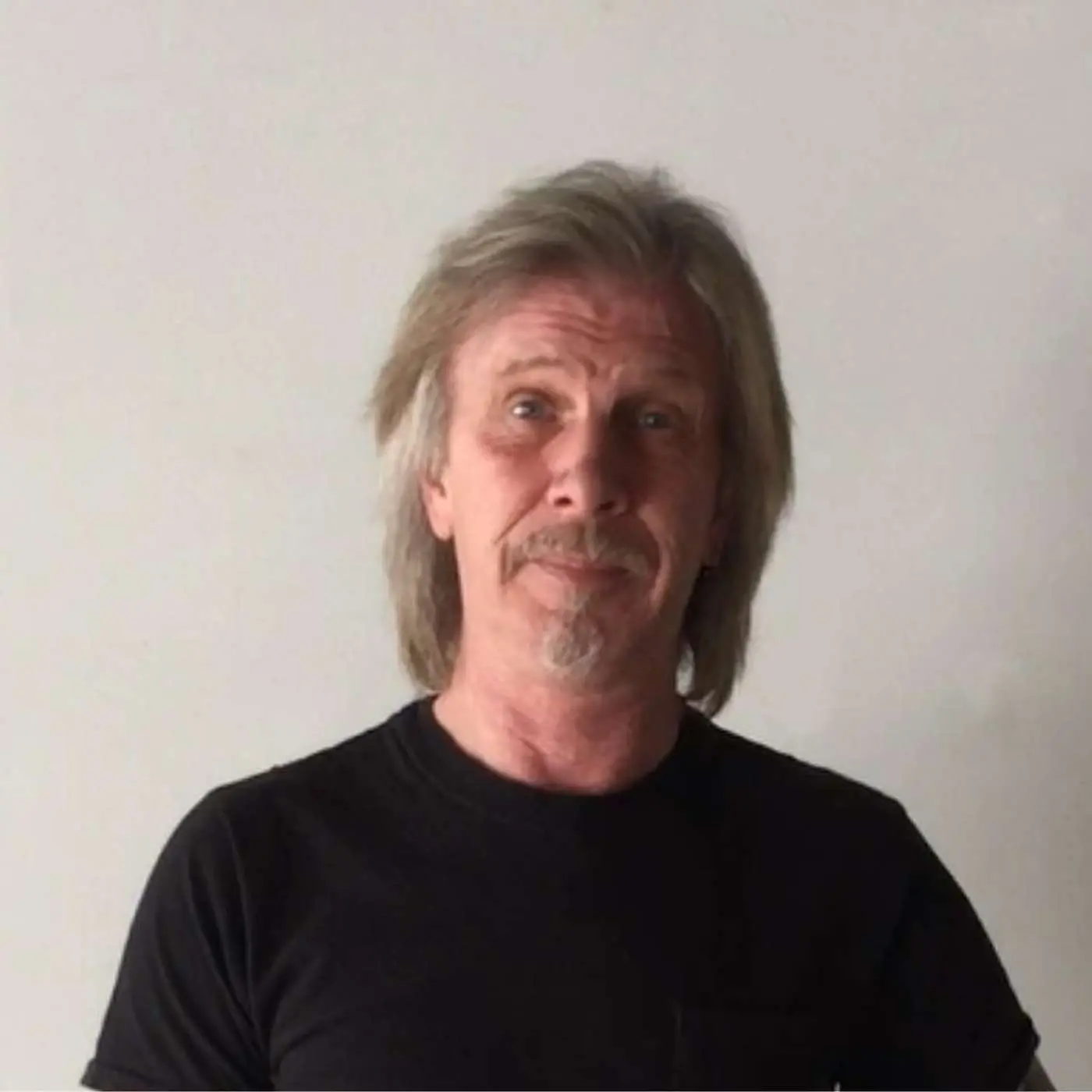

On this episode of Living It Loud, Tami Bandimere talks with artist and longtime hot rod enthusiast Jeff Allenbaugh about his unusual journey from sign painting, billboards, and rock band stage backdrops into a new mission focused on encouraging creativity in children. Jeff shares stories from painting for bands like Kiss, Tesla, and Train, along with memories of racing hot rods at Bandimere Speedway during the high school drag racing era.
The conversation also explores Jeff’s “Keep Crayon On” project, which encourages children to embrace creativity through simple tools like crayons while stepping away from constant digital consumption. Inspired by
SPEAKER 06 :
From the day we’re born, we are scarred and torn, we’ve been scared to sing out loud. But we don’t care no more, cause we know life is short, we don’t care who you are.
SPEAKER 05 :
Hey everybody, it’s Tammy Vandermeer. And on this episode of Living It Loud, I am going to introduce you to Jeffrey Allenbaugh. And he told me before the interview that I can call him Jeff. So we are now friends, so I can call him Jeff. First of all, Jeff, thank you. Thank you for taking the time and sharing your story. Because let me give just a little bit of background on this. Thank you. Thanks for inviting me. This will be fun. Thank you. Yes. Well, you know, God puts unique people into my life all the time. And then all of a sudden, because of this radio show, it gives me the opportunity to then allow these unique people in their projects, their ministries, their ideas, to share with the listeners what you’re doing and that kind of thing. But I’ve got to go back just a little bit because… You sent an email to me back in June of 2025, and your opening line of that email was something about, hey, don’t know if you remember me, but I painted the Vandermeer Speedway logo on the center wall of the racetrack prior to the Mile High Nationals.
SPEAKER 08 :
Yeah, yeah.
SPEAKER 05 :
And I’m thinking… Well, that’s a good opening line. That’ll catch my attention. How can I catch your attention? I’ll just say that. So let’s talk about that first of all. So you’re obviously an artist. You’re obviously a painter. I mean, are painters artists? I mean, are all painters artists?
SPEAKER 08 :
I think so. I see art in everything. So when I had my sign business, that was… a way for me to express my art you know I did a lot of small signs I did a lot of big signs painted billboards out in Vegas I was a little kid and I remember drawing a picture of a billboard because that was one of my childhood dreams a billboard so I chased it down and I did it for a while Vegas really isn’t a place to live but it was the billboard capital of the world you know But, yeah, doing the Vandermeer sign, that was pretty special. It was strange being out there on that track with nobody around. It was quiet. I used to sit there and work. I brought my hot rod. I put all the things in the back of the hot rod. I just sat there and painted the sign on both sides of that wall. I’ll never forget that. That’s one of those mile markers that I’ll never forget.
SPEAKER 05 :
It was cool. Well, and not only that, but, you know, and I don’t say this to be, you know, to be whatever. But, you know, that setting at that ring set was so beautiful up against a mountain like that. I mean, and our family really had nothing to do with that. That was all God. We’ve always said that. But it was, when you were there, there was no ring set. So I can see how that really was.
SPEAKER 08 :
Almost kind of a spiritual kind of a thing. It really was. It really was. Because, you know, several years before that, I did the high school drags. And I’ve been at the other drag races there before, the other nationals. So, yeah, to be out there with no noise, that was pretty cool. And, you know, you guys let me run down the track when I was done. It was kind of cool. All by myself. I won. I won the race.
SPEAKER 05 :
So, yeah, you talked about before we started this interview that you were part of the high school drag team. And, you know, again, that was one of the reasons why my grandparents started the racetrack is because my grandfather really loved the automobile. And he knew that young people, because my dad was one of them, was street racing. And so the high school drive really started with my grandfather. And because he said yes to a group of kids when they asked if they could come out and race. And then over the years, you said you raced in, what, 86 or so? I think it was 85. 85, okay. It was in 85. Okay. Well, and that was when we were kind of at the height. Of the high school drag. There was, oh, hundreds of racers. They would come out the night before. They would be lined up on Rooney Road. And it was chaotic, but it was fun.
SPEAKER 08 :
It was a lot of fun. You know, all of the gearhead gang that I ran with, we all drove our cars out there. You know, we originally had trucks and trailers. We drove our cars and get out underneath the cars and Uncap the headers and get ready to race.
SPEAKER 05 :
It was a lot of fun. And you said you raced for Rangeview. Yeah. And I remember that I used to sit up in the tower and make tally marks of the high schools because everybody would write their high schools on their back windshield. And so then we would make tally marks of who had the most racers from their high school. And Rangeview was always up there. They had a good attendance of racers.
SPEAKER 08 :
Yeah, we, you know, in that neighborhood, it was just, everybody had a hot rod. So on the weekends, or really any day of the weekend, we’d all gather at this Chevron station. It was just, you know, everybody would hang out and talk. It was just, it was a lot, a lot of fun. It really was. I miss those days.
SPEAKER 05 :
Talk about those hot rod days. Talk about, because it was, the cars were the connectors for you. Oh, yeah.
SPEAKER 08 :
You know, like bar. And that’s… That’s really all there was to connect a crowd like that. We’d share stories about each other’s cars. If somebody had a problem with their car, everybody would help. You need an engine oil stirrer, whatever. Everybody was there for everybody. And when somebody got a new hot rod, everybody would come over and check it out. Pick it apart. Oh, you’ve got to change this or change that. There was a lot of Chevy people. And I had four ancestors on the line in Missouri, back in the late 50s. So I was brainwashed as a little kid. GM, Chevrolet. I remember my parents would buy foreign cars. They had a Datsun one time. And my grandpa said, you’re not parking that in our driveway. He was a woodworker. So, you know, I was brainwashed. GM and then, well, I must have been 10, 11 years old. The older kids in the neighborhood, they were teenagers. They were doing hot rods. So I was exposed very early to cars and hot rods.
SPEAKER 05 :
It’s interesting what you say about Chevrolet because, you know, my grandpa and my dad, They loved all kinds of cars, but Chevrolet was really, the Vandermeers were big Chevy fans. And, of course, my grandpa could make anything go fast. That was what he loved to do.
SPEAKER 08 :
Right. It was cool. About 20 years ago, I came across a 55 Handyman. A lot of people thought it was a Nomad, but it’s not. They’re different. And I researched the van, and it just so happened that that car went through the Missouri plant at the end of 54. And I had four relatives, so somebody probably touched that car going down the line. So it was kind of special to have that car.
SPEAKER 05 :
That is very interesting.
SPEAKER 08 :
That was cool.
SPEAKER 05 :
That is very. I’m proud of my bloodline. Yeah, yeah. Okay, so let’s go back to the painting thing, though, because you say you had a sign shop. And so that’s how you ended up being out at the racetrack, painting the center wall on the racetrack. But then you also painted stage backdrops for many famous rock bands. Yeah, yeah.
SPEAKER 08 :
I did signs for many years. You know, a lot of signs for a lot of corporations. I traveled in signs, like you discussed before. when we started talking here, I came to Billboard in Las Vegas, but I knew there had to be more. You know, I mean, every artist wants their work to be seen. And I knew my signs were being seen by people, but I knew there had to be something more. So one day I just decided I’m changing. And almost on a dime, I turned and I went right into backdrop, put the word out, started doing some smaller bands to get get my feet wet. And then I started getting braver and asking the bigger bands. Train, Drops of Jupiter was their most famous song. They were like my first famous band. And I was just beside myself. I was bouncing off the walls and listening to the songs. Like, man, I’m getting ready to beat for this band. And that’s what got it started with the bigger names. And all it took was just that one name in my portfolio. And then the other man said, oh, okay, he can do the bigger stuff. It took off. It took off real quick. And now, you know, it’s almost dead. There’s still a little bit of work to do, but the big digital screens behind them really started hurting that market. 12 or 13 years ago, I’d seen the change. First, it was printing, large format printing. But then the digital screens came real short shortly after that. And it wiped out the painters and a lot of the digital screen companies. Not only did, I mean, the bands didn’t have to have their own digital screen. A lot of the things were, they had the screen on stage already. So it was easy for the bands just to bring in a flash drive, plug it in, and have their logo up.
SPEAKER 05 :
Is there any bands now that still are, would you call them purists, you know, where they go back to that painting?
SPEAKER 08 :
Yeah. As a matter of fact, just a few days ago, I sent out some emails. I did some research to see what classic rock bands were still touring. And I started to see a little bit of a trend where they were the big names back in the day, and they still are, but they’re not arena bands anymore. They’ve had to scale back to like the smaller bands. And they appreciate the old school things. So I’ve got a couple names that might be happening for me. I hope they do. I’m ready to paint another backdrop. So I can see it maybe coming back a little bit, which would be great.
SPEAKER 05 :
So you talked about train. What were some of the other… rock bands that you painted?
SPEAKER 08 :
I think Tesla was the one that I painted after Train. Tesla was a huge and good producer. There’s Tesla and Queensryche, Great White. I did one for Kiss. They have One day I was online, and I seen that they were doing a private show at the Whiskey and Yogo in Hollywood. And the Whiskey’s actually one of my clients. I do their house backdrops. And I shot an email off to Dr. E as his manager, just taking a chance to get some of that mask. And I got it. I said, yeah. And I told him, I said, I know that stage. You guys can’t have all your stuff there. You need something. You need a backdrop. And they said, yes. So I painted for Kiss. When I was a kid, my room was plastered with this kind of space. And then to know that I actually had it before, that’s pretty special.
SPEAKER 05 :
That’s awesome. Well, hold that thought, Jeff, and we’ll be right back.
SPEAKER 06 :
I’ve got some famous friends you’ve probably never heard of. Back in Rutherford County, our crowd is second to none.
SPEAKER 03 :
Please support the American Red Cross service to the armed forces. Go to redcross.org. Thank you.
SPEAKER 05 :
Okay. So we’re back with Jeffrey Allenbaugh. And when we left, he was talking about how he had painted stage backdrops for a lot of really big bands. And you mentioned something about that one of them took about three weeks for you to complete. Is that typically what it would take from beginning to end? And talk about that process of creativity. Did they give you things that they wanted in this backdrop, and then you just kind of took creative license with it, or how did that work?
SPEAKER 08 :
Yeah, it’s pretty rare that I get to create the backdrop. They usually always send their artwork, and this one, it involved the Tesla towers, you know, the lightning going across, and the lightning’s going through the name, and it had the the New York skyline down below it. So I had to do all of that skyline, all the little windows and the depth of the city. It was so big. I had a big shop at that time. And this backdrop was so big that I had to paint it in three sections. I did the top, center, and at the bottom. Sewed it all together, then go back and make sure all the paint Yeah, that one was a monster. And I delivered it to when they had a show at Red Rocks. So we get it there, and the wind started to pick it up, and they had to lower it back down. So I couldn’t see it. I seen it go up. I seen it go down. I didn’t get to see it in concert. So all that work. Yeah, well, they took it with them. But yeah, that was kind of cool being able to bring it there and hang out with them backstage in Red Rocks.
SPEAKER 05 :
And when you painted something like that, did you have a team or was it just you? Just me.
SPEAKER 08 :
Every once in a while, my mom would come in and have me move the material around.
SPEAKER 05 :
It was just me. So was art always a part of your life? Is that how you got into it? Talk about when you were young and how you… Were you loving art class at school?
SPEAKER 08 :
Every chance I had, I was doing art. I remember laying on the front room floor. I still have a lot of my colorings. Something told me, you’re going to be an artist. Keep all your stuff. I’ve probably got half of all my artwork still. So if I wasn’t laying under the coffee table with plastic wrenches working on a cart, I was on the floor.
SPEAKER 05 :
So let’s go back, because the reason you contacted me in June was because you had organized the Melted Crayons Mission, which was providing new art supplies for children who lost all of their belongings and items. And so I don’t know if that was the beginning of this whole crayon project or what, but talk about that.
SPEAKER 08 :
Yeah, it was. During the bad fires last year in California, the Palisades fire, one of the news stations out there was interviewing a little kid. And on camera, he said, all the color’s gone. And that’s when it clicked. Like, there’s my public. Got to get them back their color. And that’s what I’ve been doing ever since. It’s a lot of work to try to find kids who lost all their stuff in fires. That’s a lot of work. And then getting stuff to them. So I haven’t backed away from that. But I did channel my energy into just more of a community thing to help support the arts. And I’m keeping that in mind. You know, if something comes up and I know I can get supplies to somebody who lost all their stuff in a fire, then yes, I’ll definitely get it there. But it was just taking so much energy trying to find those that I felt I could spend that time to reach more kids.
SPEAKER 05 :
Isn’t it interesting how that one little boy saying that with all the colors on, and that just triggered something in you. And a lot of times, things that go on to become amazing projects or amazing ministries, people can trace it back to that one little moment, and you can do that.
SPEAKER 08 :
I’ve got the name of that reporter. So I have every ambition of getting a hold of her. She still has her records. She knows me. I don’t expect her to give me the kid’s name, but if she can bridge me to that little kid, that would be amazing.
SPEAKER 05 :
Really good. So let’s move forward, because now you’ve got another project that you’re working on called Keep Praying On. And you’re working with… children, and the whole idea is to start them early in the creativity, right? Yeah.
SPEAKER 08 :
I think that’s one of the most important things in an early childhood is creativity. You don’t have to be extraordinarily creative. It’s just a matter of being able to be open-minded and to use your hands transfer the thoughts in your head through your arm, through your hand onto something where you can look at it and say, I created that. I think that’s the very beginning of what can be amazing. Where you’re not staring at a phone all the time. I’ve seen little kids on phones. You know, nothing against that, but I know they’re missing out on it.
SPEAKER 05 :
Well, and it’s not, it’s teaching them that they can do something different. That they don’t have to, they can do something that they want to do. And you’ve chosen the crayon and you’ve chosen the art to teach them. You know, we had a reading program out of the race track for a long time. And we worked with preschool and elementary age children because they were the ones that like you said, um, they’re the ones that are, have the most open mind. And there’s still, for lack of better phrasing, you can still kind of control them. You know, you can still kind of say, Hey, we’re going to turn off the TV and, and color. We’re not, we’re going to turn off the TV and read, you know, that kind of thing. You know, you get into middle school and high school and even adulthood. And it’s like, you know, so to teach them early. So, um, the kids versus adults thing is probably, that’s a great thing, right? Yeah, yeah.
SPEAKER 08 :
Yeah, I mean, I see crayons as kind of like the low-hanging fruit in an orchard, you might say. Not only can I grab those crayons easy to pass them out, but the kids can also have easy access to them. You know? So yeah, just Engineer with crayons, and from there you can engineer a lot of stuff.
SPEAKER 05 :
It makes me think of something that a friend of mine said, because I said something about, you know, I don’t like to do that. He said, well, that’s why there’s 64 crayons in the coloring box, because not everybody likes to do the same thing. So the creativity is that, you know, some kids might pick up all the blues and greens, and some of the kids might pick up all the reds and yellows. Because that’s where their brain goes. And so what you’re doing with Keep Crayon On is that you talk about creation before push consumption. And so here we go. Talk about that.
SPEAKER 08 :
It’s kind of like what I was just talking about. There’s so much noise out there that it’s easy to get distracted. All the the social media and I mean a lot of that I know a lot of it trickles through the schools into those kids and I don’t want to see kids getting absorbed by that noise before they have a chance of expressing themselves in their own way and be a I think in today’s world, it’s pretty easy to get conditioned if you don’t have an open mind and a creative mind on your own. Somebody’s got to keep that alive. It’s not like it used to be way back in the day. We didn’t have all the social media and computers back in the day. Nothing against that. I think technology’s great, but I think there’s a bit of a dangerous side to that, too. If it’s not, I don’t want to say controlled, if it’s not kept under wraps, you might say.
SPEAKER 05 :
Well, and the crayon is such a basic thing. We all have it. And, I mean, the truth is that most everybody has access to crayons. You know, I mean, you go to a restaurant and they pass out coloring sheets in a little box of four crayons. You know, so they don’t expect you to leave those crayons there. You know, you can take them home if you want. So now you’ve just got four free crayons, you know, and that kind of thing. So what does that simple choice of a crayon give a child that more advanced tools don’t?
SPEAKER 08 :
You can make mistakes with it. You know, you can’t erase a crayon, but you can certainly set it aside, set your, whatever you made a mistake, set it aside, grab a piece of paper and start over. Or if you’re, you know, other materials or whatever, you make a mistake, you have to start over in a whole different way. With crayons, I’ve made a mistake, but just click into your mind, start over, and mark on it. You know, just glance over at your mistake, start on your new one, and try not to do it again. I think that’s one of the basic principles of engineering. You’ve got to make your mistakes to be able to see it and start over. Crayons allow that.
SPEAKER 05 :
I’ve even seen kids, because I taught Sunday school for many, many years at my church, and the kids always loved the coloring sheets and that kind of thing. And I’ve seen kids start with an idea, And then they think that they made a mistake and then they kind of pivot in their mind and go a different direction with it. And so what started as a tree ends up being a house that’s got, you know, trees or flowers. And again, it goes with that whole creativity thing, right? I think seeing something like that happen, that’s amazing. That’s the cool thing. And we probably don’t give it enough credit, do we? I don’t think so. I think it’s overlooked.
SPEAKER 08 :
I think it’s overlooked. I think it’s important to recognize what that kid did. Did they make a mistake? What did they do? And now look at it. And they need to be told that. It’s so important to let them know, look what you did. What you thought was a mistake, but you stayed at it. You thought it through, and now look. Look at what you did with that. That’s magic. And it does need to be credited.
SPEAKER 05 :
Well, that’s us, Jeff. We’ll be right back.
SPEAKER 01 :
Celebrating God and His Word in America.
SPEAKER 04 :
Ephesians 6, 12, and 13 says, That’s Ephesians 6, 12, and 13 from the New International Version of the Bible.
SPEAKER 01 :
Let God’s Word come alive in your life today.
SPEAKER 05 :
So we’re back with Jeffrey Allenbaugh, and I can call him Jeff, because we’ve known each other for 20 minutes now, so we’re all good. But I love the fact that when we took the break, right before we took the break, we were talking about how simple… a crayon is, but yet how complex it can be too, because it starts out as just being something that you’re just going to color on a piece of paper. But if you, if you go a different direction with it and realize that, you know, sometimes in life you have to pivot. And so even in starting a piece of art, did you have that when you were doing art? Did you start a project with a, thought in mind going, I’m going, this is the way I’m going, and then you went, hmm, I’m going to have to change this a little bit.
SPEAKER 08 :
Yeah, and yeah, a lot of times. One thing about artists is their art is never done. You can keep going and going to the point where it’s overworked, or you can stop and just not like it, totally set it aside, or You get into their frame of mind and say, okay, I can fix this. And I’ve always kind of had the philosophy of the real pro can fix their mistakes rather than start over. And I don’t want, you know, that’s kind of, that philosophy can get kind of deep. It’s a little too deep for kids. I just want kids to create and learn that over time. It’s okay to make mistakes. It’s okay to stop and set aside. But don’t stop the entire process. You know what I mean? Sure. Just keep going. Even if you have to start something brand new, keep going. You’ll get it.
SPEAKER 05 :
Yeah. You will get it. Same project, but maybe just go a little different direction. Yep. Sometimes that’s the way life is. And like you said, don’t get a little too deep. But, you know, sometimes that is the way life is. You know, you think you’re going to go a certain direction, and then all of a sudden it goes a different… And you think, huh, I would have never… You would have never known that if this hadn’t worked out. Right.
SPEAKER 08 :
I mean, there was one time I was painting a backdrop, and it was so big I had to have it out on the floor. And I walked out with a spray gun, getting ready to do some spray work, and I had forgotten to put the cap. And I kind of shook it, and paint went everywhere. And I was so far into this backdrop, and the deadline was coming up. I couldn’t start over. So I had to figure out, how am I going to make this paint splash work? And it did. They liked it. They didn’t know I made it. I think the same thing can apply to crayons and a little piece of paper. Just in a different level.
SPEAKER 05 :
So you are now taking this whole crayon idea on a whole other level. That’s where your intentions are. Keep crayon on and And you even had talked about doing a world record for the longest end-to-end line of crayons and markers and all that kind of stuff. So where do you want to go with this? What is your end game on all of this?
SPEAKER 08 :
I want to have a tight community of people who believe in it that I align with to where I can make it something that’s respected and noticed in the community to where when I’m too old to be doing it, somebody else can easily take over. I want it to be just a nice little performing support the art machine that can be counted on and where I can actually see what it’s doing. Like, for instance, on special days, I go out and I hand out a hundred boxes of crayons just randomly to kids I see out with their families. But this year, I’m going to do that and I’m going to set it up to where the parents can submit artwork that the kids created with that box of crayons. And then I’m going to turn it into like a video collage That could be on YouTube where those kids know that their artwork is being seen by people all around the world. I want them to be able to feel that. I felt it with backdrops. I just want kids to be able to feel that too and have that opportunity. You never know where it would lead them.
SPEAKER 05 :
You never know. Well, and there’s that confidence piece too. That piece that says, you know, I thought I did a good job on this and so did somebody else. And somebody else, and so on, and so on, and so on, you know, and that kind of thing. Yeah, they can tell their friend, hey, I got artwork online.
SPEAKER 08 :
I remember a year ago, I had the Smash Mouth donated their backdrop back then. I had it laid out in the parking lot, and the neighbor in Isabel Grove out there said, hey, you want to get a picture of her standing on this backdrop? It was all kids, no stress. Mm-hmm. So she got out there. I told her, I said, I can put this online. I’ll blur her face or whatever. I’m protective about that. And she looked at me. She goes, really? I’m going to be online?
SPEAKER 1 :
Yeah.
SPEAKER 08 :
That was kind of special.
SPEAKER 05 :
Right there was proof. Tell us about Vera Lynn.
SPEAKER 08 :
Oh, Vera Lynn. Vera Lynn is a real-world 77 Chevy van and also an animated Chevy van. I’ve always been a hot rodder, like we were talking about. So I’ve always wanted to have a Chevy van. It’s like, okay, I can build a van for this, for Keep Dragging On, and turn it into an animation where kids and their parents can follow the episodes. And I want the episodes to teach things or to have special announcements, you know, that maybe she could show kids how an engine works. You know, there’s engineering there. talk about a famous artist from the past. Those things like that. I wanted a character. A real character that people can say, oh, there’s Vera Lynn when they’re out on the street. I think that’d be so much fun.
SPEAKER 05 :
Besides the fact that when people see stuff like that, it’s eye-catching. There’s got to be a question. Huh, what’s that all about?
SPEAKER 08 :
Curiosity. Curiosity’s the hook. Get them curious and do a lot of stuff.
SPEAKER 05 :
Jeff, do you go to, like, schools? I mean, you talked about, you know, passing out all these crayons. Was that just kind of a random parking lot situation, or are you connected with organizations or schools or events or that kind of thing?
SPEAKER 08 :
Last year I went to the big Fourth of July picnic in Broomfield and handed out all the 100 crayons to the kids there. I did Easter, I’ve done Easter two years in a row. This will be the third annual Easter Day Crayon Giveaway. And this year’s the first spring one. But mostly just going around town and seeing if I see parents that look good. And I’ll stop and say, hey, you want a box of crayons? Sometimes they look at me kind of strange. Some of them have said no, and I get it. But when I hand a box of crayons to a kid to smile on their face, You know, they’re getting a gift and they’re understanding the gift of getting. You know, a stranger just gave me something. And hopefully they’ll remember that and carry it on. You know, you don’t know. That’s why I love this. The mystery of it, you just don’t know. And I might not see an end result when they’re 20 years old of what they did to somebody because they remember what I did. You know what I mean?
SPEAKER 05 :
somebody just randomly gave them something brand new. It wasn’t like, eh, this is a throw-off. It was brand new. And I’m assuming that when you give it to him, it’s almost kind of, I wouldn’t say reverent, maybe that’s not it, but it’s kind of like, it’s really special. You know, it’s not like you’re just throwing them out from a parade float, but you’re actually handing them to the children. Spending time with them, even if they don’t
SPEAKER 08 :
talking to them for a minute or another few minutes or 30 seconds. It’s just that human-to-human interaction that I think makes a big difference.
SPEAKER 05 :
What age were you when you realized that you could kind of make a living out of being involved? Because there’s always that thing where it’s like, Oh, yeah, my son’s a musician. He’s never going to amount to anything. Or my, you know, whatever, my son’s an artist. But, I mean, there’s such a skill in that. And for those of us who aren’t artists, I just am so, I’m so in awe when I see somebody be able to sit down and draw something. And so at what point in your life did you say, huh, I think I could actually make money off this? I think I could make a living out of it.
SPEAKER 08 :
There was probably times when I was really young, maybe before I was a teenager, that something crossed my mind in there. I can’t recall right now, but I do remember the first time I was really serious about it. I was maybe 16, and I started drawing some stuff up that I wanted to send to Hallmark Parts. I wanted to work for Hallmark Card. That was my goal. So I started drawing some colored pencil stuff that I was going to send them. It never panned out, but that is probably the earliest memory that I have of really knowing that I wanted to be a professional artist.
SPEAKER 05 :
And then at what point did you think to yourself, what was the first paycheck? Let’s put it that way. What was the first paycheck that you got and you went, huh, this is great.
SPEAKER 08 :
I was 21, back in the 80s, crazy 80s. And we had all gone to a club. There was a local band playing. And you didn’t know who they were unless you’d seen the flyer or you heard them singing it. But, you know, there could be a banner hanging behind them. And I talked to them, and I got it. That was my first paycheck.
SPEAKER 05 :
my first professional paycheck was in the background well and then I’m sure you brought all your friends and family to see it and so that was that was cool too because then it kind of it kind of moved into you know bring more people to their concerts too right well it was it was just a small neighborhood neighborhood band yeah but yeah that was kind of cool going to see them again at a different at a different club at a different
SPEAKER 08 :
city nearby, and they were using my backdrop. I was like, yeah, this is really cool. Knowing all the people there in that bar is seeing my artwork behind the band. And that’s when I knew, even before I had my sign business, I knew kind of what I wanted to do. At that time, it was hard reaching the bands because there was no internet. I was like, okay, I’m just going to do some sign. So, yeah, I went from small backdrops
SPEAKER 06 :
the signs and then back the backdrops and let that grow into the into the big backdrops hold that thought we’ll be right back ain’t looking for nothing but a good time and it don’t get better than this
SPEAKER 02 :
Hi, this is Dr. Mary McNeil-Jones, co-host of Outlook on Colorado, a conversation around the table. I’m inviting you to join me and Sandy Thompson every Sunday at 1 p.m. and 6 p.m. in the evening. We talk about the things that are important to you and our community only on 1220 AM KLDC.
SPEAKER 05 :
Oh, things ain’t but things. All right, well, we’re back with Jeff Allenbaugh with the Keep Crayon on project and all the art and all that kind of stuff. And I’ve just really enjoyed, this is our last segment with Jeff, but I’ve enjoyed this because like I mentioned earlier in this interview, I am so far from being an artist. For me, it was getting on a computer and saying, there’s a great piece of art that I can use and I’ll embellish it, you know, that kind of thing. But from scratch, no, that really was never my gift. But when we left off in the last segment, when you were talking about the first time that you saw a piece of your artwork, you just lit up. I mean, you just lit up. And so I’m thinking that that is your… motivation for this whole project is watching children light up in fact you sign off on email thank you and have a vivid day and I’m like that’s such a cool way of signing your name you know and so as we finish up all of this talk about like the best advice that you’ve probably received during all of your years of being an artist and that kind of thing because I’m sure there were a lot of people that said, oh, no, no, no, that’s not where you want to go with that. But what was some of the best advice? And what’s the best advice that you could share with another young budding artist?
SPEAKER 08 :
The best advice I got was from a window painter. I used to paint a lot of windows, window splashes with fluorescent ads on storefronts. And one day I was at the paint store buying paint. And there was an older guy there buying the same paint. And I believe in asking. Just ask. You never know. So I asked him, who are you? And he told me his name. And it’s like, wow, that’s you? Because his work’s been all over town. And we exchanged numbers. And I eventually started running around with him, painting windows, because I knew this guy could teach me a lot of stuff. And I believe if you’re going to learn something, try to get to the top as quick as you can to the top people and learn from them. Don’t You know, I mean, make it as quick as possible, that learning curve. So I started hanging out with him, and one day I was watching him, and we used to use little three-inch rollers with latex paint. And I’m watching him doing this, and I told him, I said, Don, that’s amazing. He’s going, you’ll have your aha moment, and I will never forget that. And I’ve experienced aha moments. You know, you keep at it, it’s like, aha. get it. And then you’ll always remember it. And there could be dozens of aha moments. So that’s the best piece of advice I’ve ever gotten. And that’s probably the best piece of advice I could ever get. And that was so powerful.
SPEAKER 05 :
That’s almost your turning point. Yeah. It’s so interesting when you talk about being a window painter because when my dad had the auto parts store, And he had storefronts, you know, that he used window painters. That’s what he did. And I remember a couple of years, he had that window painter come to my parents’ home, to our house, and paint a Merry Christmas thing on our front window because my mom and dad had a big front picture window. And I remember us kids thought we were the coolest kids in the neighborhood because we had this awesome Merry Christmas thing. artwork on our front window, you know, and it was, it was so, but again, we watched them do it, you know, we, mom would say, they’re coming to paint the window, and we’d just be like, oh my goodness.
SPEAKER 08 :
I used to paint for Wendy’s, Wendy’s of Colorado Springs, the franchise, and they had like 42 stores, I think, through Colorado, New Mexico, Utah, and North Dakota, So three times a year, they would send me out to do their windows and all those stores. I’d be gone about a week. But the best part of doing that, besides the travel and the experience, was showing up during lunchtime and at dinner. And all those people sitting there watching. And I got it down. I was doing a window. I could do a window in an hour. Because it was just one after another. It’s routine. You do your first couple stores. you know exactly what to do when you pull up with another one. So about an hour, take the old window down, put the new one up, and all those people are sitting there eating. And you can just see they’re involved by watching the autopilot part of it. You know, and the kids are smiling. It’s like what you were saying, you watch them do it.
SPEAKER 05 :
Yeah. So what do you do today? Do you still do, will you still do window painting? Will you still do backdrops if somebody calls you? You said that you reached out to a few bands and that kind of thing. Once an artist, always an artist?
SPEAKER 08 :
Yeah, I got the urge last week, so I reached out to a couple bands. A couple classic rock bands. So I’m waiting to hear back from them. I might not hear back from them. I might. That’s just part of it. But most of my time goes into looking for supporters to keep praying on and researching the other stuff that’s going on. I try to keep an eye out on events. Maybe I can contact their organizer and see if I can blend in with it somehow.
SPEAKER 05 :
So if I’ve got a listener right now that’s listening to this and they say, I’ve got a connection or I’ve got somebody that I’ve that Jeff would be great at this festival or whatever with kids or that kind of thing. Or I want to be involved. I want to get involved in some way. Number one, how do people contact you?
SPEAKER 08 :
The best way is through the website.
SPEAKER 05 :
It’s KeepCrayonOn.com. There’s no G in crayon. There you go. I was just going to say KeepCrayonOn. So not craying, but crayon on. KeepCrayonOn.com. That’s always the best way. Okay. All right, they can see a little bit more about some of the different things that you’ve done. Yeah, I’ve got a little bit of history on there and information about the pray on handouts that I do. Yeah. And then I guess the second thing is, what are like maybe your top three needs? Are they, I mean, obviously probably funding, some funds and that kind of thing. But what else is it that you need to move Keep Praying On forward?
SPEAKER 08 :
A solid network. You know, the more people that I align with, the more powerful this can be. Sometimes I don’t align with people. Sometimes I do. And I’m pretty picky about that. Funding is always important. I don’t make profit on anything I do. It’s all supporters. I’m not a nonprofit. I don’t want to be a nonprofit. I believe in nonprofits, but in my case, it’s better to be ran as a business where it’s completely transparent and supporters see exactly what’s being done. Now, like nonprofits, you donate, and you really don’t know where your donation is. Mine, it’s a transparent business. So, yeah, just the network.
SPEAKER 05 :
funding if there’s events coming up. Yeah, it sounds to me like it’s kind of a balance of all of that, correct? You know, that you need to have the exposure, but you also need the funding for, you know, getting some of that out. And I’m assuming that you won’t even turn down in-kind kind of stuff. I mean, if somebody says, I’m going to donate three cases of crayons, you’re going to be like, Yep, bring them my way. I’ll take them. I’ll get rid of them. Crayons, markers, whatever.
SPEAKER 08 :
And everybody gets, you know, they get their logo on the website. Either the monetary supporter or in-kind, you know. I make sure everybody gets recognized for their kindness. I’m not a, I don’t treat my website as an advertising platform. And I can kind of sense that from businesses who want to supported, but I know they’re just interested in getting their logo out there. And I can kind of sense that. To me, that’s really not much of an alignment for me.
SPEAKER 05 :
Yeah. Did you have somebody that was a role model or a mentor in your life? Somebody that you watched in the artistic world that you said, wow, someday I wish I could be somebody like that. I mean, I know artists typically have their own style, and they try to create their own style. But was there ever somebody’s style that you kind of said, that’s pretty cool, I think that’s kind of cool? You talked about your window painter guy. Yeah, he’s definitely one of them.
SPEAKER 08 :
I’m not what you would call your typical… fine artists, if somebody wanted me to paint their portrait, I’d probably struggle. If they wanted me to paint the landscape, I’d probably struggle. But give me a logo or some commercial art, and I can do that. And there’s a difference. It’s two different animals. Commercial art allows you to be professional a lot. So that’s the road I took. So one of the, when I was painting billboards in Vegas, a guy named Walt, Amazing, amazing billboard. So I, you know, I admired his work and I learned from him. And then, like you said, the window. As a kid, there really wasn’t anybody. The commercial art field was something that wasn’t easily accessible, you might say. to where my ambitions were. So, yeah, it started out, I guess I’d say, the first time I really started my skills.
SPEAKER 05 :
So as we wind this interview down, we’ve got about a minute and a half, and being last name Vandermeer, and you talked about being a hot rod person back in the 80s, I would be remiss if I didn’t finish up with Are you still, do you still have a hot rod in the garage? Do you still have the need for speed? That kind of thing?
SPEAKER 08 :
Once it’s in your blood, it never leaves. I’ve got this 77 van, a Chevy van I’m going to start soon. Just got some new wheels for it a couple weeks ago. It’s a little rough, but it’s kind of hard to find old metal these days. You’ve got to kind of grab what you can find, so. It’ll be a fun build. I’m not going to take it as far as I did with my other hot rods. I’m going to leave it a little bit rough. Maybe there’s a lesson there that I can rework in. Things don’t have to be perfect. They can just be cool in their own way and low budget. If it’s got rust, maybe instead of cutting out the rust, I’ll make some flames coming out of that rust hole or something. Just to show kids things don’t have to be perfect but they can still be cool.
SPEAKER 05 :
Well, Jeff, thank you so much for taking the time and for sharing your project. And I wish you the best because it sounds like you’re on a good start and kids are great.