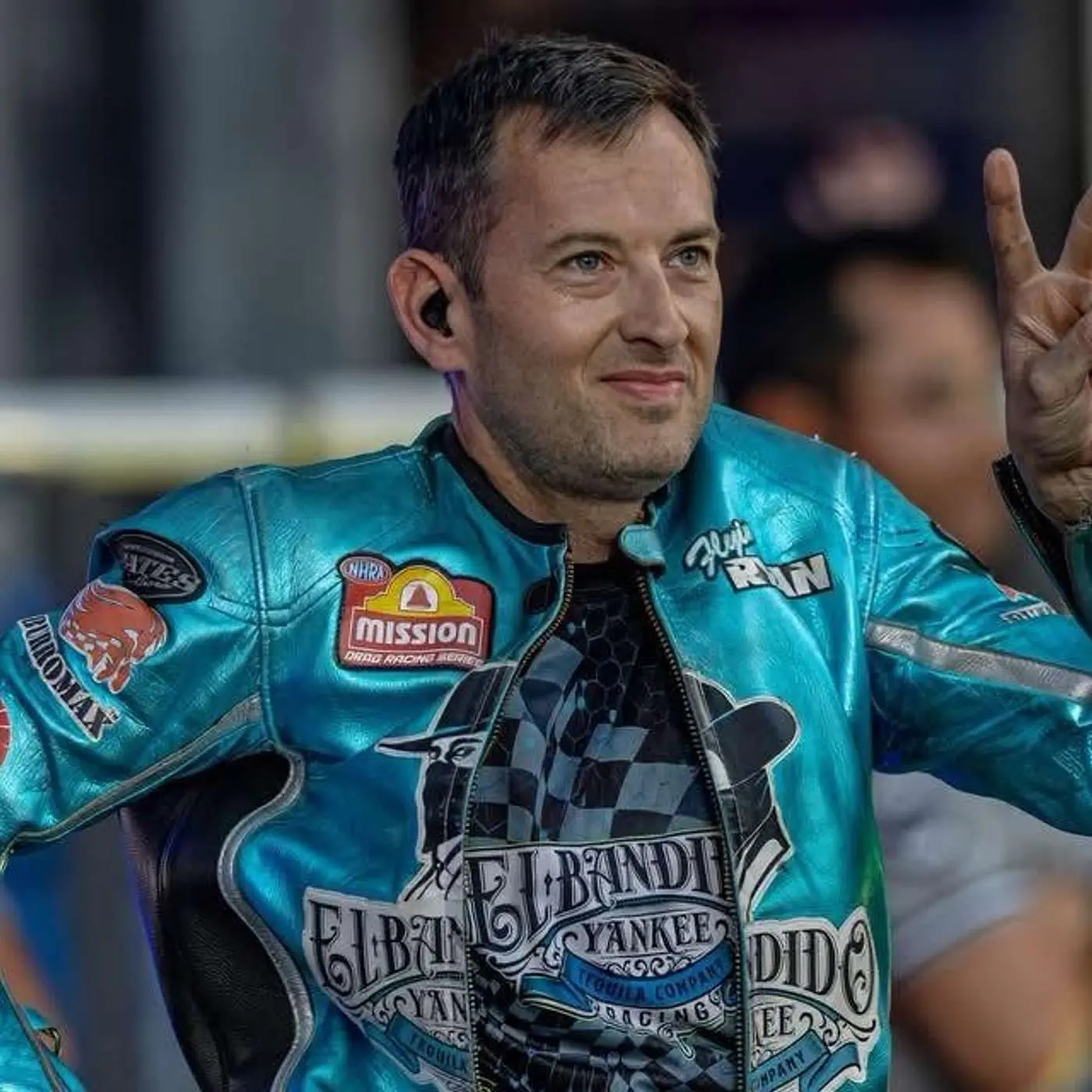

This week on LIVING IT LOUD: Flyin’ Ryan Oehler
Flyin’ Ryan Oehler (born May 2, 1984) is a professional motorcycle drag racer from Bloomington, Illinois, and a proven championship competitor at the highest levels of the sport. Known for his consistency, mechanical understanding, and competitive drive, Oehler has built a respected career across multiple sanctioning bodies. Oehler is the owner of AirTec Heating & Cooling and High Performance Marketing, successfully balancing entrepreneurship with elite-level motorsports competition. His racing résumé includes back-to-back championships in the AMRA (All Harley Drag Racing Association), where he captured the 2015 and 2016 Pro Mod Motorcycle
SPEAKER 04 :
Alright, one, two, three, here we go.
SPEAKER 03 :
Hey, everybody. It’s Tammy Vandermeer. And on this episode of Living It Loud, I am at the PRI show in Indianapolis, Indiana, which, by the way, it’s snowing like gangbusters. Ryan Aylor has graciously offered to come in and chat with me for a little bit because we are now down to the end of the show, and it’s going to take a while to get out of here. And so we found us a room, and I said, let’s do it. But, Ryan, you are the pilot, I’m going to say pilot, of the El Bandido Yankee Tequila Pro Stock motorcycle. Yep. And you’ve had that sponsorship since kind of towards the end of 2022, correct?
SPEAKER 02 :
Yeah, it’s going on, you know, four years of a relationship. And, you know, we’ve been out here since 2016, 2017. I think 2018 was my first full season in HRA Pro Stock Motorcycle. Been lucky enough to be at these PRI shows for all these years and be mentored by some of the great people out here like Larry McBride, you know, and all the exciting things that come out of a great show like this. And today the excitement is going to be the weather and we got our car hearts packed and we’re changing into boots and it’s going to be an interesting end of the show this year.
SPEAKER 03 :
Yeah, it sure is. Well, you know, Indianapolis, got to go figure. It’s kind of like living in Colorado. Here it comes.
SPEAKER 02 :
Yep. I mean, you look at the weather every year and you start to think, what’s it going to be? You know, we’re looking at the two-week out, you know, forecast. And it looked okay. And then all of a sudden, here you go. You know, we’re going to have a blizzard on our hands. But, no, this was an excellent show. And El Bandido Yankee Tequila has continued to work to promote the brand. Working with new racetracks, whether it’s Asphalt Oval, Boat Series, Drag Racing, we’re out there marketing the brand heavily. This was the first ever Indiana convention show to have a liquor company on the floor sampling tequila legitimately. We’ve had a bartender staffed all weekend from the convention center, and it’s exciting to show all If you’ve never been here before, this is a giant event. It’s the largest convention of the year at the Indiana Convention Center. We have upwards of 75,000 people that will be here through the week. the show is more than just a trade show convention it’s you get all these crazy racers under one roof we’ve got to have a good time so we started to to bring the party bring the good time and let everyone experience our tequila and they’re selling it through the concessions and it’s we’re forwarding this relationship so that for time to come we can start to build it bigger and better and have more fun
SPEAKER 03 :
And when you say that, what a great cross-promotion. I mean, you know, for you to be able, first of all, yeah, first ever to sample. And so I’m sure booth number 100, which is what your booth was, was a very popular booth.
SPEAKER 02 :
Yeah, it was. We were right here in the corner of the main hall. So as soon as you came in, you know, you couldn’t miss us. And we had, you know, the Pro Stock motorcycle on display. If anybody, you know, can It sees pro stock motorcycles. I think no one really gets the real behind the scenes. Look, usually they’re all bodied. It’s a very secretive class. Everything that’s been developed is millions of dollars is spent over a career of a rider to develop certain parts and everything’s. Well, we brought one of the SNS Gen 2 Pro Stock motors and put it on display so everyone could see, you know, naked, if you will, the motor and what really powers these Pro Stock motorcycles. So that was really cool to get to do.
SPEAKER 03 :
Well, and your dad is your engine program guy, correct?
SPEAKER 02 :
Yeah.
SPEAKER 03 :
So that’s got to be fun.
SPEAKER 02 :
Yeah, my dad spent a lifetime of being involved in motorsports and started at a very young age, self-employed at 15 years old, doing rear ends and building race cars and was going to pursue pro stock cars and was building a pro stock car. And the rules changed in that time period from the Vegas and the Monza’s to the Camaros and the Mustangs. So his whole pro stock car was no longer, you know, current. And he got really frustrated. And I think he went to NHRA’s office and asked if Wally was in. And he was. And Wally looked at my dad and said, Brad, when we tell a driver to build a new pro stock car, we tell him to do it in three months, not three years. Maybe you should think about joining one of our sportsman categories. And it just infuriated my dad to where he sold his entire operation and he bought a brand new Chevy van and brought a brand new Harley Davidson in 1979, 1980. And, uh, over 10 years, turned it into the world’s fastest gas, Harley-Davidson, and raced up against guys like Junior Pippen. Junior Pippen was one of the few people who come from the all-Harley ranks to join Pro Stock Motorcycle, and I grew up watching this class since forever. I was drawing pictures of uh, in kindergarten of racing suit and helmet. And I said, I’m going to be racing, you know, at that time, I don’t know if I would have known if it was pro stock motorcycle, but I was going to be motorcycle drag racing for sure. And, uh, so yeah, my dad, uh, was always, you know, on the cutting edge and one of the first guys really to enter into the Harley drag racing scene to bring that kind of pro stock level knowledge and was behind many things that helped you know further the performance of the Harley drag racing so grew up in that grew up in the shop and was around it my whole life and very lucky to be here today doing it and doing it as a family my dad Right now, I can guarantee you he is in our shop. He is working on our program. During the show, he’s sending me data. We’re running the engine dyno. So as I’m here doing B2B and working with our team and promoting the tequila, he’s back home making engine dyno pulls and making changes and trying to come up with that secret sauce for 2026. So it’s pretty cool.
SPEAKER 03 :
Which is, it’s crazy because 2026, you don’t go, what will be the first race that you’ll go to? Gainesville. And that’ll be in March. Yep. So you start right away working on, I mean, we just got done with… what was supposed to be Pomona, which got completely rained out. But yeah, there’s no downtime, is there?
SPEAKER 02 :
There isn’t. And, you know, when you live the sport, you see that, of course, we’re going to enjoy Thanksgiving. We’re going to try to enjoy Christmas. But it’s a seven day a week program. Of course, everybody’s got to have a break. And, you know, everybody tries to take a family vacation, get one of those in. But Yet, you know, there’s a group of about six of us, so we’re always working on the program. And we’re trying to get on the track right away in January. We have three Pro Stock motorcycles. We have the one current bike that I’ve been riding, and that bike’s finally starting to come together. And it wasn’t necessarily the bike itself. It was the whole program. And we’ve found some of the missing links. A lot of it’s been reliability problems. which also fell into lack of performance. But Vegas, everyone was watching. You know, we ran number five, and we about drove off the end of the track. We messed the clutch up, and we couldn’t keep it together for the whole weekend. But, you know, we have these moments where everyone says, oh, wow, they found something. They just got to put it all together. So first time, I think, in a long time, I can say I truly know where I stand on a – reliability point, what are the weak links in my program that we’re currently working on with the help of many of the companies that are here this week. And when we show up next year, I don’t think I’ll have a lot of gray areas or fog. I think I know right where I’ll be and I think you’re gonna see the bike in the top half of the field.
SPEAKER 03 :
And that’s gotta be reassuring for you because we are talking two wheels. And what’s the best run you’ve ever made?
SPEAKER 02 :
I’ve been 678. This year was the first. I’ve been 200. I went 679 at 200 for the first time. And, you know, the bike’s performance has shown to really have turned a corner. And when you’re an underdog team like we are, with not as many resources as the biggest teams out there, you get a lot of people behind you. You know, we went 200. You know, you had… people cheering me on forever. All the teammates and all, or all the competitors, um, they’ve been, they’re very supportive and they all, uh, want to see us succeed because they know how hard we work.
SPEAKER 03 :
Well, and you, you have a look to you too. So what is the color? What is the color? Is there a certain color that…
SPEAKER 02 :
born in a Harley shop, orange and black. I’m going to be orange and black forever. And my wife, Laura said, honey, do you think we could do like teal or aqua? And I said, no, absolutely not. You know, and then bam, we have a teal and aqua operation now, you know, it’s the El Bandido colors are, are black and teal and, and a silver and white, you know, so we, we adopted that. And it was probably one of the smartest things i think we did um the bikes are have a lot less real estate and they’re hard to identify uh from the stands a black bike um a red i mean the colors don’t you know do a lot with that amount of surface area but teal you know who I am, and you know it’s the El Bandido Yankee Pro Stock motorcycle, and Angie Smith, same thing, hers is pink, you know, together, side by side, we have a really unique looking operation, and it gets, you know, definitely, it gets the attention of the ladies in the crowd, it’s a it’s a fan favorite color for the, for the women, you know, and I, I don’t say I didn’t like that, you know, get some more attention from, from that side of the fence. So, but it’s pretty cool. And, you know, I think it looks really impressive, uh, all put together from the suit to the bike, to the trailer. Uh, it’s really neat.
SPEAKER 03 :
And it’s very identifiable. I mean, when I see you pull up, I’m like, there’s Ryan. I know you’re there.
SPEAKER 02 :
It’s going to be hard to go back. I don’t think we will. So El Bandido has been with us and been very positive. To have a sponsor that’s supporting you when your performance isn’t there. It feels really good. They want to see you succeed, too. For us, though, we work really hard for our sponsor. You have all these when you have a booth like we’ve had this year at PRI, all these other race teams come up to you and they want some of what you have. Well, they don’t sometimes realize that they’re talking to the racer of the operation who is you. is being sponsored and you have to let them know that hey i’m sponsored by these guys because we sell a lot of tequila and you can be there too everyone here can be sponsored but you all got to go sell tequila that’s what we did and you know um i think the first year that we were at your race uh in colorado was the first time we came out with the operation el bandido and um The first, we didn’t get the sponsorship until halfway through the season. So at the end of the year, we had sold 500 cases of tequila already. And I asked, you know, El Bandido’s main people, Eric, our CFO, and I said, do you think we were going to sell any tequila? He goes, no, we didn’t. we didn’t think you would we just were thinking exposure and it was cool and but no now you know we’ve really shown what you can do for a sponsor and how to how to maintain that relationship and like any business it’s sales yeah well and and um we’ll touch we’ll finish up this segment and then we’ll go into the next one and talk a little bit more about it but you know the truth is is that
SPEAKER 03 :
you are on the racetrack for a very short amount of time. So basing everything off of racing, I get the performance thing too, but it’s a lot of that behind the scenes and all that other stuff leading up to it and activation at the racetrack and before and after. So we’ll take a break and we’ll come back and we’ll talk a little bit about all the things that go into keeping a sponsor happy.
SPEAKER 02 :
Sounds great.
SPEAKER 06 :
I don’t remember ever not having allergies. My seasonal allergies and allergic asthma kept me inside when I wanted to be outside with my friends. I tried over-the-counter allergy medications, but either they didn’t work for me or they made me so sleepy. But you know, I finally got smart. I saw an allergy specialist and I got the right treatment program. My name is Melanie Schell, and this is my true story. Get smart like I did. See your allergist or personal physician. Call 1-800-842-7777 or go to smartaboutallergies.com.
SPEAKER 03 :
Hey, we’re back with Ryan Ehler. And when we took our break, we were talking about activation with sponsors. And, you know, there’s just so much. You are on the track for such a short amount of time. So, you know, there’s got to be more to a sponsorship package than just…
SPEAKER 02 :
point a starting line to finish line point b yeah you know the the event starts with where are we going where are we selling where can we go and promote the product where can we get fans to sample um Bristol is a good example. In Bristol, we didn’t sell into the racetrack the first year, but there’s a liquor store gas station at the bottom of the hill, Pit Road Liquors, and on a Thursday, we take the bike down, we have a tent, we have a bar, and we set up in the middle of the gas station, and your average guy getting off work in Bristol, Tennessee, maybe not a race fan or nothing, swings in and Buys a bottle of tequila. Another one comes in. A garbage guy just got off work. It’s all covered in filth and trash and whatever. And he buys a bottle of tequila. We sold 50 bottles of tequila on a Thursday of two and a half hours. You bring the right people. You travel the country and you realize… I may be a little too wound up to talk the language in Bristol on a Thursday, you know, because I’m over there doing a burnout, and the girl from, you know, local says, this is El Bandido, Yankee tequila. It’s from Jalisco, Mexico. And I’m like… Come on, come on, come on, get it out, get it out, get it out. Tell them where it’s made. Tell them about it. And then yet the person on the other end is very receptive to her tone and her approach, and they just didn’t ask no question. They said, I’ll take it. Then she kicked it into high gear and downshifted and said, oh, come right over here to the restroom, get your bottle, get your free hat, and moved on and bam, back to her speech. So, yeah, it was a lot of fun getting to do the events. It’s a lot of work. Um, to be set up at the racetrack, be tuning your bike, be overcoming problems and then have to go set up somewhere and do something. But we got a good support group. We got a, I mean, like here at PRI right now, we’re about to be tearing down and, uh, we set up on Tuesday. We had, it was nice and relaxed. It wasn’t a lot of people here. Well, on Wednesday, we were pretty much done, so we helped three, four other people set up. Well, those are the same people who have helped me in the past tear down, and they’re going to help us out here in the snow, get everything loaded. So it’s that pay it forward type of sense. But, yeah, back to the marketing side of things. It’s really knowing. It’s a lot of groundwork. You need to have a good runway at all these events and be planning. uh where you know and build those relationships and then go out and activate and then then your team that’s local uh has to support those places so it’s not just a smash and grab um you know we build these long-standing relationships and we come in and we support them throughout the whole year and then it becomes a big deal when nhra is back in town and pro stock motorcycles are here and um And then, you know, we know that Flying Ryan and the El Bandido team’s coming out here and it becomes that, you know, event that they’re looking forward to at that point.
SPEAKER 03 :
How did the name Flying Ryan find you?
SPEAKER 02 :
My last name is Ehler, and it’s spelled O-E-H-L-E-R. It’s been butchered my whole life. So when I was going into NHRA, I felt like I really needed something that came off the tongue nice. And I was searching for names, and I raced the all-Harley world, and I had a nickname. that I came up with after a really interesting Vegas trip. Tyrannical. And tyrannical was this prehistoric demon, three testicles, and I was riding a sickle in a bottle of moonshine, and I’m like… Boy, that’s going to be hard to explain that name to NHRA all the time. So my friend’s name was Flying Taco, and we were in Tampa or Clearwater at a restaurant. And I looked at him. I said, you know what? Flying Ryan just sounds so good. I said, is mainstream? Yeah, it worked great. I’m stealing your name, Taco. I said, I’m sorry. I’m stealing it. I’m going Flying Ryan. So it was just a kind of random moment at a wing house or a Hooters, one of the two, in Clearwater, Florida.
SPEAKER 03 :
And now it’s become part of your identity to a certain extent on the racetrack. Yeah.
SPEAKER 02 :
It’s you got to have that. That’s part of racing. My dad, I call my dad Bad Brad, you know, and he goes, man, don’t call me that. I don’t want to call you that. When we were first getting you, don’t call me that. Because that’s what the you know, the cops used to call me. You know, I have flashbacks. So then I go get a big 10 by 20 tent with Bad Brad flying Ryan on it. And he’s like, oh, goodness gracious. Yeah.
SPEAKER 03 :
So speaking of bad Brad, he raced motorcycles. He got you interested in it. And so what did your dad say when you said, I’m going to do that?
SPEAKER 02 :
Well, they knew it was coming. They tried real hard to keep me out of motorcycles. My dad knew that if he got behind me when I was young, that I wouldn’t have maybe went to college. I wouldn’t have got the education I got. Because he knows it would have probably taken over. Because it’s what it does. You know, we love racing so much. It’s so addictive. And it is really… a great sport to be involved in because it makes you work extremely hard because no one out here has the things they have unless they have amazing work ethic. So, but they really wanted me to go to school. So they just kept me away from as much as they could. So, um, I was street racing. Uh, I was, um, bracket racing at Joliet, uh, with my car. And then I had a street bike. I was going to Morocco, Indiana for testing tunes and Indianapolis and just, and having fun. But, um, When you bracket race and you don’t have a true bracket car and you race against this group of guys and you start with 60 cars and 40 of them have been doing it for 40 years. Um, it’s, I would go two, three rounds and then I’d run into the same group of 20 guys and I’d get beat every time. So I said, I really want to go pro motorcycle heads up racing. I want to be, you know, I want to utilize my dad’s top talents, uh, He’s bad Brad. As soon as he builds me a bike, we’re going to be the fastest. Well, we had shifted from the Harley racing scene as our main source of income in our profession to heating and cooling. And that was really the best thing that could have happened to our family. It was a very successful business to get involved in. Also, very hard work, labor intensive. Like right now, it’s going to be below zero tonight. And I’ve got guys out working right now. And, you know, it’s a tough thing to be a part of. So but yeah. So we’re in the heating and cooling business. I want to get us back into racing. That was a big goal of mine, and we maintained our shop, but it was not at any production level. And I was going to college, and… I had this idea that I could take out a school loan to start my racing program. So I took out $35,000 in a school loan, and I picked a class, Pro Mod Harley, in the all-Harley racing section. and pro mod is very similar to pro stock motorcycle it was heads up a seven inch tire versus a 10 inch tire similar weight but horsepower to traction ratio is very similar we made about 300 horse with our sportster and we make about 400 horse with the pro stock bike we have a seven inch tire there we have a 10 inch tire here so on and so forth so And I started, I seeked out DNG chassis out of Largo, Florida. They had the record in many of the gas classes. So they, he built me a loop and I said, I just, I can only afford a loop. He goes, Brian, I never built someone a loop and they turned it into a running bike. It’s those, it’s that dream. They don’t, so he wanted to build me a rolling chassis. I said, I can’t afford a rolling chassis. I said, just sell me the loop. okay. So sold me a loop. I bought a front end. I bought wheels. I bought tires. I bought engine cases. I bought blank cylinder heads. I bought cylinders. We started piecing it all together. And my mom starts freaking out because she works at the front desk at our air tech, our business. And all of a sudden the semi’s backing up and unloading this and boxes. And she’s she is worried that I am now a drug dealer on college campus. And, and when she found out that I had took out a school loan, I’m not sure what, if she would have been more mad or at that moment, she was pretty mad. She, you know, and, uh, Now she’s extremely happy to see what we’ve done. But yeah, after speeding it up, it took us several years to build the bike because we had owned the heating and cooling business with some partners. And in 08, right when I graduated college, Three months later, we sold the company and reformed AirTech, our new company, and it was just me and my dad. And at that same moment, now I took over the company, and my dad started to work more to get back into the racing. And at a certain point when he wasn’t really getting it done and I was waiting forever, I went back and I took his phone one day and said, build my engine, you know? So then I, I, that’s when I really started to run the company and he really got focused back in racing. And then when we got the bike running, it was 2010. And, uh, we go out to, we went to bunker Hill, Indiana, which is funny enough. The one’s the oldest racetrack in the United States, but it’s the first racetrack I’d ever been to. And it’s where we would go a lot because we were from Lafayette, Indiana. And, uh, we, we, A lot of the old Harley stuff was there in the 80s, so I got to make my first pass on the bike at that track. And then as we progressed and it started to become a better program, I still thought that we were going to have it. I didn’t know what it was going to be like. I didn’t know how hard it was truly going to be to take something from nothing and turn it into a champion. And we showed up running nine flat. The group was running eight 50s. And then the next year we ran 870s. They were running 840s. They set the record at 830. Then the next year we run, we were competitive. 2015, I won the championship in the final round of the season. 2016, I set the national record, won every single race but one. And we were, you know, miles ahead of everybody then it seemed like. So then it was… We call it riding the wave. There’s a wave of success here and you’ve got a lot of momentum. We need to make the transition into pro stock bike. And how am I going to do that? Where am I going to come up with that money? I’ve got to get a loan or something. And I was literally, I had been bothering George Bryce from Star Racing often. I’d call him because George had helped. I’d done the school with George and Frank Holly. And then I did a challenge with George where he took 30 riders and tried to groom one to be a teammate to Angel. And I was very successful in that. And then, so I’d call George and be like, hey, so-and-so’s got a bike for sale. And he’d be like, ah, you don’t want that. And I’d go, yeah, he had one for sale, but he had a high price tag on it. And was no negotiating and i i couldn’t get him to do anything and one day i was in an attic it was 140 degrees i was doing a blower motor on a furnace and george called me and said that jackie his wife and him had talked and they want to make me a deal and that uh we’ll bring you on the team if you and if you have ten thousand dollars down we’ll let you uh get started and you can make payments i had ten thousand seven dollars to my name and i said deal And I crawled out of the attic and then I paced around the parking lot like a chicken with his head cut off for about 30 minutes to figure out, how the hell am I going to come up with the rest of this money? And that’s how it got started.
SPEAKER 03 :
Well, hold that thought and we’ll be back with more with Ryan Aylor.
SPEAKER 05 :
Quotes from history.
SPEAKER 07 :
It is not how much we do, but how much love we put in the doing. It is not how much we give, but how much love we put in the giving. Mother Teresa Mother Teresa was born in 1910 to a Roman Catholic family in Macedonia. Feeling a calling from God to serve among the poorest of the poor, Mother Teresa became an independent nun to open the Missionaries of Charity, where she bestowed faith and hope to countless people in more than 100 countries.
SPEAKER 03 :
I was back with Ryan Ehler, and we talked about how he got into the racing and how George Bryce, and I remember George and Jackie, great people. In fact, when we announced that we were selling the racetrack, he called and he had to share some stories with me and that kind of thing. Cause you know, that’s just, they’re part of your family, you know? And, um, so you’ve been racing since about 2017. What have you noticed is changes? You know, what are the biggest changes that you’ve noticed in the class?
SPEAKER 02 :
Well, it’s, that’s complicated. Um, coming into the program in 2017, you know, I, I hadn’t, basically adopted this recipe from George and Jackie and learned to utilize it. We put our little touch on it. We didn’t change it a lot, but we started to give it a little bit more performance down low and learned what we felt the bike really wanted. Having all the Harley experience that we did, we started to work with the program. But there were some features that weren’t real reliable. When we started to squeeze it and make more power, the weak links started to show up. And in the early, not even early, it would be in the middle of the timeline of the S&S V-Twins, excuse me, the crankshafts were the problem. And they were a multi-piece crankshaft that’s similar to a Harley-Davidson knife and fork rod. And someone would ask me, Ryan, how many runs you get out of one of these pro stock motors? And I’d say, well, right now it’s somewhere between half and four. And they, huh? I said, that’s the truth. I said, I’m blowing up engines all the time. And that wasn’t good. We were successful. We had won. We were in some finals in 19 and we won our first race in 2020. We won again in 21. We were a top 10 competitor. And then, you know, I blew up an engine really bad in Atlanta and I drove off the end of the racetrack at like 120 mile an hour. And it was because the engine, when it blew up, it, it lost both rods and the engine kept spinning. But without the counterbalance of the pistons and rods, it was vibration was just insane. I always say it’s kind of like sticking your fingers in an outlet and holding them there. And just, it felt that intense. And, uh, And you’re trying to save the bike, too. I mean, you don’t want to… And I had just driven off the track the weekend before in Las Vegas when we won, and then the guy at the end of the track holding the flags, he shoulder shrugged me at 120 mile an hour like he said, what the heck, Ryan? What are you doing? And I looked at him and shoulder shrugged back like I’m driving into the sand right now again, you know? So I told my dad after that, I said, man, we got to do something. You know, we… I had some PTSD of just what is winding up out the back of going, oh, boy, stay together. And I said, this is not don’t feel safe. So then we we we got into the upgraded engine package, which is a. The GIN2 motor, which now is a billet crankshaft, a knife, side-by-side connecting rods, like what everyone in the automotive industry is familiar with. And now we were on to finding all these other problems that were going to come up. So that’s what we’ve been working on for three years is… the new set of problems that came out of that. And that’s where we’ve been.
SPEAKER 03 :
Well, and where do you call home?
SPEAKER 02 :
Bloomington, Illinois.
SPEAKER 03 :
Okay, Illinois. So, you know, the snowy weather is nothing for you, right?
SPEAKER 02 :
Oh, I hate it. I’m supposed to be in Florida. That’s where I was supposed to be born there, you know. But one day we will be there. But for now, I’m lucky to have what I have going on in Illinois. It’s tough when you have your own shop. Our building’s 18,000 square feet. Half of it is our heating and cooling business. Half of it is our racing business. It’s hard to pick that all up and move it.
SPEAKER 03 :
Oh, yeah, for sure. Well, and what I’m hearing you say, too, which just kind of blows me away, is that not only do you have a full-time race operation, but you also have a full-time business as well. So there’s got to be some kind of… balance between that and to be successful at both.
SPEAKER 02 :
It’s a challenge. Also the family. We’ve been growing a family. I have a four and a half year old daughter. I have a four month old boy. I have a wife that works with me in the business and she is taking care of all the mom duties and bless her because it’s changed my whole outlook on Mother’s Day. Having children was like, oh, man, I owe my mom such an apology for not celebrating Mother’s Day with fireworks, you know. So, but, yeah, I have ventured into other businesses. On top of that, I had my racing program down in Florida. And, you know, I feel like I could do anything. I’m a real, you know, go-getter. But, man, I really did bite off more than I could chew.
SPEAKER 03 :
Well, in your racing program in Florida, and I think I’m talking about the right one, is that you had the Tampa Bay race rental program where you could come and rent a Ford Mustang and see what it was like to go down the track. And, you know, I don’t know if you know, but out at our racetrack, we had eight Dodge Challengers. And we called it our Challenge Race Program. Same thing. You know, give people the opportunity to go down the racetrack and have the, you know, not use their own personal car, but to do that. And it was very successful. And when people realize that they can mash the pedal on a car and it’s not their own car, they really have a tendency to go, oh. okay, I can do that. And, um, and so how long did you have that?
SPEAKER 02 :
And that’s, I just hung it up this year just because I had too much going on. And, uh, I decided that it, I really need to be there. It would be very, and I could always do it again, but I really need to be, uh, present. Uh, it can’t be ran from, you know, a thousand miles away. So, um, step back from that and, um, You know, now we’re really just focused on the race team. Air tech is growing tremendously, and it’s hard to keep up with. It really is. I manage that with a team of guys, and that’s pretty much what I focus on for eight hours a day. But we’re traveling so much with the race team, and, you know, we’re working on that, you know, as well. We have three guys full-time in the race shop, as well as Brad McCoy, who is our main tuner out of Mooresville, North Carolina. And then, of course, I’m there filling in the gaps, but, you know, air tech has been occupying a lot of my time. And then, of course, now the traveling, and then you… come home and wrap your head back around everything that’s gone on while you were gone. And then of course, back out the door again, racing again, that’s what the challenge is. And then now it’s even harder being away from the family because a little four year old girl is starting to miss her daddy, you know? So, but I took her around PRI remote with my phone, showed her all the cool stuff. She thought that was just amazing. So it’d be interesting to see what we, what we got out there in a few years behind the wheel, because she’s, she’s going to be something.
SPEAKER 03 :
I remember when my dad used to go to the SEMA show every year, and we would, like, oh, we hated it when he left. But that was when Toys R Us was brand new, and he always brought us back a toy. So, you know, we were like, okay, the tradeoff, we don’t get Dad for, you know, five days, but we get a toy when he comes back, so…
SPEAKER 02 :
Thanks for reminding me. I need to stop at the pilot on the way home and pick up a stuffed animal.
SPEAKER 03 :
Pick something up, yeah. So what would you say someday if one of your kids said, hey, Dad, you know, I think I want to race a motorcycle?
SPEAKER 02 :
Well, I don’t doubt that that’ll happen, you know. It’s such a tough sport to be in, though. And with my dad, you know, my dad’s 71. He works seven days a week, 12 hours a day. And he has a talent that truly I may have it, but anyone who wants to be a professional at something has to focus on that very thing. Hmm. and i am the ping pong ball i am bounced all over the place and my talent and my specialty is putting out all those fires and making everyone happy and managing all these this operation and keeping everything going and paying all the bills and tuning the motorcycle fixing the motorcycle i’m real good at multitasking but to be a cylinder head of engine developer um You have to have that time and that expertise, and it takes years and years of focus. So if we just want to go race and have a good time, that’s definitely going to happen. And if my child, as they grow up, want to be professionals, we’re going to have to find an avenue to do that. It just may be a little bit different course than what I’ve had in my life. So this is a unique experience to do what I’m doing with my dad, and I’m enjoying it. So it’ll be interesting to see what my kids bring to the table. I was hoping maybe my daughter might go more like the Taylor Swift route or something like that, and maybe help pay for my top fuel car when I’m in my 60s or something. Who doesn’t wish for that, right? We’ll wait and see, though. The funny thing is when we had our daughter, Kinsley, we came out of the hospital, my wife, Kinsley, me, and we just have a Chevrolet Blazer RS. We pull up outside, and I stop right in front of the hospital on the road, and I look over at my wife, and I torque it up, and boom! And flew out of there, and we come up to a four-way stop. There’s no one around. We go right through the four-way stop, and my wife goes, what are you doing? I said, my baby girl is going to learn what speed is and breaking the law right off the bat. And my wife’s like, oh, my God. Most wives in that situation would be screaming and hitting, but no, she just, oh, my goodness, no.
SPEAKER 03 :
Like she almost expected it.
SPEAKER 02 :
And then when we have our baby boy, you know, four years later, I leave the parking lot like on eggshells. I don’t know why. Maybe I’ve grown up just a hair in four years. I’m not quite sure. But, yeah, it was funny.
SPEAKER 03 :
That’s awesome. So did you have any people that you looked up to when you were getting into this, somebody that you were like, I want to be like that person?
SPEAKER 02 :
Well, my very first NHRA race I went to was 1996. So I was 12 years old. And it was a race all of us remember, which we lost Elmer Trett and Blaine Johnson that weekend.
SPEAKER 03 :
And it was here in Indianapolis.
SPEAKER 02 :
It was here in Indianapolis. So my dad having the race shop and the bike shop, there was always guys around that were, you know, drinking beers after work. And I hear them, they’re going to the U.S. Nationals. They’re going to the U.S. Nationals. So they show up the next day to meet there, and they’re going to take one vehicle. So a guy had an Astro van, I remember. And I got in the back, and I put a blanket over myself, and I laid there until about champagne, so about 45 minutes or so. And then I popped up, and they scared them, and oh, you know. Surprise. Yeah, and they, of course, before cell phones weren’t real popular then, so pull over at a gas station, call the pay phone, call B&K. Hey, Brad, your son stole away in my van. Can I take him to U.S. National? Yeah. So I get to go and Elmer Trett was very influential with my dad and they had worked together. So that was a sad, you know, sad moment for everyone. Um, and then, um, but I got to see Angel that weekend and Angel and I are very good friends now. And, uh, she mentored me and has helped me a lot in all these years, you know, and, um, A lot of the other guys, Steve was still out there, but me and Steve didn’t become good friends until here in the last couple years. So, yeah, it’s a good group of people. You said earlier it’s a family. It’s amazing to be adopted into the racing family. Yep. Hold that thought. We’ll be right back.
SPEAKER 03 :
Don’t need nothing but a good time. How can I resist?
SPEAKER 04 :
Ain’t looking for nothing.
SPEAKER 01 :
Every song tells a story. On our sister station, 95.3 FM. Legends of the 60s and 70s. Streaming live at legends95.3.com.
SPEAKER 03 :
So we talked, we just finished by talking about family and that kind of thing. You know, it’s interesting, Ryan, because, you know, our family had our business for 65 years. And then in 23, you know, that was it and we’re done. And I still come to the races. And it’s kind of funny. I come to the races to see a lot of friends. Sometimes I very seldom get to see Q1 or Q2, but… maybe part of q3 and then I might be there for part of q4 but you know you’re you’ve got friends that you’re talking to and you just you come for the the relationships so you know talk a little bit about some of those relationships and how you’ve you know I mean you can leverage that too because there’s you understand the whole networking thing I know that because of all the the things that you’ve worked on and getting involved in things and
SPEAKER 02 :
Yeah, I mean, we’re all here to race each other, and we all want to beat the person in the other lane, no matter who they are. But as soon as that’s over, it’s, you know, Matt Smith and I, for example, he is a fierce competitor. And him and I got into a very heated argument one time after I tried to help him, but it wasn’t the way he wanted to be helped. And it turned into a big fight. And years had gone by, and he still held some anger, I feel. But then, you know, his air conditioner was broken. And I went and helped him fix his air conditioner, you know. And then, you know, just… you get over it. You know, I mean, when you’re, you have your real family, your brothers and your sisters or whatever, you know, um, and, uh, you don’t always have to get along, but you still all love each other, you know? And, uh, I feel like that’s how it is out here, but, uh, you have a lot of different relationships and you have a lot of different personalities, but everybody works really extremely hard to be here. So we all share this, this passion, uh, to do something that not everyone gets to do, and it really unites everybody as a whole. So when you see somebody in trouble or need something, everyone usually jumps up and runs to help, you know. And I think the motorcycle group, maybe even more than some of the other classes, something to do with the fact of Our life is on the edge anyway, and I don’t know, it makes us a little bit more unique than maybe somebody else. Obviously, we don’t have as much fear. We’re okay with getting onto a motorcycle that’ll go zero to 200 in six and a half seconds, and we’re fine with that. And everyone says, doesn’t that make you scared? And you’re like, there’s not enough time to be scared. Like, if you’re scared, you’re already in the wrong place, you know, so.
SPEAKER 05 :
Mm-hmm.
SPEAKER 02 :
But yeah, Steve Johnson, you know, Steve, I first met Steve in like 2015 and I went up to him and I’d love to to be animated when I when I give this story. So you’ll have to just I’ll do my best through voice. But I said, Steve, my name is Ryan. I’m going to be coming out here one day. I’m going to be racing pro stock motorcycle. And he just looked me up and down. Like, as clear as he could. And then he just turned around and walked away. He didn’t even say a word to me. And I’m like, well, that didn’t turn out like I expected. And then later on, he took me under his wing. And he’s really helped me understand some of the business aspects of what we’re doing. And we became good friends. And we play a lot of pranks on each other. And, you know, the guy’s a great, great guy. Big heart. And, you know, and gel. Same thing. Always been there to help me through and introduce me to the right people. And it’s amazing.
SPEAKER 03 :
I can’t believe I’m going to ask you this, but, you know, hobbies. I mean, do you have any hobbies? I like to play golf.
SPEAKER 02 :
I used to play golf in high school. I don’t get to play as much as I’d like, but I like to play golf. I think my favorite would be boating. I love going. And when people come out with me and they’re like, oh, my God, we’re going to go boating with Ryan. It’s going to probably go 200 mile an hour. I’m like, no, no, no, that’s not how I vote. I vote boating. very slow and we enjoy the scenery. We like to boat in Florida in clear waters of dolphins and all that stuff. That’s just amazing to get to see that when you’re from Illinois, that’s a real treat to be out on your own boat and look over and dolphins are following you. You know, it’s wild. Aside from that, I mean, there’s not a lot of time for anything else but enjoying the time with my family and I’ve always maybe considered work a hobby. I love to work. I love the weekends when I can go into my office and just work on stuff and work in the race shop and be undisturbed because usually Monday through Friday and at the races, it’s just go, go, go. It’s such life in the fast lane. Yeah.
SPEAKER 03 :
I did read, though, that one of your hobbies is fitness, that you really like to do that, to be, you know… And I have to be honest with you. Every one of you motorcycle riders are lean and mean.
SPEAKER 05 :
Yeah.
SPEAKER 03 :
And you just… I mean, you line all of you up during a morning of introductions, and you all could almost wear the same fire suit, driver’s suit, you know, because you’re all… Lean and mean.
SPEAKER 02 :
Yeah. Got to be thin. It is one of the few professional categories that does probably require a lot of fitness because we have to stay in good shape. But also riding the motorcycle requires a certain level of core strength. But I think weight is our biggest concern. So, yeah, when I first came out, my bike that was Angel’s, she was so lean and small that the bike was heavy and I’m six foot tall. So I, I got, I weighed 170 some pounds when I raced pro Harley. And then I got down to 135 pounds to race pro stock. And I, uh, I look back at these pictures when I was with George in this school and I was always doing this yoga stuff. In the background, you’d see me like, and they all made fun of me and I was doing P90X all the time. And then I started the bathroom workout, I call it. Every time I go to the bathroom, I do 50 pushups, 50 sit-ups. Or actually, I think I was doing 100 at one point. I think at the end of the day, I’d do like 1,000 push-ups, you know? And it really started to affect my elbows, but it also made me look kind of strange. I’d come out of the bathroom, and I’d be sweaty, and my veins would all be pumped up, and everyone would be like… What just happened in there? I remember my accountants were there to meet me, and I was like, came out of the bathroom, and you know, whoo, yeah! And they’re like… That’s strange. You know, I had a little mini gym in my bathroom, you know. So but yeah, now I the only time I’m undisturbed in my life is early. I was never an early riser. Now I get up at five in the morning and I work out and I sauna. And that’s how I start my day now. And when I’m on the road, that I miss. I have to try to, you know, I have to put a mobile sauna in my motorhome or something like that, you know. But, yeah, it’s an important thing to stay very fit and active. And I think it’s more for just… general life as well you know i have a lot of aches and pains the bike is kind of hard on you it really affects your back and i was in a bad car accident when i was a kid so i’m trying to try to overcome that so when everyone says oh you’ll feel that when you get older
SPEAKER 03 :
So I got here early to the PRI show, and I went to the Women in Motorsports North America event. And there was a lot of young girls that were there because they wanted to network. They wanted to develop a relationship because they want to get involved in some kind of motorsports. And what kind of advice would you give to someone right now that says, oh, I want to do what you do?
SPEAKER 02 :
You know, we get this on Fridays at the track a lot because that’s when the schools come out to certain races. And, you know, I’m a worker. I like to work. And I haven’t actually worked for somebody, you know, in a long time. I’ve been self-employed for a long time. But I tell the high school kids that find a team, find a shop, find a local guy who races. Maybe he races… No prep. Maybe he races sprint cars. Maybe he races dirt cars. I don’t know. Sweep his shop. Sweep it so good that he will have to hire you. In drag racing in general, we don’t work 40 hours a week. We work 80 to 100 and we get paid for 40. You’ve got to be okay with that. You’re devoting yourself to this something that’s bigger than life situation. You want to do it so bad it’s not about the money. Very few people are getting rich out here racing. There’s a lot of people here that are maybe have businesses um that are uh very you know profitable from the from the network and the the need and demand of the sport but just being a racer it’s pretty challenging to to become wealthy from that but um I don’t think a lot of us are here for that so yeah I tell the young people to find these places go there and make the best impression you can and uh And prove to this person that you have something that other people don’t have. And they will take you under their wing and you will become part of that team. There’s also all kinds of, I walk around and think the same thing. What am I going to do when my daughter wants to get involved? And you see all these, there’s lots of programs and there’s lots of schools, especially in the Indianapolis area. um in michigan i’m sure that have uh educational foundations that can help promote different areas of motorsports and get people involved so no better place than the pri show you bring those kids here and go to the seminars and talk to the different groups of people and figure out what their group has to offer and you know i wanted to go to purdue I wanted to be involved in their engineering department because I grew up in Lafayette, Indiana initially, and I thought that’s the way you got to be an engineer. Well, I wasn’t, I maybe could have went and been an engineer after I graduated college the first time. I wouldn’t, you know, I finally was maybe mature enough to be able to sit back and focus on something like that. But by that time, it was… It was time to go racing, and I’d maybe missed that window. But, yeah, definitely look at the – NHRA had came out recently with a program to help drive young people into forms of motorsports, and I’m drawing a blank on what the name of that one was.
SPEAKER 03 :
Well, they had the YES program.
SPEAKER 02 :
The YES program, yeah. And is that the one Terry Vance got behind with the large – It was – the next one was Launch.
SPEAKER 03 :
Launch. Yeah.
SPEAKER 02 :
So a lot of people that are seeing the future know that we’ve got to get young people involved, and young people have strayed maybe from the path as a whole of hard work, and we’re trying to re-embody that and get them out there. I think once they see it, and they see these cars, and they see the race, and they become part of it, they realize that this is why… my parents or my cousins or uncles were so involved because it is so impressive.
SPEAKER 03 :
Well, we’re at that point in the interview where you get to go put on your car hearts and your boots and you get to load everything out of here. So thank you, Ryan. Thanks for taking the time. And, and if anybody watches NHRA drag racing, when pro stock motorcycle comes up, look for the teal bike rider and it’s flying Ryan.
SPEAKER 01 :
Thank you so much for having me.
SPEAKER 03 :
Thank you.