



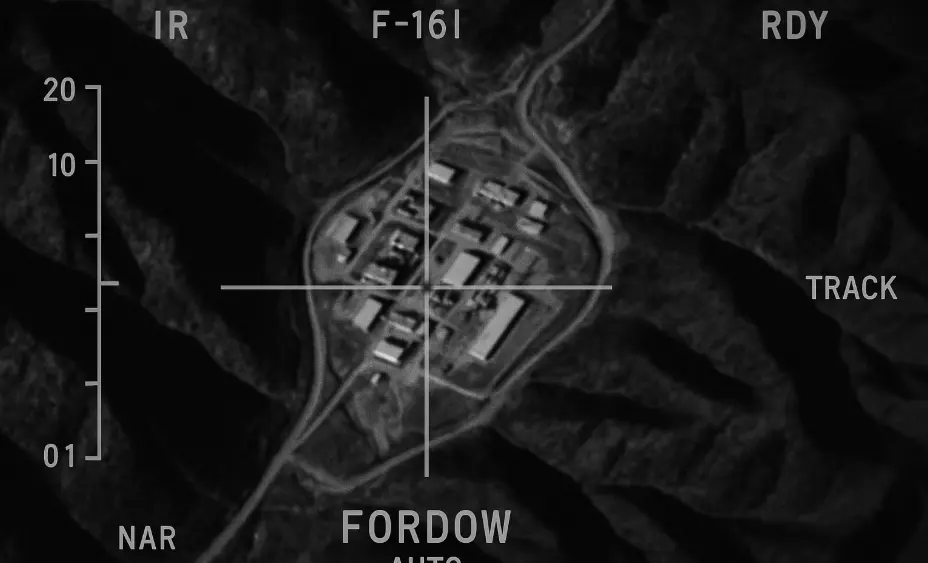
Artificial image of what the gun pod on an F16I may look like targeting FORDOW nuclear fac. / Open AI
by Stefan J. Bos, Worthy News Chief International Correspondent
TEHRAN (Worthy News) – Iran warned Wednesday that its missile capabilities are “non-negotiable” as tensions increased with the United States, which appears to be preparing military options, even as the Islamic Republic faces unrest at home following a deadly nationwide protest crackdown.
“The Islamic Republic’s missile capabilities are non-negotiable,” Ali Shamkhani, an adviser to Iran’s supreme leader, said, according to state media, while appearing at a march commemorating the 47th anniversary of the Islamic Revolution.
The comments came after U.S. and Iranian diplomats held indirect talks last week in Oman, communicating through intermediaries rather than meeting face-to-face, in an effort to avert conflict. The negotiations took place despite a growing U.S. military presence in the region, including the redeployment of missiles on mobile launchers at Qatar’s al-Udeid Air Base, the largest U.S. military base in the Middle East.
Satellite imagery analysts said the use of truck-mounted Patriot missile systems increases their mobility, allowing them to be repositioned more quickly for defensive or offensive scenarios.
U.S. President Donald J. Trump has threatened military action against Tehran over its nuclear and ballistic missile programs, its support for allied armed groups across the Middle East, and its suppression of domestic dissent, although negotiations continue in an effort to prevent a wider conflict.
U.S. MILITARY BASES IN THE REGION
The United States maintains military bases in Iraq, Jordan, Kuwait, Saudi Arabia, Qatar, Bahrain, the United Arab Emirates, Oman, Turkey, and on Diego Garcia in the Indian Ocean.
Iran’s Islamic Revolutionary Guard Corps has warned that in the event of any strike on Iranian territory, it could retaliate against U.S. forces at bases across the region.
William Goodhind, a forensic imagery analyst with Contested Ground, said a comparison of recent satellite photographs showed a buildup of U.S. aircraft and other military equipment in the area.
At al-Udeid, Patriot missile systems were visible mounted on M983 Heavy Expanded Mobility Tactical Trucks (HEMTTs) in early February, giving them greater tactical flexibility.
PROTEST DEATH TOLL CONTINUES TO RISE
In addition to mounting geopolitical tension, Iran remains deeply unsettled at home following a nationwide wave of anti-government protests that began in late December 2025.
Activist groups, including the U.S.-based Human Rights Activists News Agency, say the death toll from the crackdown has reached at least 7,002 people, with many more feared dead, as security forces used lethal force to suppress demonstrations.
Those figures far exceed the 3,117 deaths officially acknowledged by Iran’s authorities, who have attributed many of the fatalities to what they describe as “terrorist operations” rather than state action.
Some advocacy groups allege the true number of deaths could be significantly higher, even in the tens of thousands. However, independent verification remains difficult due to restrictions on media access and reporting inside the country.
COMMUNICATIONS BLACKOUTS REPORTED
Human rights organizations say communications blackouts and restricted access continue to hinder verification of casualties across Iran. International monitors have expressed concern about what they describe as disproportionate use of force against largely peaceful protesters, with allegations that killings even happened inside hospitals.
Despite renewed diplomatic efforts, including the indirect talks in Oman intended to reduce tensions, no definitive progress has been announced, and both sides have continued military posturing.
Iran has resisted U.S. and allied pressure to include its ballistic missile program in nuclear negotiations, arguing that such capabilities are central to its defense doctrine.
Tehran’s official stance holds that its defensive missile systems are a sovereign right — a “red line” that cannot be negotiated.
Analysts say this parallel track of negotiation and deterrence reflects deep mistrust and the high stakes involved.
The post Iran Warns Missile Capabilities Are “Non-Negotiable” Amid Rising Tensions With U.S. appeared first on Worthy Christian News.