



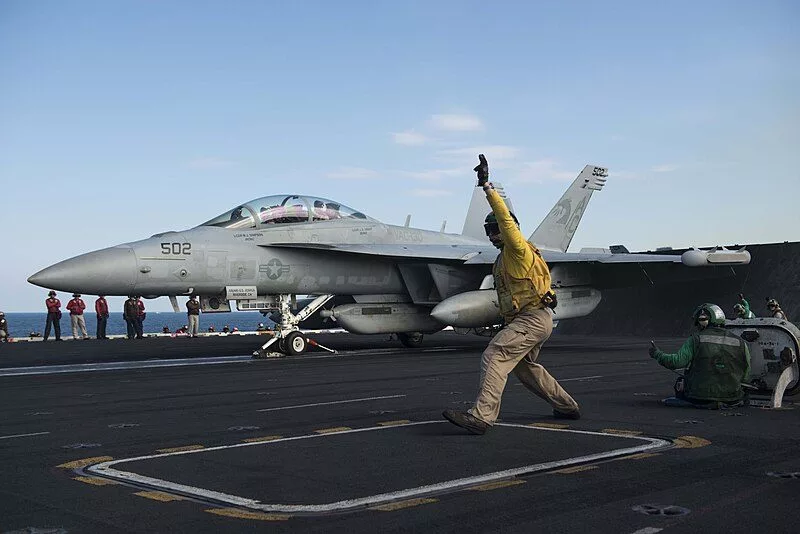
131126-N-CC806-049 GULF OF OMAN (Nov. 26, 2013) Lt. Christopher Miller signals an EA-18G Growler, assigned to the Zappers of Electronic Attack Squadron (VAQ) 130, for launch from the flight deck of the aircraft carrier USS Harry S. Truman (CVN 75). Harry S. Truman, flagship for the Harry S. Truman Carrier Strike Group, is deployed to the U.S. 5th Fleet area of responsibility conducting maritime security operations, supporting theater security cooperation efforts and supporting Operation Enduring Freedom. (U.S. Navy photo by Mass Communication Specialist Seaman Blagoj B. Petkovski/Released)
by Emmitt Barry, Worthy News Washington D.C. Bureau Chief
(Worthy News) – The United States has surged more than 50 fighter jets to the Middle East over the past 24 hours, according to open-source flight tracking data and confirmation from a U.S. official, as Washington and Tehran conduct a second round of nuclear negotiations in Geneva, Switzerland.
The aircraft reportedly include advanced F-22 Raptor, F-35 Lightning II, and F-16 Fighting Falcon fighter jets. Numerous aerial refueling tankers were also observed crossing Europe en route to the region, according to independent flight trackers and open-source intelligence analysts. The Axios news site cited a U.S. official confirming the rapid deployment.
The military buildup coincides with indirect negotiations between American and Iranian officials aimed at addressing Tehran’s nuclear program. A U.S. official told The Jerusalem Post that while the talks in Geneva were constructive, significant gaps remain. Iran reportedly indicated it would present more detailed proposals within two weeks to address unresolved issues.
“There were good meetings, but the gaps are still wide. There’s still a lot of work to be done to reach an agreement,” the official said.
Carriers and Air Defenses Deployed
In addition to the fighter jet surge, the Pentagon has reinforced naval assets in the region. The aircraft carrier USS Gerald R. Ford is reportedly being redirected to the Middle East after previously operating in the Caribbean. The USS Abraham Lincoln and its strike group have already been deployed to the region since January.
Carrier air wings include F-35C and F/A-18 fighter aircraft, EA-18G electronic warfare jets, and E-2D early warning aircraft, supported by destroyers armed with Tomahawk cruise missiles capable of long-range precision strikes.
On the defensive side, THAAD and Patriot missile systems have reportedly been positioned at U.S. bases across the region, including Al Udeid Air Base, which serves as the forward headquarters of U.S. Central Command. Satellite imagery recently indicated operational Patriot batteries at the base, a move viewed as precautionary following Iran’s retaliatory strike on Al Udeid after Operation Midnight Hammer in June.
Regional Bases Activated
Several regional bases are serving as hubs for the incoming aircraft. Muwaffaq Salti Air Base has already hosted dozens of F-15E fighter jets and is believed to be receiving additional F-35 aircraft. The United States also maintains active installations in Qatar, the United Arab Emirates, Saudi Arabia, and Oman.
In recent days, heavy transport aircraft including C-17 and C-5 cargo planes have conducted dozens of flights delivering equipment, support personnel, and logistical assets. Surveillance aircraft, electronic warfare platforms, search-and-rescue units, and communications relay planes have also been repositioned.
Pressure and Diplomacy
The buildup reflects a dual-track strategy under President Donald Trump, combining diplomatic engagement with a visible show of force. Trump has previously warned that military options remain on the table, first in response to Iran’s crackdown on protesters and more recently over concerns about Tehran’s nuclear ambitions.
While negotiations continue in Switzerland, U.S. officials acknowledge that any agreement remains uncertain. The rapid military deployments underscore Washington’s effort to maintain leverage at the negotiating table while preparing for potential escalation.
The post U.S. Moves Over 50 Fighter Jets to Middle East as Nuclear Talks With Iran Continue appeared first on Worthy Christian News.