



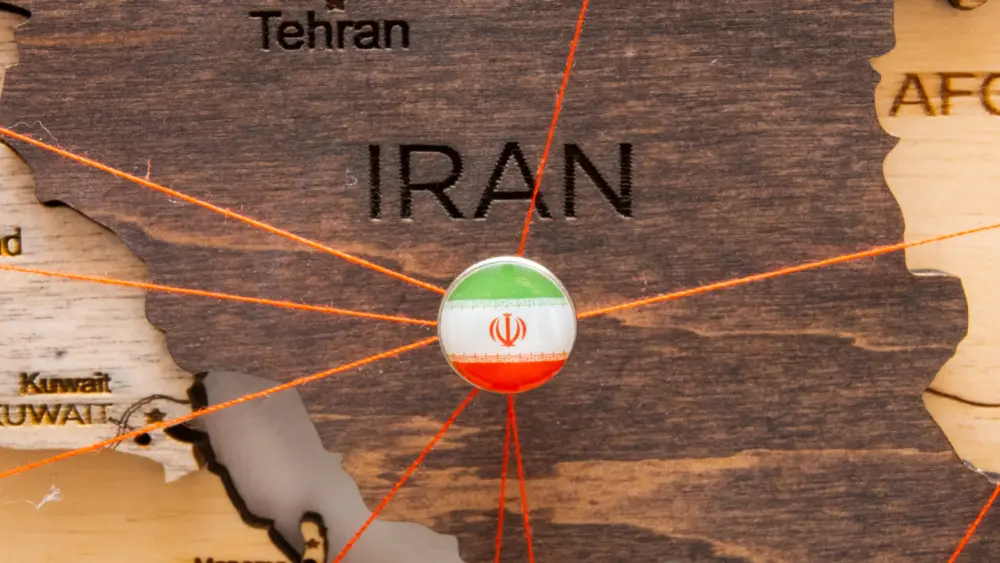
Iran Flag and pin / Envato Market
by Emmitt Barry, Worthy News Washington D.C. Bureau Chief
WASHINGTON (Worthy News) – U.S. President Donald Trump said Tuesday that the ongoing conflict with Iran has already resulted in what he described as a “regime change,” signaling a dramatic shift in leadership dynamics within the Iranian government as Washington presses forward with negotiations to end hostilities.
“We have, really, a regime change,” Trump told reporters in the Oval Office. “The leaders are all very different than the ones we started off with that created all these problems.”
The president emphasized that U.S. officials are now engaged with what he called “the right people” inside Iran, expressing strong confidence that Tehran is eager to reach a deal. “They want to make a deal so badly,” Trump said, adding that negotiations are currently underway, though he declined to provide specifics.
Energy Concession and Strategic Leverage
Trump also revealed that Iran had made a significant energy-related concession to the United States, describing it as a “very big present” tied to oil and gas—likely connected to the critical Strait of Hormuz, a vital global energy corridor.
“It was a very significant prize,” Trump said, suggesting the move demonstrated that Washington is negotiating with influential decision-makers within Iran’s power structure.
The Strait of Hormuz has remained a central flashpoint in the conflict, with global markets closely watching any disruption to oil flows through the narrow waterway.
Military Pressure Continues Alongside Diplomacy
Despite ongoing diplomatic efforts, the Pentagon is preparing to deploy thousands of troops from the elite 82nd Airborne Division to the Middle East, according to officials familiar with the plans. The move underscores the administration’s dual-track strategy of negotiation backed by military force.
Defense Secretary Pete Hegseth reinforced that posture, stating, “We negotiate with bombs,” emphasizing that military pressure remains a key component in securing U.S. objectives.
Trump asserted that Iran’s military capabilities have been significantly degraded, claiming the country no longer possesses effective naval, air, or missile defense systems. He further stated that Iran has agreed to forgo nuclear weapons entirely, placing the United States in what he called a “very strong bargaining position.”
Framework Deal Raises Israeli Concerns
Reports indicate that the Trump administration has presented Iran with a 15-point proposal aimed at ending the war, potentially beginning with a monthlong ceasefire during which a broader agreement would be negotiated.
However, Israeli officials have expressed concern that Washington may pursue a rapid “agreement in principle” before all conditions are fully secured. Intelligence assessments suggest that significant gaps remain between the two sides.
Efforts are also underway to organize a potential peace summit, possibly in Islamabad, with mediators including Pakistan, Egypt, and Turkey. While discussions are reportedly advancing, Iran has yet to formally agree to participate.
Uncertain Path Forward
While Trump expressed optimism that the war could soon come to an end, U.S. and Israeli officials caution that a resolution may still take weeks, with negotiations complicated by internal divisions within Iran and ongoing military operations.
Iran has publicly denied direct negotiations with the United States, though backchannel communications through intermediaries appear to be ongoing.
Prophetic Perspective
Many analysts remain skeptical that Iran will genuinely pursue peace unless its most hardline leadership elements are sidelined. The ruling ideology of the Islamic Republic has long been shaped by apocalyptic expectations surrounding the arrival of the Mahdi, whom some believe will emerge amid global conflict and upheaval. In that context, a negotiated settlement with the United States and Israel — nations Iranian leaders have historically labeled the “Great Satan” and the “Little Satan” — would mark a striking ideological reversal, particularly during the holy month of Ramadan. Such a shift could be interpreted domestically as a moment of reckoning, potentially prompting deeper questions within Iranian society and opening the door to broader spiritual and cultural change.
The post Trump Declares ‘Regime Change’ in Iran as U.S. Pushes Toward Ceasefire Framework appeared first on Worthy Christian News.