



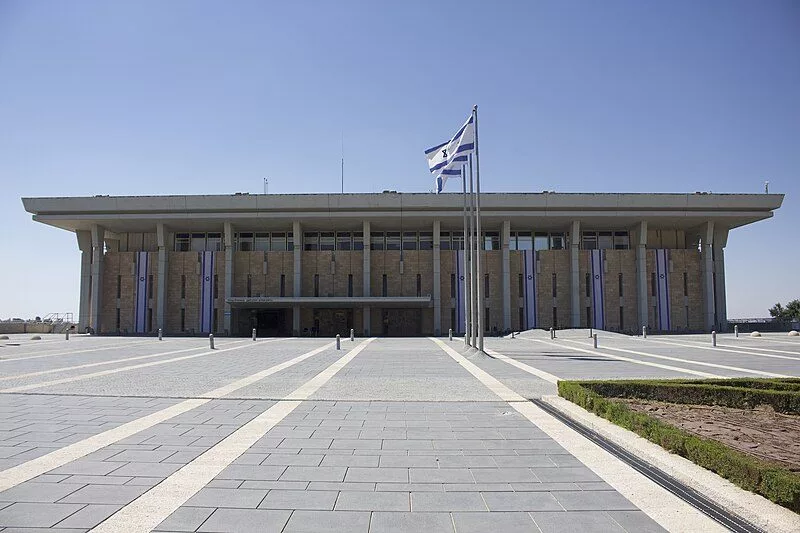
The Knesset Building/Clema12, CC BY-SA 4.0
by Emmitt Barry, Worthy News Washington D.C. Bureau Chief
JERUSALEM (Worthy News) – Israeli Prime Minister Benjamin Netanyahu’s coalition has submitted legislation to dissolve the Knesset and send Israel to elections, moving to seize control of a fast-developing political crisis triggered by ultra-Orthodox anger over the government’s failure to pass a draft exemption law for yeshiva students.
The coalition bill, filed Wednesday by Coalition Whip Ofir Katz, does not set a specific election date. Instead, it would require elections to be held no less than three months after the bill’s approval, while leaving the final date to the Knesset House Committee, which Katz chairs. The move appears designed to prevent the opposition from dictating the pace of the dissolution process and to give Netanyahu’s bloc maximum control over the timing of a possible national vote.
#BreakingNews #israelelections26
Coalition’s chair Ofir Katz (Likud), has submitted a bill to dissolve the 25th Knesset together with all coalition faction leaders. Elections are rolling. It means that they will not wait until October 27th, but will hold it earlier (Sept 1st… pic.twitter.com/3JY2khFoBz
— Tal Schneider טל שניידר تال شنايدر (@talschneider) May 13, 2026
https://platform.twitter.com/widgets.js
The political maneuver came one day after the ultra-Orthodox Degel HaTorah faction announced it would support dissolving the Knesset over the stalled conscription legislation. Degel HaTorah, part of the United Torah Judaism alliance, has demanded legal protections for full-time yeshiva students who have long received exemptions from mandatory military service — a deeply divisive issue in Israel, especially after more than two years of war following the Hamas-led October 7, 2023 massacre.
Opposition parties quickly submitted their own dissolution bills Tuesday and pressed Knesset Speaker Amir Ohana to hold an immediate preliminary vote. But Ohana declined to accelerate the process, leaving the earliest likely vote for next week, when the Knesset typically handles preliminary readings. Under Knesset rules, bills must clear a preliminary vote, committee deliberations, and three additional readings before becoming law.
If the Knesset is dissolved, elections must be held within five months of the vote, meaning Israelis would go to the polls no later than mid- to late October. Israel’s next election is already legally required by October 27, though ultra-Orthodox parties reportedly prefer an earlier date, possibly in September.
The coalition-sponsored bill was backed by lawmakers from United Torah Judaism, Shas, New Hope, Religious Zionism and Otzma Yehudit, signaling that the government’s religious and nationalist factions may be coordinating on a controlled path to elections rather than allowing the opposition to frame the government’s collapse.
Opposition leaders celebrated the development as evidence that Netanyahu’s government is nearing its end. Opposition Leader Yair Lapid declared on X that his camp was “ready,” while Blue and White chief Benny Gantz called it “the beginning of the end for the worst government in Israel’s history.”
Yet beneath the public drama, the political math remains complicated. The ultra-Orthodox parties may threaten Netanyahu, but they do not appear to have a realistic path to securing broad support for a sweeping draft exemption bill outside his coalition. The opposition is unlikely to concede to Haredi demands on conscription, particularly as military service has become an even more sensitive national issue during Israel’s multi-front war.
Some Israeli political observers believe the latest crisis may be as much about leverage and messaging as it is about immediately toppling the government. Dr. Assaf Shapira of the Israel Democracy Institute described the episode as a struggle over “status and framing,” with the Haredi parties needing to show their voters that they are fighting for Torah students, while Netanyahu seeks to delay or manage elections on terms most favorable to his bloc.
The timing could prove critical. Rosh Hashanah in 2026 begins on the evening of September 11 and ends at nightfall on September 13, while Yom Kippur begins on the evening of September 20 and ends on September 21. A September election window around the High Holy Days could become part of the political calculation, with ultra-Orthodox parties hoping to maximize turnout and strengthen their bargaining position in the next government.
For Netanyahu, the challenge is to hold his right-wing and religious coalition together long enough to shape the battlefield before the campaign begins. For the Haredi parties, the challenge is to prove to their base that they did not surrender on conscription. And for Israel, the looming question is whether the nation will enter another election season while still carrying the burden of war, security threats, and unresolved divisions over who bears the cost of defending the Jewish state.
Worthy News Analysis
The ultra-Orthodox parties are applying maximum pressure, but their options remain limited. They lack the votes to pass a broad conscription exemption without Netanyahu, while the opposition is unlikely to grant them the legal shield they seek for yeshiva students. That means even if elections are held, the Haredi parties may eventually find themselves realigning with Netanyahu because he remains their most plausible route back to influence.
Their immediate goal appears twofold: demonstrate to their voters that they fought over the draft issue, and position themselves for a stronger hand in coalition negotiations after the next election. A September vote, especially near the High Holy Days, could be viewed by Haredi strategists as a turnout opportunity that may improve their leverage in the next Knesset.
The post Netanyahu Coalition Files Bill to Dissolve Knesset as Draft Crisis Pushes Israel Toward Elections appeared first on Worthy Christian News.