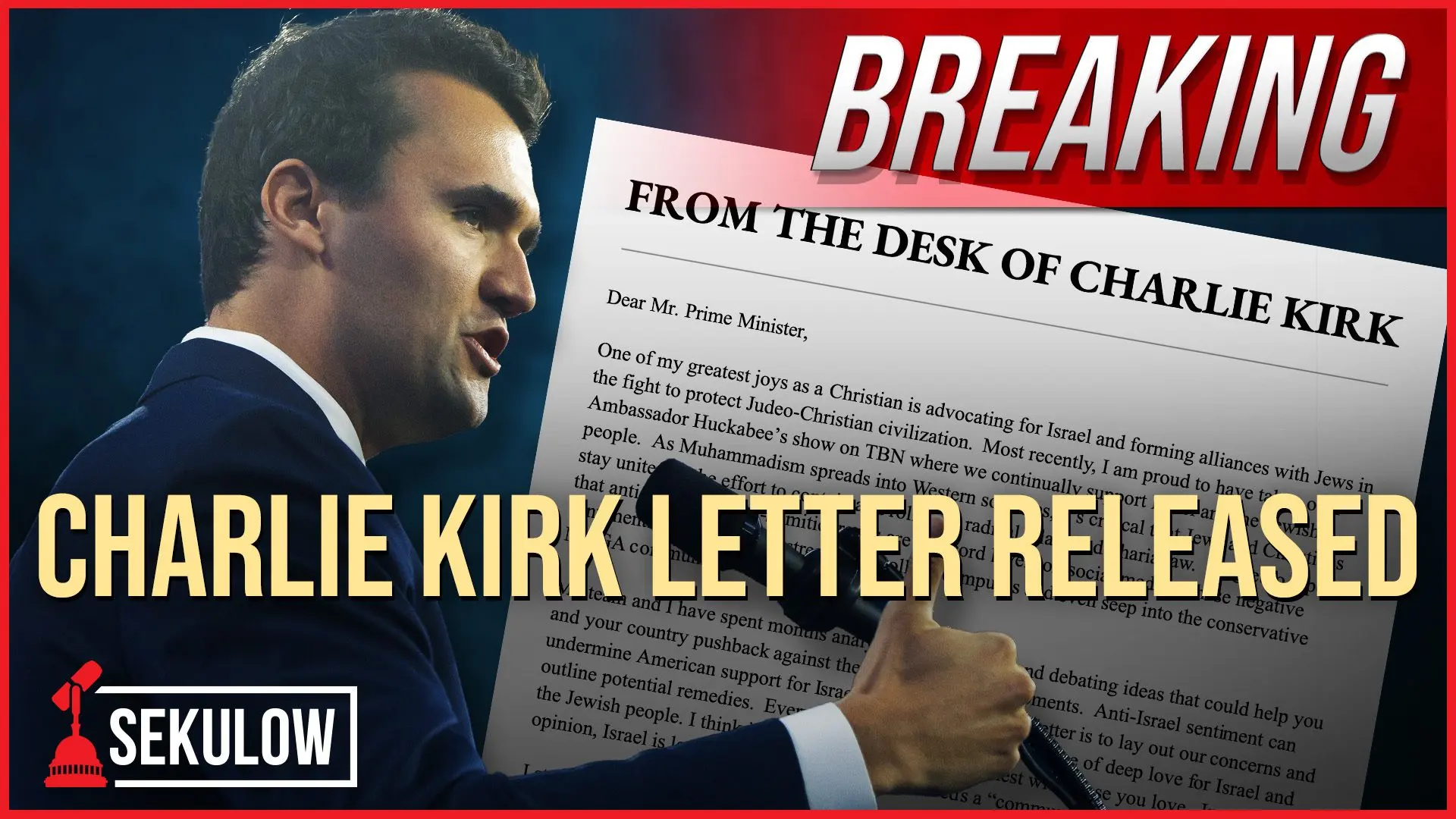

In this episode, we dive into the recent release of Charlie Kirk’s letter to Prime Minister Benjamin Netanyahu, unraveling its implications and the reactions that have followed. With Logan Sekulow and a team of experts, we analyze how this letter has stirred conversations across political and social spectrums, highlighting some misinterpretations along the way. As we discuss Israel’s ongoing PR struggle on the global stage, we come to understand the intricate connections between political influence and public perception.
SPEAKER 06 :
On today’s show, Charlie Kirk’s letter to Benjamin Netanyahu has been released.
SPEAKER 04 :
Keeping you informed and engaged, now more than ever, this is Seculo. We want to hear from you. Share and post your comments or call 1-800-684-3110.
SPEAKER 06 :
And now your host, Logan Sekulow. Welcome to Sekulow. We are going to take your phone calls today at 1-800-684-3110. A jam-packed show in the studio with me right now. My brother Jordan Sekulow is in the studio. Will Haines as well, executive producer here of the show. And then later on we’ll be joined by Rick Grinnell. and mike pompeo so you’re not going to want to miss any of that give me a call right now though if you can at 1-800-684-3110 or if you’re just joining us online share with your friends we are talking about the breaking news item which happened last night which was that A letter that had caused a lot of stir and a lot of controversy of what was going to be said that was from Charlie Kirk just from a few weeks ago to Benjamin Netanyahu. Now, Benjamin Netanyahu had referred to this letter and pulled out some selective quotes. And a lot of people, sadly, on the right, questioned not necessarily the authenticity of those quotes, but that you were getting the full picture. But the full letter was released, and what this letter really showed was that, look, I don’t want to put words into anyone’s mouth, but if you read this multi-page letter from Charlie Kirk, it lays out a pretty specific plan about how to get the American people back on the side of Israel as he saw that there was an issue coming, which we all have said, by the way, for years, that Israel… fails on the PR battle. And this is precisely what he wanted. And when you actually read this, I don’t think there is a second in here that makes you consider whether… I think I’ve said all of this on air before. Same. That he is wavering from his support of Israel.
SPEAKER 07 :
Different times in history of different conflicts Israel’s been in because we’ve represented Israel’s position at the ICC. We’ve always talked about there’s a difference in how Israel gets the two days of… The world’s saying, yes, what happened to you is bad, the rockets, and then they respond like any other sovereign nation and the whole world then starts to condemn them. But I want to just read the first part of the letter because of all these other influencers, I’ll name them out, Candace, Tucker, they were all saying this letter was going to be, oh, he was moving away. Let me read you the first paragraph. Let me ask you if you think Candace had no idea what this letter was or just lying, Tucker as well. Dear Mr. Prime Minister, one of my greatest joys as a Christian is advocating for Israel and forming alliances with Jews in the fight to protect Judeo-Christian civilization. Most recently, I’m proud to have taken over Ambassador Huckabee’s show on TBN, and I will tell you, because I’ve been on that show a number of times, and now he’s the ambassador to Israel, where we continually support Israel and the Jewish people. As Mohammedism spreads, and that’s, of course, radical Islam, into Western societies, it’s critical that Jews and Christians stay united in the effort to contain and roll back radical Islam and Sharia law. Here’s the part that we’ve been talking about that the Candaces and Tuggers tried to jump on is he was moving away from Israel. It’s the opposite. I regret to report that anti-Israel and anti-Semitic trends are at record levels on social media. These negative sentiments then flow downstream into college campuses and even seep into the conservative MAGA community. He goes on to say, basically, we need more support.
SPEAKER 06 :
We’re going to still wave your flag. Let’s create a coalition. Let’s get people behind it. We’ll break this more down when we get back. But this totally undoes a narrative.
SPEAKER 07 :
That’s just paragraph one.
SPEAKER 06 :
Yeah, this totally undoes a narrative that was being spun by sort of the far right, what they call the woke right, I guess what you’d say, influencers that were coming at this. And look, some of them are very popular. And I see in the comments, people are questioning even the authority of this letter. Now, of course, we’ve checked. A lot of sources have reported that this is accurate, that this is coming from real sources here. Nobody has said this isn’t real. No one has said it isn’t real.
SPEAKER 07 :
It would have come out immediately if it wasn’t.
SPEAKER 06 :
And I think this is a moment where we need to go, okay, question your sources, sure, but question also what you’re hearing. Because, again, if you listened to Charlie Kirk’s statements or something like that, they were taken in and out of context, whether that’s on Megyn Kelly, whether that was on Candace Owens, whether that was from Candace Owens or from Tucker. Sure, conversations were happening. But here is this letter that kind of proves the opposite. The PR battle for Israel has always been very tough. Israel does a lot of things good, but they have really stunk in terms of getting the mainstream media and to getting influence and everything to understand what they’re doing and why what they’re doing is right. We have said that. We have preached that gospel for years and years and years and tried to help as much as we can. But you know what? It actually is that little bit of a language barrier that happens. We’ll be right back. Welcome back to Secular. We do want to take your phone calls also at 1-800-684-3110 right now. Of course, we’re also talking about President Trump and Netanyahu were meeting yesterday. We did pretty much most of the show on that. But they released what would be their plan and their plan, and we talked about it. And it seems to be getting more traction than maybe we were going to potentially give it credit for. It seems like we’re headed towards some form of deal.
SPEAKER 07 :
We’ve got it. Big news out of the Palestinian Authority. The Palestinian Authority is welcoming this deal. And part of this deal requires the Palestinian Authority to basically stand down as well. Now, Mahmoud Abbas, who leads it, is 89. We looked it up. Looks decent for 89. He’s billions of dollars in corruption. He can go to Dubai. He could probably stay in the West Bank if he wants. But what they’re saying is new leadership. After that international community… Remember, Tony Blair’s been doing this for two or three decades. So he’s got a lot of trust on both sides.
SPEAKER 06 :
He’s not a young man either.
SPEAKER 07 :
He’s in his 70s. Although it’s not going to be much of an Israeli component. It’s going to be all Arab countries. So the citizens of Gaza, the people in Gaza and the West Bank… It isn’t like Israel’s going to be… It’s the opposite. Israel’s going to immediately withdraw if you accept these terms. And all they really have to do is stop fighting, give us back the people who are alive and the bodies that you’ve got, and you’re not going to be killed, you’re not going to be arrested, and the prisoner release… is an unbelievable concession by Israel. So if you don’t think that Prime Minister Netanyahu, all those people say he’s a warmonger and all those conspiracies about Jews, if he’s willing to release that many hardened killers to get to peace for the children of Gaza… that’s not a hardened hater of air.
SPEAKER 06 :
I saw a lot of people posting yesterday, and I’m pretty connected to that world, sort of the Zionist influencers, if you will. And a lot of them were just sort of like, you know what? If this is what it takes, this is what it takes. And most of them were not happy with a lot of the concessions, including me. That’s concessions. But they go, if this is what it takes to end it and to get the hostages home. What they were showing a lot was a lot of people saying… Say no to this. They’re showing the other side saying, say no to this deal. This deal is not a good deal. You’re not getting what you want here. It’s like, oh, so really it wasn’t about the children. It really was about Hamas and destroying Israel.
SPEAKER 07 :
You can demilitarize Gaza. And the West Bank, which has some still pockets of very radical… I mean, areas where if you went in as an Israeli, it’s different terror groups, but they’re there and they kill you.
SPEAKER 05 :
Well, in the last couple of days, they actually found a munitions factory in the West Bank that was owned by Hamas. But once again, that’s under the control over the oversight of the Palestinian Authority.
SPEAKER 07 :
Because Janine and some of those places, I think Hebron as well, like… The Palestinian Authority basically can’t even go in. The times I’ve been in the West Bank when Hamas was coming up, when they took control of the Gaza Strip, the police in the West Bank for the Palestinian Authority, who have a good working relationship with Israeli police forces, they were all masked. because of the same concerns like our ICE agents have here right now, which is that there’s enough Hamas operatives walking around that if they’re unmasked, they’re going to be killed in their place they’re protecting. So I know there are very good… and great Palestinian people because I’ve worked with them my entire career. And I’ve been praying for a moment like this. I wish it didn’t take so much loss of life and horrible attacks on October 7th and then the war that followed to get to even this discussion. But the fact that the Palestinian Authority is saying this looks pretty good, I mean…
SPEAKER 06 :
What happens, though, to the Hamas? I mean, they’re saying, yes, they have to say, I’m not going to be violent.
SPEAKER 07 :
Well, there’s going to be an international force there of Arabs.
SPEAKER 06 :
Yeah, true. It does feel a bit pipe dreamy.
SPEAKER 07 :
But remember, that international force is there until they’re demilitarized. But it won’t be Jews or Israelis, IDF, fighting back Hamas. It will be…
SPEAKER 06 :
arab countries it’ll be kind of like a un peacekeeping mission made up only of uh of people who speak the same language and follow the same faith and i’m hoping that this is a moment where the tide turns uh when you have the letter from charlie kirk coming out that kind of debunks the narrative that was out there saying that he was uh pressure being pressured to uh really turn on israel now you’re pressured to he wanted to turn on israel uh which is what they were saying that he was getting pressured not to uh when you have this full-fledged letter which i think we can break down even more and then you have this uh really a very moderate agreement coming out of the of israel uh one that you could say is uh like i said has a lot of concessions in it um it kind of starts changing that narrative and i was like i was watching the house of david last night i was watching that it’s like man this has been going on You know, for thousands and thousands and thousands of years, you know, in the fight for Israel’s safety. And I know some people will argue with me and say, different Israel, different time. But you know what? When you look at the struggles that were going on even then, not so different, not so different at all.
SPEAKER 05 :
and when you go back to this letter one it debunks what some of the uh conservative influencers like candace and tucker have been lying about or or making up about that one that you know he was changing his mind no this entire thing is actually how to combat the rhetoric coming from some of these influencers that have turned their back on israel and and and play into these wild thousand year old anti-semitic tropes and conspiracy theories but i
SPEAKER 06 :
just turned their back on Israel or said, you know what, that’s not an issue I care about anymore. I’m America first. I don’t care about what goes on in Israel and the Middle East. That is one thing. And I’m not for that either, but I can at least say that’s it. That is saying I no longer want to be affiliated with this political issue, war, and these kind of things. It’s when they start adding in all of the tropes and all of the conspiracy theories. and all the things that don’t just loop in Israelis. They loop in the Jewish people as a whole. And look, and I will tell you, from just the content I’ve seen, and I’ve seen quite a bit from them, it’s not that, we’re not, you know, bloviating here, that the right, this sort of extreme right, was starting this process. And looping it in, lumping it in with a lot of their issues with immigration, a lot of issues with a lot of things, support of Israel started coming in.
SPEAKER 07 :
Benjamin Netanyahu had to come out and say, we didn’t kill Charlie Kirk. And in fact, Charlie Kirk, how many visits he had made, he talked about this letter, the support, how he was trying to help Israel. And people said he was trying to steal the moment. No, he only had to do that because a bunch of people with huge microphones in the US were blaming Jews for killing Charlie Kirk and specifically Netanyahu.
SPEAKER 05 :
And then gaslighting the American people or their audience when, oh, why would he say that? Why would he have to come out and say that? No one was saying that. It’s like, yes, you actually were inferring that. You directly were. And this is a part I think, once again, it goes to what you and Jordan and everyone at the ACLJ has said for a long time on this broadcast and in our work with ACLJ Jerusalem about Israel needing to find a better way to present themselves to the world, especially to the American audience. But this even pushes back that, you know, the Israelis were trying to buy him. That’s been a narrative that’s been pushed disgustingly after his death and assassination. But it says he gives some examples of things he’s hearing at his events from conservatives that are coming to his events. And then he says above are just a sampling of the negative Israel Jewish comments and questions I confront on college campuses. I am accused of being a paid apologist for Israel when I defend her. Does that sound familiar? However, if I don’t defend Israel strongly enough, I’m accused of being anti-Semitic. I know you’ve got a seven-front war, and my kvetching pales in comparison. but I’m trying to convey to you Dennis Prager played a huge role in his life and he mentions that and he says but I’m trying to convey to you that Israel is losing support even in conservative circles this should be a five alarm fire and then instead of saying so you deal with it I’m out of here he gives this is a seven page letter examples and plans like here’s some i know these are unsolicited recommendations but my team and i suggest this to you if you’re open-minded about a communications reset starts giving him a playbook of how to speak to american conservatives because as you mentioned sometimes it gets lost in translation when you’re trying to speak to an american conservative audience and unfortunately some people with big platforms and big microphones as jordan said are going to tell lies to get their point across in their dollars people think
SPEAKER 07 :
APAC does this? APAC plays very down the middle. It’s a bipartisan group to just try and keep U.S. support from Israel by both Republicans and Democrats. They’re not the right group to be doing this for a specific conflict. What he’s saying is we need, which conservatives, we’ve always known this is why we have CPAC. It’s why we have the Leadership Institute. Prager is doing the education. He was saying you need to put together these surrogates who aren’t you.
SPEAKER 06 :
yeah and educate us on and so we can educate you too on messages that will actually resonate to the people we’re talking to in america understand we’ve been on those calls and emails with people israel for decades about this conversation this is an ongoing conversation because israel somewhat knows they lose this battle it is does get lost in translation because a conservative israeli is very different than a conservative uh american They have similar political views, but it’s definitely not one-to-one. It’s not one-to-one culturally. It’s not one-to-one socially. There’s a big difference. So you have to figure out how to talk to people about these issues. I am going to address something real quick as we go to break. There’s some people in the YouTube chat saying they want to super chat to help support this channel and everything. What I’m going to encourage you to do is actually go to ACLJ.org. and make a donation we’ll know that if it’s coming in in this hour that it was because of this show and know that we appreciate that that’s tax deductible that helps us out a lot more more money gets to the right people if you make that donation through aclj.org you can cut out youtube as a middleman you know google takes their cut and all that if you do super chat nothing wrong with doing a super chat we appreciate it but if you’re just looking to financially support the organization and this show go to aclj.org if you do it today know right now if you’re doing it during this show we’ll know it’s for this we’ll know it’s for this reason and look for all the other people who are on there the haters on there we understand too you know what you’ve been brainwashed a little bit we’ll do our best to help fix that call in 1-800-684-3110 either side i’d like to hear from you yep very back Welcome back to Secular. We still would love to hear from you, by the way. Phone lines are completely open, I’ll be honest with you, and it’s a good time to call.
SPEAKER 07 :
If you disagree, unless you start screaming and calling us names, we’re not going to cut you off. If you can do it in a way that we’re just going to have a conversation, you don’t have to agree with everything we’re saying or everything that Charlie Kirk was writing in this letter, but I did want to read this one part because… again, this idea that he was somehow criticizing Netanyahu instead of saying, no, here’s how I think we can actually help more. I’m not going to stop doing it, but I think I can do more since I’m getting 50% of my questions on Israel now at these campus events. And he said, Israel never asks American troops because Israel does its own fighting. I suggest the same approach for the information war. You lead talking to Netanyahu and people like me will follow. That doesn’t sound like someone who was reconsidering his support for Israel or even his support for Netanyahu’s policies. He is not against the war, the conflict. He knows that they try to clear people out. He knows the human shields, as he says. It’s that regular people don’t even understand what a human shield is.
SPEAKER 06 :
We looked at the multi-point plan. We were talking about this yesterday, and one of them was the demilitarizing, obviously, and the disarming of Hamas. Like, is that anything short of just leveling what is left because of knowing how much the tunnel systems are and all that? I mean, that is the part that’s tough.
SPEAKER 05 :
Well, and to that point, and that is one reason you’re going to end up getting Qatar and you’re going to end up getting the UAE and you’re going to end up getting Saudi Arabia all pushing Hamas as hard as they can say, you better take this right because they will be doing the security force because let me tell you, they’re pretty tough guys. It says funding from the Arab and Muslim countries for the new administration in Gaza and for reconstruction and development of the enclave. So once again, this deal that President Trump put together is very businessman minded.
SPEAKER 07 :
Remember when he was mocked when he said we can make this like another Mediterranean? Right. If you actually look at the Gaza coast and you see even Tel Aviv, they’ve got some even clearer Mediterranean water that looks more like almost like the Greek Mediterranean. They have warm water, tons of area for warm water ports, just like Haifuk, because they’re on the same. So much potential, and he was mocked. They were like, oh, put a Trump hotel there. First of all, we want the Muslim world to invest. If there was a Trump hotel one day in the Gaza Strip, great. You know what that means? You, me, when we go to Israel, now we visit the West Bank, we can actually finally go visit some of our clients that we’ve represented in Gaza, and I’d be happy to do so.
SPEAKER 06 :
It also just means that the safety and security is finally at bay. Even during the good times. It was always risky.
SPEAKER 07 :
And Israelis would love to do business with Gazans. Remember, so many of those people who were killing those people on the kibbutzes were people the kibbutzes were smuggling across the border and working on their farms and communities. That’s how they knew how to get there. So Israelis have never had an issue. with employing palestinians in fact i don’t know how many come in a day from the west bank but it’s it’s like a hundred thousand plus um so and that hasn’t stopped so there’s and that doesn’t sound like apartheid no and and of course there’s many arabs israelis inside the government of israel as well uh who are muslim and i think again it doesn’t flow much the other way And I think that’s okay.
SPEAKER 05 :
Well, here’s also the point to this redevelopment as well that’s in this plan and why the neighboring countries will be on board. You think of the Jordans, even the Egyptians that have economic prowess as well to pour in. We talk about the issue of because the UN schools have been training these children in Gaza. to become Hamas fighters. We know that this is the fact. It’s been Hamas propaganda that there were teachers from the UN schools that were participating in October 7th, that were harboring the terrorists in their homes, that were keeping hostages prisoner in their homes. When you have a complete culture shift where it’s redeveloped and it gives children that never had opportunity, their only opportunity came from what they were indoctrinated with from the schools to hate Jews and to hate Israel. as well as no real economic pathway to ever get out of wherever they were. When there’s development and there are jobs and there’s an actual economy and all of the resources coming in aren’t being stolen by Hamas to be used in terror tunnels and to feed their fighters. Right. That is a way that people start to change their outlook on life because they’re no longer. Now, it’s not easy, but they once they have an opportunity as opposed to only facing death and fighting for Hamas, things get a lot different.
SPEAKER 07 :
major travel hubs are able to open and major ports are able to open those are high-paying jobs even in those parts of the world so are they hard jobs tough jobs yeah but they’re a lot better than having no job or being forced into fighting for a terror group and if you saw a video out of last week if you don’t do exactly what that terror group wants uh they throw you down in the who they threw down the middle of the street, kick them around like they’re an animal, and shoot them in the head. And they’re laughing about it. So I think it’s going to be very different, Logan, when it’s not the IDF there, but it’s the Arab militaries. Because let me tell you, they get the mindset better, and those guys are tough. So they’re not going to take that.
SPEAKER 06 :
What’s interesting, that story of Rami Ayyad we’ve learned is always sourced when you talk to AI about Christian persecution in Gaza or West Bank.
SPEAKER 07 :
It was really the beginning of how bad it got.
SPEAKER 06 :
When you say, was it? They go, oh, yes. And it refers back to it. Grok does it. If you even say, are Christians persecuted in Gaza? It will go back to that case. Yes. It’s just pretty interesting because that’s the one we talk about.
SPEAKER 07 :
I thank God for Israel that we were able to get that family out. Yep. And, you know, they did that the day before Operation Cast Letters.
SPEAKER 06 :
This is a family that we spent time with, had dinner with. Many times.
SPEAKER 07 :
I’ve brought student groups to meet. And you know why? Because I wanted them to see when we were in Israel that across the border in the Palestinian territories in the West Bank, there are a lot of believers like you, a lot of Christians, a lot of good people who want to live in peace and we’re just in a bad situation. And Israel… Two hours before a war began, made sure her and her children were able to cross the border. I was on the phone with a Hamas guy and he said, there is no way this border is opening. I don’t know why this woman’s here, but everybody keeps telling me, I’ll let her walk across fine. And then when she got halfway, they have to close their door Israel appeared, they weren’t there before, opened their door and I remember getting a phone call, it’s Christmas day and we were there. Literally when we landed, the war in Gaza had begun.
SPEAKER 05 :
So they care that much about one family. And that points out, it destroys the narrative that they are keeping Gazans in. These were a Palestinian family. The husband and father of the kids was brutally murdered In the streets for running a Christian bookstore. The only one. I mean, talk about courage to even have that in Gaza.
SPEAKER 07 :
There’s something called the Palestinian Bible Society. It was in Gaza, East Jerusalem, and in the West Bank. And it still is in those two places. And are they always saying that they think that everything Israel does is perfect? No. But do they share a Christian faith? Yes. Which means they don’t see violence as the answer. They understand that they have leadership that… is preventing actual dialogue. But what is so key is that I think this plan also elevates those people and allows them, potentially in the future, and as Christians, this is wonderful for those communities, to preach the gospel again, where people don’t have to fear that they’ll be executed in the street for even opening up a Bible.
SPEAKER 06 :
That’s right. Hey, phone lines are open for you. As we come to the second half hour, I want you to join with us in this conversation. Of course, support the work of the ACLJ if you can. You heard about our decades-long support. What did you say? I mean, this is the work we do every single day. Every day.
SPEAKER 07 :
We don’t talk about it all the time. We do this work for those people every day. We, I think, have represented more individual Palestinians than Israelis.
SPEAKER 06 :
That’s probably true. Go to ACLJ.org right now. Support our work. We have a second half hour coming up. If you don’t get us on your local station, find us broadcasting live 12 to 1 p.m. Eastern time on ACLJ.org or YouTube. And you can obviously find us archived later on. Have a good podcast. Be right back.
SPEAKER 04 :
Keeping you informed and engaged now more than ever. This is Sekulow. And now your host, Logan Sekulow.
SPEAKER 06 :
Second half hour coming up. Jordan Sekulow in studio. Will Haynes in studio as well. We’re going to have a packed second half hour here. Rick Grinnell’s joining us in the next segment, followed by Mike Pompeo after that. We’re going to talk about the agreement that looks like it may be going through between not only America and the plans they put through BB&N and Yahoo, but of course that would be a a really the end of the war i mean you could say it’s that aggressive that’s what it says in the a permanent ceasefire i mean that’s what you would assume that means the end of the war and if that is planning to happen we’re also talking about the charlie kirk letter that was released of course it was a controversial moment when uh benjamin and yahoo said some quotes from a letter he’d gotten from charlie kirk earlier in the year a lot of people called foul on it, said that that’s not what Charlie really meant by it. He was writing this letter because he was showing that he was turning on Israel. And after reading the letter in full, you cannot take that as any kind of truth. This was someone who just was saying the obvious and saying the facts that we had as well to the Israeli government, which we’ve been involved in with so many years, which is just Israel often fails on the side of PR. They often lose. and getting new people on board and how, what can we do? What can we do to help? Whether that’s in the church or whether that was, we always said it was in the church. Now it was within the MAGA movement. And how do you make sure that they stay on board? That’s what he was concerned about. Of course, we’re all concerned about that. That being said, in the next couple of segments, we’re not going to have time to take a lot of calls. So let’s go ahead and take these calls that are coming in. Roberta’s calling in Colorado. Roberta, go ahead.
SPEAKER 01 :
Hi, this is my question. I heard President Trump say there will be no Israeli citizens in Gaza. It will be governed by Palestinians and other countries. Am I the only one that heard that?
SPEAKER 07 :
I know that the force that will eventually go in. Now, that’s like part three. We’ll transfer from the IDF withdrawing. So that would mean Israeli military out. Those are the only Israelis I know that are there. So it’s military. So they would be out once the international forces, which is really a regional force of other Arab countries, goes in and is able to set up. and keep things under control the IDF will then keep pulling back keep pulling back then ultimately leave Gaza I don’t know if he said that there will never be Israeli citizens allowed in Gaza maybe not Israeli run government but that’s what I think he was trying to say this is not going to be because there was a talk of that Israel yes what is going to happen is that Israel will withdraw when the Arab countries in this joint force are able to coordinate with the IDF keep the security at a certain level and then Israel continues to withdraw and then of course Hamas has to do the release of the living hostages as well as the bodies and Israel after that fully pulls out.
SPEAKER 05 :
Yeah. And Roberta, to your point, I did pull I watched the whole thing and I also pulled up the transcript. I’m not finding that exactly. But what he’s saying is that the at least what I’m looking at and remembering as well is that it won’t be the Israelis that are going in and redeveloping. doing the security, because that is the big concern. And honestly, it is the better thing for the PR of Israel that it’s not an occupation of Gaza again. So I think the goal, obviously, in any sort of peace would be that the two sides can live peacefully next to each other and cooperate and have a an actual neighborly relationship in this situation which is not something that is in the history of Israel been something with Gaza and Israel so to that point I don’t think there was that direct no Israeli citizens are allowed in.
SPEAKER 06 :
All right let’s continue on well you only got one minute all right yeah stay on hold Pat. And stay on hold, and we’ll make the decision whether we’re going to be able to take calls anymore coming up in the next segment. So just stay on hold for just a minute. We’ll do our best to get you if we can. But we got Rick Grinnell joining us. We also have Mike Pompeo joining us. So it’s going to be packed. We’ll do our best to get to some calls. If you want to support the work of the ACLJ, I encourage you right now. If you like this show, we’re not funded by major sponsors. You may hear sponsors. If it’s on YouTube, that’s a very small amount of money. If it is through the radio or what you see on other networks, we don’t get any of that. Often we pay to be on. You may say, why do we do that? Because then no network can tell us what to do. We’ve seen censorship come in in full force in mainstream media. They can’t do it to us. But that’s only because people like you support the work of the ACLJ. So I encourage you, if you enjoy what you see here, be a part of this group. Go to ACLJ.org right now. And of course, you can subscribe as well, however you get your podcasts. Welcome back to Sekulow. I want to kick this segment off. Rick Grinnell’s joining us, but with a call. I want to go to Ann in Pennsylvania. Ann, thanks for holding. You are on the air.
SPEAKER 02 :
Oh, my gosh. Thank God. Oh, you guys are such a blessing, what you’re doing. There’s so much on my heart, and I just wanted to talk about this whole Gaza thing, what you just recently discussed. I totally agree with what the president is doing and the situation with Gaza, but I just, with the whole, you know, aspect of people in our own party who are actually, you know, they’re saying things about Israel, accusing Israel of financial this or whatever that, you know, and that somehow, but not also, even if that was remotely true, but they’re not summing it up with, but Israel is still our spiritual sister nation. You know, we have always supported Israel. And then quickly, I also wanted to say with all of this, oh, it’s all about just, you know, criticizing the government and what Netanyahu is doing. Fine. You have a criticism, but don’t throw Israel under the bus. Israel itself has been defending itself against this radical, extreme element of For many, many, many years. We could even argue going back hundreds of years, if not thousands.
SPEAKER 06 :
Absolutely. And I think that that has been an ongoing thing with the ACLJ, as we’ve always been saying that. And look, there have been times where there’s been governments in place that we agreed with more or less in Israel, but it’s not necessarily about that. Look, it’s similar. to how you’d feel about your own country with America. Obviously, we always want America to thrive, even if it’s under an administration that we don’t necessarily agree with. It’s not like we’re sitting here wishing for the worst. I think that’s hopefully how we feel about the entire world. We’re joined now by Rick Grinnell. Rick, there’s obviously a lot going on. We are talking about that multi-point plan that came through yesterday with President Trump and Prime Minister Netanyahu. I want to get your thoughts.
SPEAKER 03 :
Look, this is a classic peacemaker strategy from President Trump. I think he’s been frustrated. He’s articulated that he’s been a little bit frustrated about not being able to find solutions faster. And yet this is a plan that Steve Witkoff and Jared Kushner have worked very hard on. And it’s a good solution. I mean, Hamas would be ridiculous to not immediately grab this plan. We need to be able to have the United States of America doing diplomacy, bringing people into the room, strong arming people towards peace. And this is, I think, a President Trump strength.
SPEAKER 05 :
Rick, when you look at the plan and you see something that’s maybe different, and once again, you see the president taking different strategies, listening to different people, not the same people within the establishment diplomacy state that we have here, and taking things where… The neighboring countries will provide security and do development of Gaza and things of that nature. It has that economic piece that I feel like is so lacking from so much of our diplomatic work a lot of times. A lot of times it’s all about preventing war or ending war and not the development, the economy. And when you see that, how quickly… The Arab neighbors, many of which have already signed on to Abraham Accords, are willing to, yeah, we’ll step up. We’ll do this. It can really change the tone and also can put that pressure on Hamas because then they’ve got no one really backing them if they don’t take this anymore.
SPEAKER 03 :
Well, I think you hit it on the head. The uniqueness of President Trump on all of these diplomatic endeavors is that economic peace. He’s a businessman. He knows you can’t have politicians and diplomats sitting in a room trying to come up with political solutions and words if it really doesn’t matter to the people on the ground. And what President Trump has been very good at is focusing on how do you get the people to support it? It’s not really, the politicians are always people who just go along with what the people want. And so appealing to the people about economic development, future peace, jobs, the economy, their family hope, right? Being able to give a job to somebody means giving hope to the family. And I think that’s what President Trump does really well. I saw him do it firsthand with Kosovo and Serbia. We’ve seen it in Rwanda and the DRC when you talk about mining. and critical minerals that’s about jobs that’s about economic development that’s just not asking one side to like the other or to issue a statement that you’re going to get along that’s all politics and words economic incentives jobs hope for the family that’s what’s going to move people to support peace plans
SPEAKER 05 :
Rick, and you bring up Kosovo and Serbia, something that is near and dear to your heart, something that you’ve worked very hard on. And I think that even that aspect of what President Trump was able to accomplish that you worked very hard with as well, people may not realize, you know, they think of how Gaza and Israel, so much hatred, so much hostility. the Kosovo and Serbia so much hatred and hostility throughout generations that that is a very remarkable thing that’s just not the headline that everyone is reading all the time or debating in public or marching about on college campuses but there are a lot of parallels to that type of negotiation and what we see here.
SPEAKER 03 :
Yeah, there’s no question. It’s decades of war. It’s families who have been experiencing tragedy, family members who have been killed by the other side. It is a generational hatred because of fear and because of tragedy and because of war and death. And so it’s difficult to get past that emotions. One of the things that I did was come in right up from the start and just say, look, I’m not, filled with the emotions that you are on both sides for Kosovo and Serbia. I don’t understand the generational tragedies that you both have felt. And so I hope you understand that there’s a value in me looking forward, just like I have to understand that there’s a value looking backwards and trying to understand the pitfalls. But the only solution is looking forward and appealing to the next generation. That is the only way that you’re going to get through the emotions of tragedy like this.
SPEAKER 07 :
You know, Rick, I actually wanted to read from the Palestinian Authority statement that they issued, which we know this is their official news agency, Wafa News, and they said, quote, they welcome President Trump’s sincere and determined efforts to end the war in Gaza and that they have affirmed our desire for a modern, democratic, and non-militarized Palestinian state committed to pluralism and the peaceful transfer of power. So right there, you’ve got, you know, the Palestinian Authority, one half of this puzzle is, I mean, and I think, Rick, a lot of that has to do with the fact that Israel said it’s not going to be us occupying and kind of making sure that Hamas demilitarizes. It’s going to be fellow Arabs and Muslims in a joint force. And the Palestinian Authority is ready to move on it.
SPEAKER 03 :
Well, this is where the regional players, Egypt, Jordan, and others really have to step up and put pressure on the Palestinian Authority. My first thought is I’m wondering if Abbas issued that statement from Paris where he’s been sitting. The Palestinians have had a leadership that was elected in 2005 to a five-year term. So I don’t have great faith in the Palestinian leadership. I think that’s part of the problem. And so we really need to have the regional players step up. But again, you can’t do that and just talk about politics. You gotta talk about hope. and economic development and why families are going to want to embrace this because it is going to be an economic plan that’s going to allow them to stay in the neighborhood, in their home for future generations because they’re able to have a job and support their family.
SPEAKER 06 :
Yeah, Rick, I think that is one of the problems I see. And look, our listeners are saying, and I see in the comments, I was talking to my wife about this yesterday. Of course, most of our gut jump reaction is, oh yeah, like they’re going to stick to this. Like this is a play. These are, these are not always the case, but this is a little bit different. Like you said, if we focus on hope and, At least there’s some potential for positive outcome when we’ve been dealt with really death and destruction for the last number of years.
SPEAKER 07 :
If we can get that international force in and the IDF out, even that step. Even Tony Blair. That’s not getting all the way there yet. Even that step would be huge.
SPEAKER 03 :
Yeah. Look, I’m really comfortable with the public being skeptical and complaining about, oh, they’re never going to do this. And, you know, if you’re a member of the public, if you’re listening, you have that right to be extremely skeptical. That’s your role. But I hope you understand that people in government positions, diplomats, cannot be this negative. We have to embrace hope. We have to keep trying. We have to be smart about what we put forward. But we have two different roles.
SPEAKER 06 :
All right, Rick, thank you so much for joining us. It’s always great to hear your insight. And it is a very interesting time here at the ACLJ. And I want to make sure everyone out there understands that we have been fighting these fights for so many years. I mean, decades upon decades when it comes to Israel. And understand that we get whether you’re skeptical. We’re skeptical, too. We’re always going to be looking forward to what could possibly happen, but making sure we keep ourselves balanced in reality as well. As Rick said, we can have hope. We can pray for the peace of Jerusalem, pray for the peace of Israel, and even pray for the peace of Gaza. We would love to see the war end. And look, if this is what it takes, like I said, my hope is that even though looking at some of these events, concessions and feeling bad about them and don’t feel like they’re right you go you hope president trump and prime minister netanyahu have the right intentions and i really know what’s going on and i will put my trust somewhat in that that being said we’re going to continue on next segment we’re going to be joined by mike pompeo you’re not going to miss that uh let’s tell pat unfortunately i don’t know if we’re going to be able to get to pat on the air today uh so we’ll have mike pompeo coming up tell him to call back tomorrow we’ll do our best to get him up front we’ll be right back on cyclone Welcome back to Secular. To wrap up today’s show, we’re joined by Senior Counsel for Global Affairs, Mike Pompeo. Secretary Pompeo, obviously, this is coming after. We know your work with the Abraham Accords that have been brought up now an endless amount of times, I feel like, in the last 24 hours, 48 hours. As a deal starts to maybe come into fruition between Israel and… And Hamas with somehow the U.S. involved with the PLO, the Palestinian Authority involved with it feels like Tony Blair involved. They’re throwing out all these people that are going to be involved in this potential new leadership. But with that being said, the president has given Hamas three or four days to decide on this peace deal. The clock is now ticking. I just want to get your thoughts on. where things stand and the deal in general, because it’s someone who has worked there. Like I was telling our last segment, I said, look, I told this to my wife and her first reaction was, you know, they’re never going to go for it because that’s somewhat what we’ve been trained to believe and trained to have a little less hope than maybe we should.
SPEAKER 08 :
Well, look, the Palestinians have continuously for decades now rejected proposals that would have been good for their own people. This is another example of that proposal that is good for them. I hope they’ll sign up for this. I hope they’ll say, yes, this makes sense. And then maybe even more important than saying yes in this moment, that they’ll actually deliver against this because these are serious commitments, right? You have to return all of the hostages, both those that are still alive and those that have been deceased. They’ve got to disarm. They’ve got to declare that they’re going to recognize Israel. This is something that the leadership, because frankly, it’s being driven by Iran. The leadership in, whether it’s the Judea and Samaria or in Gaza, has never been prepared to do that. So they’ve never wasted an opportunity to blow an opportunity. I hope they don’t blow this one. And my second idea here is, This strikes me very much as what President Trump did with Iran just a couple of months back now. Right. He gave them a window. He gave them a time and said, if you don’t do it, we’re going to go. We’re going to go self-help. We’re going to go solve this problem on our own. In this case, just as in the last, the Israelis went and did a lot of the work. And in this case, they’re prepared to do that again. I hope not only Hamas, but Hezbollah sees that this this path towards peace is in their best interest and they execute on an agreement that President Trump has now brokered.
SPEAKER 05 :
We see kind of a tale of two diplomacies this week where earlier last week you had the UK, France, Australia, Canada decide in kind of a Michael Scott way, we declare a state of Palestine. And with nothing to it. Now you have this other side of it where there’s a real plan. It’s a tough plan, I think, for both sides. There are hurdles to it that… You wouldn’t have been able to see even a few years ago. But I think also I want to get your take. What makes this different is the work that you did with things like the Abraham Accords, where there weren’t partners in the region with Israel that could have done it this way and ensured the security of the Israeli state. now that there are the Abraham Accords, many of these people that would be going in, so Israel doesn’t have to be an occupier of Gaza, can help redevelop, ensure security. And these are now people that are diplomatically friendly with the state of Israel, which never were before.
SPEAKER 08 :
Yeah, that’s spot on. Now, this is a corollary. This is a follow-on to all the hard work that went into building the Abraham Accords now, goodness, six years ago. All that work is now paying off with creating a real opportunity for the people of the region, not just the people in Israel, not just the people in Gaza and Judea and Samaria, but for the entire region. I think you’ve precisely got it right. This could not have happened but for that, and but for the remarkable leaders, right? Whether it’s President Trump and Mohammed bin Salman, Mohammed bin Zayed in the Emirates, uh the leadership in israel right all prepared to do something that’s hard this is hard this was hard for prime minister nate yahoo there are many that are in his coalition that think this deal is not sufficient it’s not good enough and are opposing it so this was politically difficult for him but i think he has confidence that the united states will continue to stand with them be with them and gives the space for exactly this kind of an outcome look if you can actually not only get this deal but execute it over the coming months and years this would be an outcome that is absolutely lovely for every human being in the region
SPEAKER 07 :
It changes the region, Secretary Pompeo, for so many people, both Israelis and Palestinians, including Christian Palestinians, who are sometimes facing severe persecution, especially in Gaza. Some tolerance in the West Bank, depending on what city you’re in and what terror group is operating and holidays are going on. But, you know, so the long term impact, not just for the people of Israel, but for the people of Gaza, for the people of the West Bank and for those Arab nations surrounding them, the ability for potentially new warm water ports and again, businesses, it could change the entire Middle East.
SPEAKER 08 :
This kind of agreement would be truly historic if it’s executed. You make a really good point. There are Christians living in Judea and Samaria. There are Arabs living in Israel. This is not about faith. This is about people understanding that sovereign nations matter, that Israel is the Jewish nation and has the right to be there. It’s been there for an awfully long time, and it’s going to continue to be, and accepting this as a rational basis to move forward. And if you can build on that and having the Gulf Arab states prepared to participate alongside the United States at providing security guarantees for the Israelis. This is a powerful change. You talk about energy, you talk about ports, you talk about commerce, the lives of the people. You’ve got these protesters on these campuses saying stupid stuff, saying, no, we want Hamas to still be in control in Gaza. This would be an outcome that would stand that on its head, put leadership in place, a governance model in place that would really deliver what it is those students claim they really want, better lives for the people in those regions. I pray that we can get to yes on this from all the parties and then that the parties will work diligently towards executing against what will be a very difficult agreement to implement and execute. But lots of folks will have eyes on and be working to do that.
SPEAKER 05 :
Mr. Secretary, final thought here. And this is something we talked about yesterday on the broadcast that last week at the end of the week, Bill Maher was talking about Nigeria on his show, real time. Something that I just want to acknowledge for our audience and for you, the hard work that you did as Secretary of State that we fought for as well, of pointing out the persecution of Christians in Nigeria. You listed them as a country of particular concern. because of what Boko Haram and these terror groups are doing against Christians. And it’s not something that gets talked about enough. It’s something we advocate for here that you fought hard for as Secretary of State. And when you’re starting to see people like Bill Maher that’s saying, why is the media not covering this? This is clearly a genocide. It’s sometimes thankless work when you are fighting for Christians in places aren’t getting. But when you keep doing the good fight, it does get recognized and hopefully we can make a change in places like that too.
SPEAKER 08 :
I’m going to say something I don’t say often. Kudos to Bill Maher. Look, I must say the ACLJ has been just relentless in fighting for Christians all around the world. And your point’s well taken. It doesn’t make the news so much. It’s not in the headlines in the same way that what we see in Gaza taking place is in the headlines. But it is really important to protect Christians and their religious freedom in places like Nigeria. where they have not had that is something that I was proud to work on alongside you all at the ACLJ for the years I was Secretary of State. And that’s true for Christians in northern Iraq and many places that often go to unnoticed. We can deliver better outcomes for those Christians. And I pray that we all stay at it in spite of the fact that it is sometimes not rewarded, not in the headlines, but it is important, noble work. And that’s a blessing that the ACLJ stays at this.
SPEAKER 06 :
Secretary Pompeo, thank you so much. Thanks to all of you who have been watching today. We appreciate it. If you’re just catching the end here, you can obviously go back and watch the rest of the show on ACLJ.org or however you get your podcasts on YouTube. There’s over 500,000 people that join us on YouTube. That’s 524,000 subscribers currently. Let’s get that to a million. Let’s march to a million. Be a part of that right now. Hit the subscribe button if you haven’t yet, or go to our YouTube channel, ACLJ, official ACLJ. Do it today. Be a part of it. And of course, if you could donate, great time to do it. Keep this show on the air. Keep us in court. ACLJ.org.