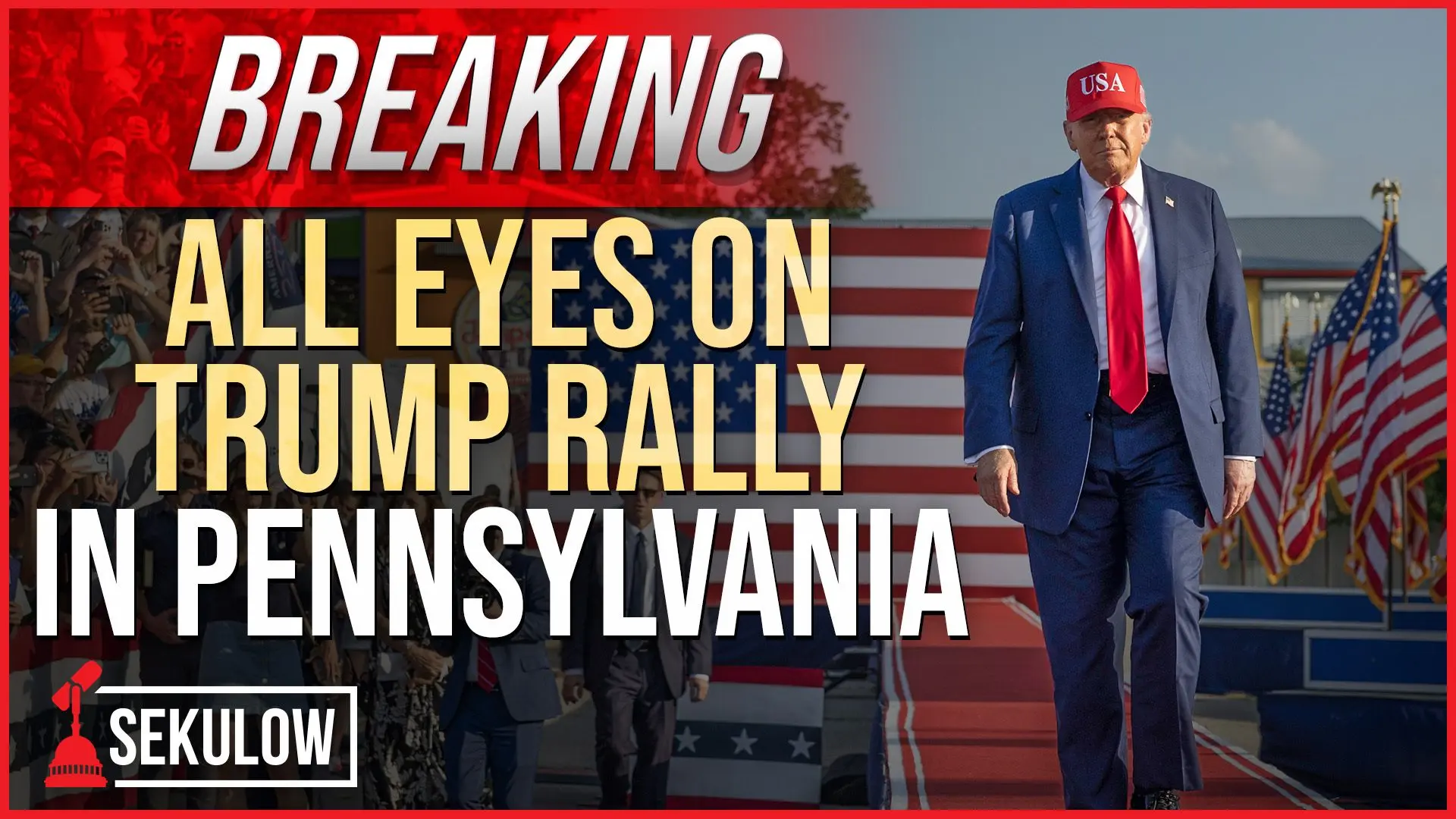

The complexities of economic recovery are front and center as we explore the narratives surrounding affordability and the potential for an economic reset under the Trump administration. Special guests join the Sekulow crew to discuss the calls for conservative policy unity, the challenges state legislatures face in implementing effective solutions, and the pivotal role of state attorneys general. Hear how global conservatism is on the rise and what this could mean for Europe’s political landscape.
SPEAKER 04 :
On today’s show, all eyes on President Trump as he heads to Pennsylvania for a rally on the economy.
SPEAKER 08 :
Keeping you informed and engaged, now more than ever, this is Seculo. We want to hear from you. Share and post your comments or call 1-800-684-3110. And now your host, Logan Sekulow.
SPEAKER 04 :
Welcome to Sekulow. Phone lines are open for you at 1-800-684-3110. 1-800-684-3110. We got a packed show. We got people joining us from Washington, D.C. We got Rick Grinnell joining us a little bit later. And again, we got a lot of topics to hit. And of course, one of the main topics of the day seems to be when you start flipping around the station, what’s everyone talking about? They all seem to be talking about this morning. Of course, we’re going to address it as well, which is affordability, the economy. And this is because President Trump will have a major event tonight, a rally, if you will. I guess in celebrating the economy. We’re going to find out more about that. We do know that this is still, you know, pretty early in the process of an economic fix. There have been some pluses. Of course, they are touting the eggs dropping in price. And that became a huge deal last year. We were talking a lot about eggs. The eggs seem to be get off the news. But hey, eggs did drop. But look, I think we’re also now seriously heading into one year down as President Trump, as president. And look, when you know you only have one term as president, I think things do change. The expectations change. Your goals, your presidential promises, your promises in the campaign start to be adjusted. Look, I always say you can give a year. where you are blaming the other president because you are having to work your way out of a pretty big hole. Always, that always is the case. And I think that there’s truth to that. You got to give time for there to be an economic reset of any kind. And Will, as we’ve discussed, it’s not like it’s an easy thing to ever bring prices down. Stability is sometimes maybe something you can shoot for more than to bring the cost of goods down or cost of anything down. It’s just simply not how things are set up here. But, You know, they’re still blaming the Biden administration. I think it’s okay to do that. But I think we’re about a month away, especially when you’re talking about a presidency that is only going to last another three years and probably another really year, year and a half, year until the midterms and a year and a half until you start finding out who could potentially be our next president of the United States. Things have to start moving if you want to meet those campaign promises. And I think the idea of blaming it just on your predecessor starts to go away in about six to eight weeks.
SPEAKER 03 :
So tonight, President Trump will be speaking at a rally for someone who’s running for the House of Representatives in the midterm in Pennsylvania, obviously a state that President Trump won, but that is more of a purple state. It is a swing state as we traditionally think of it. And with a congressional race in a year where affordability has really risen to the top of concerns of Americans. Yes, it should. What they are saying the president will do tonight is kind of shift the messaging where he has been just blaming the previous administration and just saying like, I’m doing things. He is really going to tackle this saying, I am working on affordability for the American people. We’ll see what that language ends up looking like. And if he stays on script, I think that’s another big problem. The president likes to tout his economic chops, likes to be the one that’s the businessman that can fix the economy. However, what we’ve seen pop up in all of these special elections or the mayoral race, the off year in New York, as well as in Virginia, what has been at the top of the mind of voters is affordability. The economy itself on paper, looks to be doing well. The GDP is growing. The job numbers are very good. But are people feeling it? Are they feeling a good economy? That’s a different story. That’s why some of these insurgent candidates have made such ground.
SPEAKER 04 :
Well, I want to hear from you. It’s Christmas season. You’re starting to buy gifts. You’re starting to maybe get everything set up. What does the holidays look like for you? Are you feeling it? Do you feel the pressure? Do you feel like things have gotten better? I want to know. Look, politics aside, you can just be honest with us. Again, we know the stock market only tells a very small portion of the true American spirit in terms of financially how they’re doing. Let me know. 1-800-684-3110. What would you like to see President Trump talk about tonight as we begin? We are only a few days away from Christmas. Phone lines are open for you. 1-800-684-3110. Even during this Christmas season, we’ve got to remain vigilant in the defense of freedom. And I want you to be part of our Freedom Drive right now. That’s at ACLJ.org. I’ll talk to you more about that coming up. Welcome back to Secular. Phone lines are open for you at 1-800-684-3110. I want to hear from you. Some of you called in. I’ve just said, hey, the affordability crisis is something that we have been tackling and talking about for many years now. You’ve had about a year of President Trump back in office. How do you feel as he heads to Pennsylvania to hold a rally? But one of those big moments is going to be also discussing the economy as things have to pivot. Though just yesterday, President Trump was saying we’re bringing prices way down. You can call it affordability or anything you want. The Democrats caused this affordability problem and we’re the ones that are fixing it. We actually have the bite. You can hear from President Trump himself. So you can kind of understand his tone of where he’s coming from because, again, I think this plays. I think giving it a year is totally fine. And then we get past a year, especially when you only have three more years as president of the United States, then we know there will be a new president in charge. You want to start seeing some real big adjustments happening soon. Let’s go here. Bite one. Here’s President Trump.
SPEAKER 06 :
We inherited a mess, affordability, but you can call it affordability or anything you want, but the Democrats caused the affordability problem, and we’re the ones that are fixing it, and they have a tendency to just say, this election’s based on affordability, and nobody questions them, John, you know? Nobody says, oh, well, what do you mean by that? But they just say the word. They never say anything else because they caused the problem, but we’re fixing the problem.
SPEAKER 04 :
I saw actually a pretty interesting interview with the governor of Kentucky who said, you know, he’s Democrat in a, in a, in a Ray red state typically, uh, saying, you know, the reason I feel like I resonate with people is cause I don’t use certain words. I don’t use food crisis. I say people are hungry. Uh, kind of like he said with affordability doesn’t use that. He talks about people being broke. Uh, There is something about that too. And the way that you frame this from a psychological point of view when you’re talking about it, it’s honestly sometimes better to, instead of saying a housing crisis, than to say people are homeless. People are starving on the streets. That is something we can all get behind and understand. And it becomes this less blurry version of what affordability, as he said, is. What is when the economy is doing well in terms of the stock market, but people don’t seem to be doing as well, or the prices are going down? on certain things, but they’re going up on others. How do we start talking about this and having constructive conversations? Let’s go to John, who’s calling on line one. A lot of you are calling in with your thoughts on this and keep calling 1-800-684-3110. John’s calling in Colorado on line one. Go ahead.
SPEAKER 13 :
We are not feeling the economy booming here or anything. Elaborate on this. You’re saying you’re not feeling… With the whole Doge thing… me personally, I lost a ton of money in the market and then it ran into tax time. So I had to pull it and pay my taxes. So okay. Construction is slow. And everything else has just not been fun.
SPEAKER 04 :
Look, I don’t think it’s been fun for a lot of people. I think this is a time, whatever happened with you in the stock market and your taxes, I’m not sure exactly that specifically. But John, in terms of the way people have had to react here, I understand. And look, it’s weird to look at your gas prices and go, oh. It’s only 295 because we had been adjusted so high to where things had gone, which you honestly start not seeing those changes, even when they’re pretty abrupt because they aren’t what they were just a few years ago, five years ago, something like that. And then you have an economy that is theoretically booming on one side, and then you have people who are clearly not feeling that.
SPEAKER 03 :
Well, and Logan, to your point earlier, I agree with you on the point of the messaging. At some point, you have to stop just blaming the previous administration and own it and say, here are the policies I am putting forward. However, I don’t think by the way. Right. No, I don’t think that the time is. But there is there is a cutoff date when you have to stop. And it appears the president, even though he’s still saying we inherited a mess, is starting to shift more on. Here is what we’re doing to to bring affordability back. And however you want to phrase that. But here is also the real truth. Bad policies that are put in place are more quickly realized in something like an economy than the correct policies. When you do what you see under the Biden administration, the ways that inflation spiked, the ways that the government spending was out of control and that contributed to these things. It’s much easier to wreck an economy than it is to rein it back in. And the president of the United States always has a big responsibility and a lot of pressure and eyeballs on helping the economy thrive. In reality… We don’t want one single person, a president, to be the one that controls the economy. We want good policy in place from the government, which allows the American economy to thrive. We are starting to see that in many sectors. However, some of the very damaging things do affect The people that need it most in an economy. And so it can take a long time to dig out of that when it is really bad policies. When we were seeing year over year, 10 percent inflation, when you were seeing monetary policy from the Federal Reserve, which was highly skeptical and still being criticized by President Trump to this day. You end up with a situation where it is kind of a V type economy, where you have people at the top that seem to be doing very well, especially with the GDP growth, the job numbers. But then you have people in the middle where the inflation impacted things like housing much more disproportionately than food. You see food prices that can stabilize and even decrease, but you’re seeing other needs of the American people that have gotten out of control. Things like housing, things like transportation. That’s why people like Zoran Mondami, who said, I’m going to give it to people for free. I’m going to pause their rent. That’s why it resonates with people, but it’s not the right policy.
SPEAKER 04 :
It’s not just free because of free sounds good. It’s because
SPEAKER 03 :
free isn’t maybe feels like it’s needed right now right and then when you start to look at the the republican party as itself not just president trump but conservatives people who have conservative economic policy right now it used to be that the republican party was the party that was trusted with economic issues they were more conservative they weren’t about spending money everywhere and causing inflation But what we’re seeing now, Logan, is an issue where there are many different ideologies on how to help the economy within the party. The party itself has not come together with a consistent message to help American people in this affordability issue and crisis that is happening across the country. And they need to fix that if they want to be able to deliver.
SPEAKER 04 :
Yeah, look, we have calls coming in who kind of share both of those points of view. I think let’s take one. Let’s go to Michael in Florida. Look, there’s always people with different points of view. Michael, go ahead. Watch it on YouTube.
SPEAKER 11 :
Gentlemen, you know, when it comes to the promises that Trump made with specifically the economy, the unfortunate thing is everyone has a different idea of what soon is and how it’s going to take effect in the doing things. Unfortunately, with the Democratic Party, they fought Trump at every turn.
SPEAKER 04 :
Right, Michael. I think what’s interesting is you are right. Look, I think even within the Republican Party, even within the president and maybe the American people, there are different versions of what a thriving economy looks like. Let’s actually hear bite two. This is from a conversation with Politico President Trump had. Here’s how he’s describing how he feels the economy is right now.
SPEAKER 01 :
But I do want to talk about the economy, sir, here at home. And I wonder what grade you would give your economy. A plus. A plus.
SPEAKER 06 :
Yeah, A plus, plus, plus, plus, plus.
SPEAKER 04 :
Well, it’s interesting. A plus, plus, plus, plus. And that’s from the president saying, look, from my point of view, things are thriving.
SPEAKER 03 :
And both things can be true at the same time on paper the GDP the jobs numbers the top line things that the president looks at are very good they have actually gotten much better from the Biden administration but that doesn’t mean that the American people feel that immediately felt nor does it mean that the right policies in some areas are in place to ensure that they will feel that and so that’s why i think it’s important the messaging if the president can get out there and say how not just what the economy is good but how every american will start feeling that that’s the key to assuring people to alleviating fears and also helping conservative ideology going forward
SPEAKER 04 :
We’ll tune in tonight. We’ll see what happens. Look, I think even here at the ACLJ, we have felt the pressure of this year. This year has not been our favorite year in terms of coming in here and doing these big fundraising drives and saying, we need your support. Obviously, we do. And we have felt the negative effects of COVID. the economy and what it looks like and what the last few years have looked like. Everyone has. But if you look at the numbers, we have seen an uptick over the last few months because people like you are starting to maybe have a little bit more trust in what’s going on in the economic world and going, you know what? I feel like I can put my money where my mouth is right now. I can support the work of the ACLJ. I can support these other great organizations and nonprofits that maybe I supported throughout the year and I haven’t been able to. Maybe now I see the opportunity to do that once again. We are feeling that in the month of November and now in the month of December. So I want to say thank you to those who have supported the work because it has been amazing to see. It’s been a big bounce back, honestly, in the month of November, a big relief that happened then. And I really would love to continue that through December and December has been strong so far. And I’m not just lying to you, telling you that’s really true. We’ve had an incredible amount of people who have reached out during the last two months who have said, you know what, back on board and not just back on board because they support the work. Obviously they’ve continued to support the work, watch the shows and love our legal work, but now can financially, uh, safely support the work. And that’s what I ask you to do is to pray about it, think about it, and if you can, to give during our year-end drive right now. Your donations are doubled because other great champions are ready to unlock. Do it today. We’ll be right back. Welcome back to Seculo. We are going to continue to take your calls in the next segments. We have a whole half hour, second half hour of the show that comes up after this. So if you don’t get us on your local station or if you’re watching and maybe you’re like, oh, we’ve got a first half hour, we’ve got a second full half hour coming up. So stay tuned for that. And if you want to get on hold, get on hold at 1-800. 684-3110. We’ll be taking your calls and comments. And we’ll have Rick Grinnell joining us also in the back half of the broadcast. But now, I want to go to John Echols from Oklahoma, former Majority Floor Leader of the Oklahoma House. Thank you so much for joining us. And I’m going to kick it over to Will, because Will, we’ve been working on these things here at the ACLJ with some amazing people.
SPEAKER 03 :
like John throughout the years. That’s right. If you’ve watched this broadcast for many years, you have heard or seen John before on the show, but he’s in our studio in D.C. today, and we thought what a great time to have him on to talk about some of the things he has done that we have worked with him on, as well as some things he has coming up. But I wanted to kind of bring this up because it’s this time of the year. We talk a lot about the work of the ACLJ here at the end of the year and a lot of the legal battles we have. But one of the aspects of what we do here at the ACLJ that we don’t talk about that often is how we work. with legislatures in various states including Oklahoma to as bills are being created you know is is this the legal sound way to do it is this something that we could get some advice on and you are one of those individuals we’ve worked with many times or or even when you see a challenge to a piece of legislation how we can help you navigate through that so I kind of wanted to kick it over to you about how you’ve seen the work of the ACLJ with you as a member of a state legislature and how we can actually help various states get involved and work for the conservative values we hold dear.
SPEAKER 07 :
Absolutely. Well, first, I got to say, it’s such an honor to be back on the show. Somebody grew up looking up to what the ACLJ does. So honored to get to see my good friend Ben Sisney, my former law partner here in the DC office. I served in the Oklahoma legislature for 12 years, eight years as majority floor leader, longer than anyone in state history. And what I can tell the listeners is no one does more to protect religious liberties on the state level, not just on the national level, but on the state level than the ACLJ. I worked with them on everything from the Choosing Childbirth Act, where you helped craft legislation that we were able to put into place that supports women that choose childbirth. We worked with religious issues, allowing time off from school for religious instruction that was constitutionally sound. I saw right before, you’re helping at the tip of the spear in the fight of 836, where the liberals in the state of Oklahoma are trying to take over this state. Right down to the Castro case in the state of Oklahoma. You ended up taking the fight to kick Trump off the state ballot all the way to the Colorado Supreme Court. But that was filed in Oklahoma. And I joined with the ACLJ to support the Oklahoma Republican Party to say, no, we get to pick who gets to be on our ballots. It’s just critically important to somebody who has lived it what the ACLJ does. Oklahoma is just one story, but we are permeated over my 12 years in office with all of the stuff you’ve done for our citizens for religious liberty.
SPEAKER 03 :
And when you also think about, we can mention as well, you are now seeking office to be the attorney general of the state of Oklahoma. We work with many conservative attorneys general from various states. People who watch this show have seen our good friend J.B. McCuskey from West Virginia as he is the attorney general there. Not only can we help legislatures when they are trying to put forward these bills and laws that can help protect religious liberty, promote conservative ideals, but we also know what happens after the fact many times. The legislature can get it through. But then we see the liberal groups or the other party file in court. And as the state’s top law enforcement officer, you will be at the tip of the spear when you are fighting back against these legal attacks, this lawfare. And many times the ACLJ is right there helping these states attorneys general navigate this or fighting with filing briefs on behalf of. There is a litany of things we can do and it’s not just going to affect the people of that state. Because many times, most of the time, these are federal lawsuits that they bring against a state for their legislation. And then that will affect everyone in this country. So the importance of that job as an attorney general or a member of a state legislature can have national ramifications. And the ACLJ is right there to fight alongside that as well.
SPEAKER 07 :
Absolutely. You’ve always been there and I’ve always been so honored to be there to fight alongside you. And I think of everything from the brief that we filed together, the amicus brief in favor of the St. Isidore case and the United States Supreme Court that I was able to sign on as local counsel. I think of the Castro case that we were able to work together, the FEMA case in Carter County, Oklahoma. I think it’s so important for the listeners to understand all the things the ACLJ does inside these local state levels. And then as I run for the attorney general for the state of Oklahoma, one of the things I talk about all the time is if you want to know what type of lawyer I’m going to be, I’m going to look at the ACLJ. Look, that’s the people that are fighting for religious liberty. That’s the people that I have teamed up with and been proud to stand side by side in this fight for religious freedom. Where you don’t just do it on the national level, you do it because these are federal cases. And we look at, for example, attorneys general. Let’s take the St. Isidore case, for example, an amicus brief that we filed in favor of school choice and religious freedom there before the United States Supreme Court. Yes, that was an Oklahoma case. But that matters for the entire state of the entire country. And when you pick those right attorneys general, one of the things I tell people to ask is what type of attorney are you? I mean, if you’re somebody that goes around saying, well, I’m going to take politics out of out of, for example, out of the attorney general’s office. Well, hey, we have five to four Supreme Court decisions all the time. You are Justice Scalia, Justice Thomas, you Justice Jackson. Well, we know with the ACLJ, you’re getting true conservatism, true protection of religious liberties, and people who have done it, who have done the work. And as I take that message to the citizens of the state of Oklahoma, it’s been resounding success. That’s what they’re looking for. They’re looking for someone like your friend, the Attorney General of West Virginia, that has a longstanding history of making a difference inside this country, but doing it from the Attorney General’s position.
SPEAKER 04 :
Absolutely, John. We’ll be watching your campaign, certainly with great interest in following what’s going on there, because I think what’s important with the ACLJ, when you support the work of the ACLJ, those of you watching right now, you understand there are people like John, there’s JB, there’s these other people throughout the country. And like you said, a lot of these happen on local individual levels. And of course, we take these cases all the time that start on the local individual level, and sometimes they stay there. But often, No, of course, we’re taking them because they have consequences federally. They have consequences throughout the country, sometimes throughout the world. And of course, we have our teams at the ACLJ. We have our teams at the European Center. We have the ACLJ Jerusalem. We have all over the world people being represented because we know the impact when someone supports the work here at the ACLJ. And I’m going to say this as we head towards the end of our first half hour. When you support the work of the ACLJ, you understand how we are impacting not just Washington, D.C., not just individual cases, but of course, individual people, states. And of course, we support our clients at zero cost because people like you support the work of the ACLJ. We do this show not behind a paywall because people like you support this show. All of it. because you support the work of the ACLJ directly. If you hear a sponsor on your station or an advertiser, that doesn’t go to us. That goes to the network or the station. Understand often we’re paying sometimes to be on there so we don’t have to have a gatekeeper. We don’t have to have anyone telling us what we can and can’t say. That’s really one of the beauties of this broadcast and what we’re able to do here. There is no one telling us what we can or can’t do. That is only because people like you support our work. So I encourage you as we head into the second half hour to go to ACLJ.org and make your donation. If you do lose us here, we broadcast live each and every day, 12 to 1 p.m. Eastern. You can also catch us on a podcast feed wherever you get your podcasts at ACLJ.org on demand. We’ll be right back with the second half hour. Taking your calls. Just a moment.
SPEAKER 08 :
keeping you informed and engaged, now more than ever. This is Seculo. And now your host, Logan Seculo.
SPEAKER 04 :
Second half hour of Seculo coming up, and we do have a few phone lines open at 1-800-684-3110. One of the big things we were discussing, of course, is the economy, the affordability, in case you want to call it the affordability crisis that has been happening for numerous years. President Trump has been You know, in process of trying to get things handled and fixed. And of course, we’re about to head towards one year of a Trump presidency here in his second term. Obviously, that was disrupted for four years. So things got out of whack. But look, when you have just four years, we ought to make sure that those campaign promises are met as well as possible. And you’re talking about people, their affordability and what they can afford. And of course, Christmas time and you have President Trump going on there saying, hey, I think the economy is an A++++. That’s a quote. What does that mean for the American people? We have a lot of calls and comments coming in about that, and I do want to hear from you also at 1-800-684-3110. Rick Grinnell’s going to be joining us on the next segment, and then I’m going to take as many calls as I can in the final segment. I’m going to take one right now, though, just to hopefully get you influence to call in as well. because I’d love to. If you’re watching right now, give me a call. Appreciate it. Martin’s calling North Carolina. He’s an ACLJ champion. And I like to put champions on first because you know what? It’s an unofficial perk here, which if you telephone screen or you’re a champion, and by the way, a champion is someone that gives on a recurring basis, they give like a membership fee to the ACLJ. They won’t do it for anything else other than to kind of set it and forget it and automatically have a charge to the ACLJ, a donation, which is amazing. And I appreciate our champions create an amazing baseline. Mass majority of people are not champions that support the work of the ACLJ. Mass majority give one time a year, two times a year, you know, when they can. They’re not necessarily always giving on that. About 20,000 of you are ACLJ champions. Martin, and you’re one of them, and I appreciate it. Go ahead with your call and comment.
SPEAKER 12 :
Thank you. I’m not an economist, but I had this thought when y’all were talking. There’s some intangible things that people don’t think about when you’re talking to the economy. And that is all good intentions were made, I’m sure, when you raise minimum wage so high that companies can’t back up their prices and things like that. And one of the consequences, and I knew this, My first jobs were the McDonald’s and things. They’re going to start putting things in place to reduce employees. There’s kiosks in there, so you don’t need a whole lot of people. So there’s a hurt side of it, and there’s a certain segment of that situation. They were never intended to be full-time jobs anyway. that you can’t back up prices because then you start eating into profit that they need to have as well, too.
SPEAKER 03 :
Martin, that point about minimum wage legislation, it’s something that happens often. It seems like an easy thing, but it has real consequences. It does really two negative things to an economy. One is the latter of both. pay scale, so to speak, it knocks off the bottom rung. It just completely wipes it out of jobs. Like you said, places find places to automate or they’re gonna look for a more skilled worker that can do other things to justify the cost of the minimum wage. But it also raises prices. It has an inflationary effect where if the baseline is raised, everything else seems to raise around it. So that’s just one of the issues that you can look at because a lot of states have risen, raised the minimum wage, not necessarily federally, but in various states. And you see consequences from that. But that’s just one piece of a large host of issues that aren’t necessarily even President Biden’s doing. They’re not even things President Trump can fix per se. But we are in a situation where the American economy is a very complex thing and has a lot of issues going on that have led to the detriment of economic policy and rising prices that aren’t so easily undone if they ever can be undone.
SPEAKER 04 :
That’s right. Listen, I appreciate you calling in, Martin. And I think that’s a big economic conversation we can have. And thankfully, Will knows a good bit about that. So we can have that discussion even more coming up. If you’d like to be a part of that discussion, I encourage you to call in at 1-800-684-3110, 1-800-684-3110. When we get back, we’re going to hear from Rick Grinnell. Of course, he’s been a member of the ACLJ team here for a number of years now, and we’re going to get some updates from him. We also are going to be, again, like I said, taking your calls. We do have four lines open right now. So if you want to get on hold and get in line, this is the time to do it. That is at 1-800-684-3110. Call me right now. Get in line. Chat it out. Be right back. I’m still waiting to connect with Rick. Sometimes, you know, things get, uh, we’ll see if Rick joins us. If not, we got some calls coming in. I want to hear from you at 1-800-684-3110. I also wanted to talk. We actually were going to discuss a little bit earlier, but we ran out of time with our guest, uh, a big victory for the ACLJ and some of the news that’s coming out from our own team.
SPEAKER 03 :
That’s right. So even as we come to the end of the year, we’ve been fighting and are getting victories even right up to the end of the year. This is one out of New Jersey. New Jersey has a law in place where if you are not going to school at the public school, but you’re within a certain radius of your private school, you can receive transportation needs met, especially in In areas of the country that have more urban centers and things, it makes it much more easy on traffic issues for people that are carpooling, but as well as it’s a service of the government that people pay taxes for. This is a case where… A student went to a Christian school and was trying to receive this benefit from the school district that was being denied. We had to take this school district to court. They were trying to find every way they could to not comply with their state law that allowed this. And we ended up taking them to court. And we did something interesting here. We asked for a motion for summary judgment from the judge. Basically, the case gets before the judge and before it even goes to trial, you ask for a motion for summary judgment, basically saying, judge, it’s so clear that the law is being violated here. That you don’t even have to take it to trial. You can just rule on this from the bench. And that’s exactly what we got. We got a victory for this student who will now be able to receive the transportation to their Christian school as prescribed by law. But even so much that… The people in the school district hired a surveyor to try and prove they didn’t have to take this student to their school. They so desperately didn’t want to take the person to the Christian school, the student, that they hired a surveyor to try. They spent more money than just complying with the law and taking the student to the private school, as the law describes.
SPEAKER 04 :
some of the bias that comes out of some of these schools i mean it’s not like it affected their bottom line since of personally you know it’s not like that person is probably getting their uh payment deducted or having some sort of issue there it is specifically bias it is going after kids for a specific reason so that is one of those moments where i just go you know it is a shame that the aclj even has to get involved in things like this that we even have to still go fight for a student who just needs transportation to his school when everyone else gets that transportation
SPEAKER 03 :
That’s right. And we are actually now joined by Rick Grinnell. Rick, I wanted to bring this up with you because President Trump did an interview with Politico. He’s not afraid to go to the fake news outlets and the ones that were formerly subsidized by the Biden administration to give interviews. And this one had a lot of issues covered, whether it be the economy, which we were talking earlier about. But they also talked about Europe. And I wanted to get your take on this as someone who’s a former ambassador to Germany, a former ambassador to the UN, and know all of the things that go along with all of the European issues. But he said this, President Trump denounced Europe as a decaying group of nations led by weak people in an interview with Politico. And he said they’re weak. I also think that they want to be so politically correct that they don’t know what to do. What’s your take on this? The president calling out our allies in Europe for being weak. And is that something that you’ve also seen from your experience?
SPEAKER 10 :
Look, I think when you look at the evidence, you have to say that Donald Trump was incredibly diplomatic because I actually think Europe is dying. I think most people understand it’s dying. They’re in the midst of really fighting the woke fight that we need. already fought and defeated in about five or six years behind us. So the political prosecutions and the wokeness is on full display in France and Germany and the UK. And, you know, the irony is Eastern Europe already agrees with the common sense attitude that you really can’t have this this woke agenda because it runs counter to what the people want. And, and so the Germans in particular as the largest economy in Europe are in the midst of this fight. And I think you need to have a rise of common sense conservatism in Germany. And here’s the problem is that the German media in particular is so bad because it’s, it’s, state run. It’s state financed. You know, all of the top TV news is like NPR style news. It’s funded by the government. There’s competing government funding. And they’re totally disinterested in anything but far left woke activism. And so conservatives in Germany are immediately labeled as Nazis.
SPEAKER 03 :
and that’s what’s sad to me is you conservative idea without the media in europe immediately saying all you’re a nazi rick one other thing though that i want to bring up because as you mentioned the president was diplomatic uh but definitely correct as far as the leadership in many of these european ally uh countries but that you’re seeing American style conservatism in places like Eastern Europe. And we’re even seeing it in some of our close allies like France, as we have the European Center for Law and Justice there. We had our director general in the office just a few weeks ago that on the ground, while the leadership may still be dominating in many places, On the ground, you’re seeing not just a European-style conservatism, which is more liberal than it is in the United States, but an actual American-style drive for liberty, for freedom, for the things that American conservatives really base their ideology on. There is a growing movement even in Western Europe today. starting to spring up obviously you talk about the problems they have to push back on in places like germany where the media will immediately demonize them but we have to deal with that here as well so i think there is some hope especially when the president calls out the the failed and weak leadership that you could see our allies kind of return to a world where they do value things like freedom and liberty like we do here
SPEAKER 10 :
Yeah, there’s no question. There’s an interesting conservative journalist in Germany by the name of Julian Reichelt. I think maybe ACLJ should have him on. He’s leading the fight to push forward common sense conservatism. And what it takes is to talk about conservative principles while the media is calling you a Nazi. And we’ve certainly seen that here with how our media attack President Trump. and his supporters in much of the same vile language. But that’s what it’s going to take in Europe is our leaders to stand up and withstand the currently government-funded reporters who don’t want to see change because they like that up because they benefit from it. And so this is exactly what Trump says when he says there’s weak leadership, and that’s exactly right.
SPEAKER 04 :
Rick, I think we’re having a little bit of a connection issue, so I appreciate it. I’m going to let you go. But I do feel like that is absolutely the case as people support the ACLJ here. We also, like Will said, support the work of the ACLJ, the European Center for Law and Justice. And I was there last year. I plan on going back very soon to spend some more time there and our European Center as well as in the UK and other places where really, if you’re the person on the ground, you feel the cultural movement happening. You may not see it because of, he said, state-run media, the BBC, all these things. You may see journalists, you may see someone getting six months in jail for a social media post that is, you know, considered insensitive or considered even racist. And look, again, not that I support saying any of these things, saying horrible things online, doing those kind of things. I’m fully against it. Do I think they should be put in jail for it? No, because then we’ll have a different sort of freedom of speech here in America. But the people themselves are fighting back against it. And the ECLJ, which we’ve talked about here, and I’d love to hear from you guys if you’re in the chat right now to tell me what you think, because we’ve always tried to expand our reach at the ECLJ, the European Center for Law and Justice. I understand that sometimes, you know, no pun intended, things get lost in translation. You don’t understand necessarily why the ACLJ needs to have a European center, why it’s important. And when I try to bring in people from our ACLJ, I understand that sometimes it doesn’t quite click. But I think you need to understand what’s happening there. And after 25 years of working really hard, we are seeing some real major changes happening in the people in Europe. And that will then, of course, impact what happens in the future. Would you love to hear more updates from our European Center for Law and Justice? Can you deal with some accents here and there and understand the importance that we have a worldwide reach? And when you support the work of the ACLJ, that you do support the European Center, that you do support ACLJ Jerusalem, and that we are around the world for a very specific reason. Scan that QR code right now if you support all these and make a donation if you can. All donations are doubled today. Today, like you’ve heard, victories we’ve been able to report. We’ve had it on, you know, hopefully future attorney generals that are supportive of the ACLJ. You heard from Rick Grinnell. You’ve heard from so many great people, and of course, our ACLJ supporters and callers. But today, I need your support during our year-end Freedom Drive. Your tax-deductible gift will be doubled by an incredible ACLJ supporter right now, ready to unlock their match. That’s at ACLJ.org. We’ll be right back with your calls coming up. That’s call for calls today. 1-800-684-3110. I’d love to hear from you. Look, I’m seeing some of the comments coming in about maybe hearing more from our European Center. A few people are excited about it, but I’d love to get more of you excited about it. I’d love to have an update every week from our European Center. I’d love for you to understand the global impact of the ACLJ and why it’s important. to have this global presence i understand sort of this america first world that maybe you don’t understand that or maybe you don’t want to hear it but understand how important it is i saw one comment that came in and says i think europe is lost why would you even do it i think you’re totally wrong i’m just going to be honest i think europe is uh like rick said just a few years behind us in terms of having a real potential revolution. You’re also seeing real moments of faith being stronger than ever in places like France and in the UK, where there is more traditional, I’d say, evangelical Christianity on the rise in these areas, where Christian music is having a moment in these areas. This is what’s really going on. When you had a state-run church like the Church of England, maybe you have a different sort of relationship with your religion or maybe you’re uh you go to france a lot of it is uh you know these old cathedrals of catholicism and and that kind of thing you have again have a different relationship in europe to your faith or to a cultural faith than you do but we are seeing an uprising happening you’re seeing people really a revolution uh in in in the churches and and in the political world, but really just from the people in Europe. So I ask you actually pray for our brothers and sisters in the UK and in Europe, because there’s a lot happening. And I’m actually maybe smiling more than I have been about our European work, because I think finally we are seeing some real change. Took time? Not going to say it hasn’t taken time. You know, like everywhere in the world, There is conservatives. There are liberals. There are atheists. There are Christians. There are people of all faiths. But it always feels like Europe has had some very different relationship with it. Now the times are changing. And I would love to share more about the work of the ECLJ with you if you want to hear it. Also, you can always find it online. But part of this show is to provide you with the content that you want. So let me know. It’s okay to say no. Let’s go ahead and take some phone calls. We’ve got a couple calls coming in. We do have a couple lines still open at 1-800-684-3110. Let’s go first. You guys have been on hold for a while, so I appreciate it. Heidi in Texas on line one. Heidi, go ahead.
SPEAKER 02 :
Hi. In reference to the economy problem, I think that three common sense things have to happen. And one of them is a national mandatory E-Verify. And it’s doable and it’s legal. He can do an executive order on it or Congress can pass it. Number two, what about the non-criminal illegal aliens? I mean, we have probably between 20 and 40 million illegals out there and they’re not being picked up. I voted for mass deportation, and I’m very angry at what’s going on. This is not mass deportation.
SPEAKER 04 :
I mean, Heidi, not to push back, but I feel like maybe in terms of immigration, things have never really been this strict right now, at least in our recent history, in terms of the way the border is being controlled and, of course, whether people like it or not. Some of the deportation that have been happening in these situations, of course, ICE has been under incredible scrutiny. Well, but this is I don’t know if I agree with where you’re coming from, Heidi. I understand the point of having something like an E-Verify, which a lot of states have. It works to some extent. They feel like there are always loopholes that get people around it.
SPEAKER 03 :
Right. And I will say, though, what Heidi is expressing is very much a common refrain that you are hearing. And when you think even back to the the election last year, you had pundits on TV saying, well, they don’t want to Americans don’t want to do the jobs that immigrants will do. So I can’t wait for white ladies in the suburbs to see the prices of their smoothies go up. Like that was actual talking points of saying, no, we have to have the illegal immigrants because Americans won’t do the jobs. But then you go back to the previous caller that talked about all the rising minimum wage jobs. It’s like, well, they cut out a lot of those jobs. for individual Americans because you’re not allowed to make less than minimum wage. So it is a little bit a crisis of policy zone making when you raise the minimum wage and then you’re like, well, we can’t, you either have to raise the price on your food or hire someone illegally. they created that scenario so it it’s heidi’s frustration is apparent not just from her but from a lot of people that voted in 2024 because of some of the outrageous policies that have been put upon us now One, the E-Verify. If he were to do that through executive order, it would be in court immediately because that’s what we’ve seen every single thing that the president has done. So it probably would need to go through Congress in order to not be tied up in litigation for years and then undone by a Democrat president whenever they get in office. So typically, if you want something like that, it’s got to go through the Congress, which I don’t know if they could get that through at this point. But to the mass deportation, there is a lot of deportation. And when you’re talking about 20 million people… I would prefer personally the violent criminals to be removed first. We start there. To start the safety. Now, they only have so many people and so much time, but I don’t know that, Heidi, that isn’t necessarily also affecting a lot of this as well. So we’ll have to see what that one play out. But I don’t know. I agree. Illegal immigration has a lot to do with the economy, but I don’t know that it is a lot of the malaise that we’re seeing right now within the traditional American middle class. I agree.
SPEAKER 04 :
Let’s go to Gary in Indiana online, too. Gary, go ahead.
SPEAKER 09 :
So I moved up to northern Indiana, Elkhart, Goshen area 20-something years ago to work in the trailer factories. And honestly, we’re not seeing a rise. We’re still at three days a week. And granted, there’s like, what, five, six different factories, well, corporations. with multiple factories, but we’re at three days a week. We’re taking three weeks off for Christmas. And we do build RVs, which is America’s luxury, so to speak. And people are not spending on that stuff.
SPEAKER 04 :
No, Gary, I understand. I feel like your frustration is one that a lot of American people have right now, and it shouldn’t be discounted. Like you said, I think to our caller, you don’t see the A++ economy. I think even when you have an A++ economy, when you’ve been traumatized for a number of years of what’s been going on, things like purchasing a six-figure RV is… It doesn’t enter the equation as it once would heading towards a Christmas season where there were people who were ready to make that decision. I think an RV also, like you said, it’s a luxury. Maybe it was for people who are retiring. Maybe they feel a bit more stressed right now to not say, hey, maybe it’s not good for us to throw down six figures on one of these massive RVs right now. And I’m not saying, Gary, that it doesn’t hurt. Because I think the people who it would be appealing to, they are a little bit shell-shocked, if you will, right now. They aren’t moving forward. So even when the economy starts to tick back up, as you said, it takes time to see a response. Look, when we’re talking about it, we’ve got a minute left. I’ll just do this here. We’re talking about the work of the ACLJ. It has taken about 10 months to really… feel any kind of effect in terms of when we start doing fundraising. Because again, like you said, not unlike an RV, we understand that giving and supporting a nonprofit organization, something like that, often is a luxury that you have as an American when you have extra income or you have a place to put your finances beyond your normal expenses, daily life expenses. And I know a lot of you… During the Biden administration or the last couple of years, really in a post-COVID world, you weren’t sure what to do with your finances. You’ve been nervous. And I understand that. That’s why we’ve been spending 10, 11 months, maybe more, explaining why we want you to support the work of the ACLJ. But what I’ve always said is you got to pray about it. You got to think about it. You got to do what’s right for your family. I’m going to encourage you right now to do it. If you can, you’re one of those people that does have that luxury to support the work of the ACLJ right now and have your donations doubled. Talk to you tomorrow.