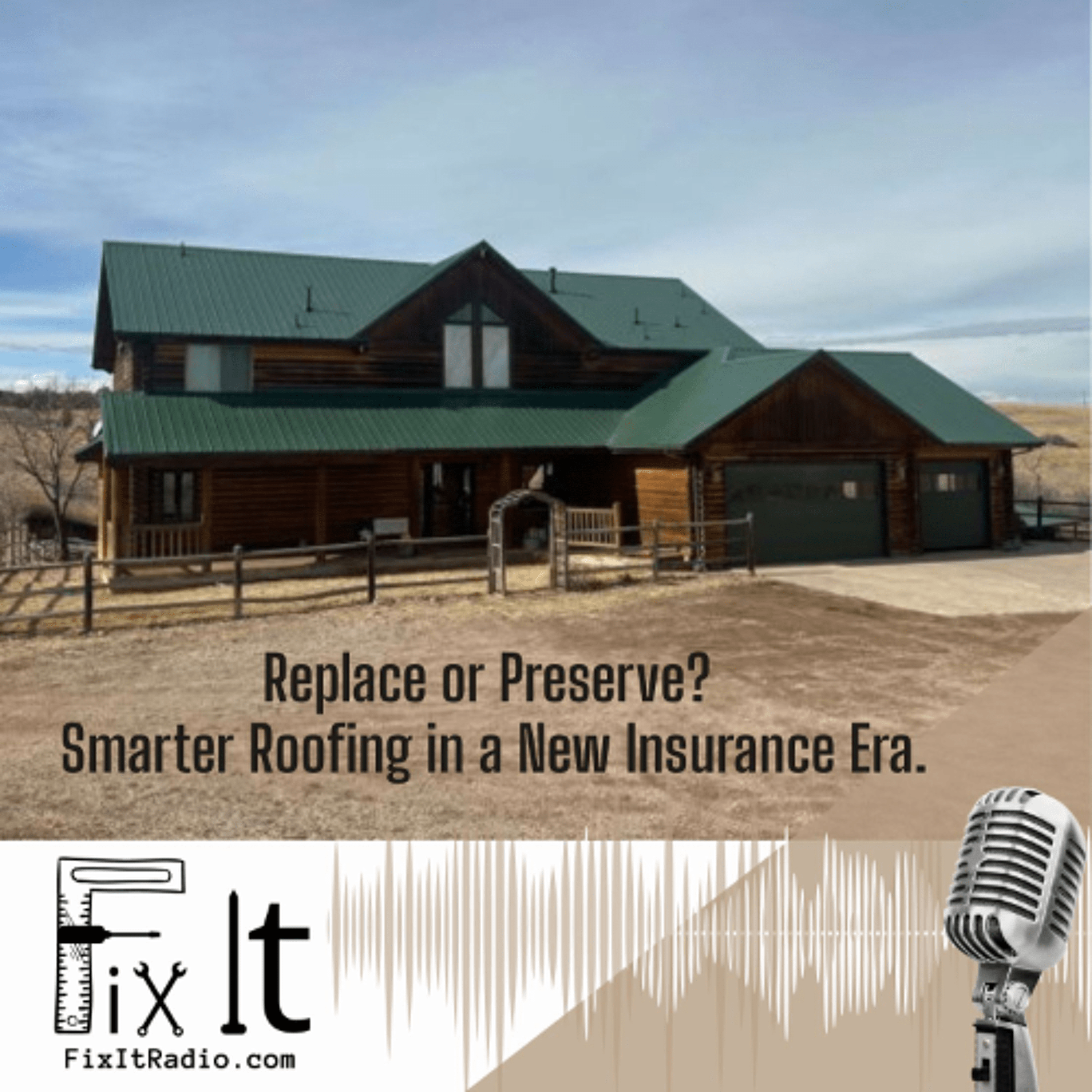

In this insightful episode of Fix-It Radio, hosts dive into the world of roofing and insurance with special guest Dave Hart from Roof Savers of Colorado. Discover how the innovative RoofMax product is helping homeowners extend the life of their roofs and save on costly replacements. Dave shares his expertise on the changing landscape of roof maintenance and the impact of new insurance policies on homeowners.
SPEAKER 04 :
Walter? Upstairs! Are you alright?
SPEAKER 05 :
In the floor behind the chair.
SPEAKER 08 :
This is America.
SPEAKER 01 :
Does everybody know what time it is? Fix It Radio!
SPEAKER 10 :
And it’s that time, Fix It Radio, KLZ 560. Thanks for joining us this morning. Fine Saturday morning on February the 7th. So if you’re listening to the replay show, you know what day it is. And if it’s a replay show, of course, you cannot call in. You can on Saturdays, though. Live program, always able to call in. You can text us as well. Call in number 303. 477-5600. 303-477-5600. Text line 307-282-22. Again, 307-282-22. Dave Hart with me today from Roof Savers of Colorado. Good morning. Good morning. How are you doing? Beautiful out. It is fantastic.
SPEAKER 11 :
We need some snow, but I need snow. You don’t. That’s right. We’re talking on the way in this morning. I cannot believe this is February.
SPEAKER 10 :
It’s so nice. I could get used to this. It’s so nice. Now, part of why we have Dave here is because of that reason. There’s lots of things you could be doing right now. roofing-wise. And Paul Leuenberger should be joining us here at some point as well. We’ll talk the insurance sides of things because what Dave does, especially with the RoofMax product, really coincides with the insurance sides of things as well. But to start with, Dave, and there’s Again, I always have to remind everybody, or myself even, that different people listen different times. Some know you. Some have heard you many, many years with me here. Some never have. So who is Dave, and what is Roof Savers of Colorado? That’s a good question. I’m still trying to figure out who I am, but one of these days, what we’ll start with is… One of these days we’ll grow up.
SPEAKER 11 :
That’s right. Maybe. Maybe. I’m having a lot of fun, but… No, again, my name is Dave Hart. Roof Saviors of Colorado kind of started in the event of trying to extend the life of roofs. We’ve all gotten so used to every time it hails to call a claim, replace a roof, get a quote-unquote free roof back in the day, all that. So there’s a need to save the roofs, keep them last longer, because not every house in Colorado gets hail. We see so many roofs that are 20, 25, 30 years old. Anyway, I see some pea-sized hail, but no damaging hail. So how do we keep those roofs alive? How do we keep the roofs alive even during hail events and keep them lasting longer as an additional protection and get back to keeping the roofs on the house, saving people money, not relying on the insurance companies? So that’s kind of what we do. We specialize in trying to save a roof, whether it be a flat roof, an asphalt roof. whatever it is, and getting more life out of that roof. And so we came across this RoofMax product a little over five years ago, and it’s been fantastic since. It’s been awesome.
SPEAKER 10 :
And for those of you listening, yes, I have a little stake in this. Dave and I have been together for quite some time. My roof was done, gosh, five years ago, I want to say, roughly. Yeah. And I can tell you straight up that does the product work? Absolutely. I’ve seen it with my own two eyes. I happen to live in an area where we get lots of wind and occasional hailstorms. And Dave inspects my roof on an annual basis, and it has survived and done extremely well. And it is now about 15 years old. And if you went up there and looked at it, and Dave knows, as you go look at it, you wouldn’t know it’s 15 years old by looking at it.
SPEAKER 11 :
No, because what the idea does, or the product does, is it takes the life that it is now, the conditions it’s in now, and we stop that aging process. We drastically slow the aging process down, so it just keeps it going longer in that current condition.
SPEAKER 10 :
Think of it this way, folks, and this is not the exact comparison, but it’s not far off. Most of us, guys especially, but even some of you ladies listening, wear leather boots. And or some of you have horses and saddles and things like that. And periodically you will take an oil. those particular products. Leather needs oil, especially in a dry climate like we have here in Colorado. And what you’re doing when you’re oiling that leather is, of course, you’re rejuvenating it, you’re softening it. In some cases, you’re putting a little bit of weather protection on it, depending upon the product you use. But bottom line is you’re putting a product on that particular skin, I guess you could say. In the case of a roof, it’s similar, but you’re putting a product on it that basically is reinvigorating That leather, you’re softening it, you’re making it last a lot longer. At the end of the day, you can get literally twice the life out of a product by doing that versus just wearing it daily and never touching it. The same type of a scenario is going on with your roof.
SPEAKER 11 :
Absolutely. Yeah, so we talk about a lot, just as your example, it’s like putting lotion on your dry skin. It’s just making it flexible again. And the advantage is to keeping the shingle flexible. And what we’re keeping flexible, I’ll back up a little bit, is the asphalt that’s in the shingle. And so a lot of times we…
SPEAKER 10 :
And we tend to forget that it’s an asphalt shingle. It’s an asphalt product, yeah. It’s made like the asphalt you drive on. It’s a similar type product. It’s much, much thinner, of course. Exactly. Yeah, it’s basically an oil-based product that’s up on your roof that’s shedding the water off and the snow and so on so that that underlayment stays nice and dry and you don’t have leaks coming into the house and so on.
SPEAKER 11 :
The other limit is there as an emergency backup to keep water out of the house. So the shingle is supposed to divert 100% of the water off that roof. And to your point, it’s very much identical to the roads that we drive on. We can see the workers put a new road down, new layer of asphalt. Three to five years later, it’s cracking because it dried out. All the petrol oils have evaporated out of the asphalt. So what we’re doing is we’re putting the oils back in, again, keeping that moist. And so what it does is it helps, by keeping the asphalt moist and shingled, it helps keep those granules on longer. Which the granules, they provide two purposes. One is a color, you know, the cosmetics of your roof. The other is to keep the UV rays off of the asphalt longer. hoping the shingles will last longer. So we just put the moisture back in, extend that life, help seal them down tighter. And it’s just doing wonders. It’s a fabulous product. I love it. I know we’re constantly looking to make it even better every year. And last year, I think we did close to 600,000 square feet, which we doubled the year before. Nice. And the way things are stacking up, we’re going to double that this year. So I think it’s fantastic.
SPEAKER 10 :
Well, and what we’ll get into in a moment, too, for those of you listening, is a lot of this, again, I mentioned this coming into the program, the insurance sides of things has changed dramatically from what it used to be. And, again, really gone are those days of, well, I’ll just wait for the next big storm to come along and then I’ll just cash out then. Your deductibles have changed greatly, whether you realize it or not. We’ll get into some of that because, yes, they have changed. And at the end of the day… those days of doing that are pretty much gone. And you really need to now get into that maintenance mode of, okay, how can I keep this roof up here lasting that much longer? And again, for some of you, you may think, well, I’m not in my forever home, so why does it matter? Well, because when you go to sell the house, it becomes a problem. It matters, trust me.
SPEAKER 11 :
It’ll catch up, yeah. That’s right. Yeah, we’ve actually had three or four transactions this last week with real estate agents of, like, how do we get past this? How do we deal with this? And the big one was trying to sell the roof. The roof’s eight years old. The inspector went up, got some minor granular loss. He noted that. Now… Buyers are used to demanding to get what they want. They want a new roof, but the seller is not in a position to credit them that or the buyer is not in a position to replace the roof. So how do we get more life? And to that point, every situation, every real estate transaction is different. But we are helping agents keep those transactions alive and going by getting more life on that roof.
SPEAKER 10 :
All right, let’s do this. I think Paul’s about to join us. We’ll take a quick break. We’ll come back in a moment. Again, questions, let me know, 307-282-22. You can call in directly as well, 303-477-5600. Guys, we’ll be right back. This is Fix It Radio, KLZ 560.
SPEAKER 01 :
Even in the age of AI, looking for the right insurance can be a huge hassle. Paul Leuenberger has you covered without the hassle. He works with the best in the business. Hartford, Travelers, Safeco, Liberty Mutual, Nationwide, Allstate, AIG, Chubb, Pure, Berkeley, Grundy, Hagerty, and more. He’s local, independent, and licensed in Wyoming, Colorado, Arizona, Nevada, and Texas. and he’s expanding into more states soon. Paul’s mission is simple, to find the right coverage at the best value and to treat every client like family. So whether you’re shopping for home, auto, or something more unique, don’t shop online. Call Paul at 303-662-0789 today. That’s 303-662-0789. Paul Leuenberger, insurance made easy.
SPEAKER 02 :
What if you could get over 110 lab biomarkers tested just like Dr. Mark Hyman advertises, but for a fraction of the cost and with a doctor who actually explains the results? At Castle Rock Regenerative Health, Dr. Scott Faulkner has recreated this powerful biomarker test panel at a substantial savings. We have a special price for both men and women. Just $689. That’s a savings of over $2,500 over the standard price. And here’s the difference. With Hyman, you get numbers on a page. With Castle Rock Regenerative Health, you get Dr. Faulkner and his team walking you through every result, showing what’s off and creating a personalized plan to fix it. What’s even better, you don’t even have to be a concierge patient to get this pricing. This is open to everyone. Think about it. Most people’s deductible is higher than this special price. And your regular doctor, if he could get approved by your insurance, would never order this many tests, let alone know what to do with them. Call 303-663-6990 today or visit CastleRockRegenerativeHealth.com. That’s 303-669-6990. Take control of your health at Castle Rock Regenerative Health.
SPEAKER 05 :
Looking to buy or sell a classic car? Need a reliable valuation you can trust? Look no further than BP Appraisals, LLC. With over 20 years of experience in the appraisal industry, we provide fast, accurate, and professional appraisal services that you can count on. Did you know that an appraisal can also entail the forecasting of monetary earning power? An appraisal is a document with a valuation conclusion. It is not a pre-purchase inspection, a mechanical evaluation, or a recommendation to buy or sell your vehicle. It’s the actual value at that moment in time, which many need for things like estate planning, insurance, or investing. At BP Appraisals, we value your property like it’s our own. Make informed decisions with confidence. Don’t settle for less. Choose the experts at BP Appraisals LLC, where precision meets professionalism. Visit us today at bpappraisalsllc.com and schedule your appraisals in just minutes. BP Appraisals, LLC. We know what your property is worth. That’s bpappraisalsllc.com or call 720-295-0108.
SPEAKER 01 :
Are you tired of dealing with hard water, stains or just poor water quality in your home? Do you worry about forever chemicals that have been found in nearly all municipal water supplies? These toxic chemicals, which can linger in the environment and the human body for extended periods, have been linked to various health risks. Municipal water also has chlorine and lead and can have other bacteria. These contaminants can also impact your health. A water filter from WaterPros can provide clean, safe drinking water right from your tap. At WaterPros, we believe everyone deserves clean, refreshing water right from the tap. Whether it’s whole home water systems, reverse osmosis, or water softeners, Water Pros has you covered with customized, high-quality solutions tailored to your needs. Best of all, installation is quick, seamless, and done by our expert technicians. Plus, you’ll love our affordable pricing and industry-leading warranties. So why wait? Join thousands of satisfied homeowners and experience the Water Pros difference today. Visit waterpros.net or call Paul the Waterman at 303-862-5554 for a free consultation. Water Pros. Quality water. Better life.
SPEAKER 10 :
All right, we are back. Fix-It Radio, KLZ 560. Appreciate you joining us. Paul Lewenberger joining us now as well. Paul, how are you this morning? I’m good, thanks. How are you guys? Pull that mic up all the way there. There you go. Much better. Breathing in. There you go. Okay, so we were talking a moment ago, again, talking about Dave and roofing and the RoofMax product. And one of the things that I had mentioned coming in, which you could explain even better than what Dave and I probably can, is… It used to be at one time, people with their roofs, they would just wait for a storm, and then they’d get hail or wind or whatever. They’d turn to the insurance company, get a new roof, and off they go. Those days are pretty much gone, right? Oh, yeah. Long gone. And so how does it work now? And I know it’s different from company to company a little bit, but in general, how does it work?
SPEAKER 12 :
Well, I’m trying to get a lot of the underwriters’ information from Dave on the RoofMax stuff just to show them that treating the roofs is going to get more life out of these roofs versus people just… Putting a roof on and waiting for the next hail storm or wind storm to come in. Right. You know, and a lot of these companies now have gone to the higher deductibles on wind and hail. And, you know, you hit year 11 on that roof and it’s ACV. So you’re getting 75% from year 11 and losing 3% every year. Yep. So now you’ve got a 2% deductible end. 50% coverage towards the new roof.
SPEAKER 10 :
Yep. All right. So what you just said a moment ago, I think the actual cash value, that was the ACV, that’s what that means. And I think a lot of folks, again, they’ve got this misconception that, well, I’ve got a, I don’t know, $500 deductible on my policy. Well, no, you don’t on your roof. No. I haven’t seen that in a long time. Right? No.
SPEAKER 12 :
Well, because they always split it up. You got… You’ll have a wind and hail deductible, and if it’s a percent, it’s what the house is insured for. So if you’ve got $500,000 in coverage and it’s 1%, then you’re at $5,000. Okay. So a lot of people look at that percent and they think it’s a percentage of the claim. It’s not. No, it’s a percentage of coverage A. Yeah.
SPEAKER 10 :
So for easy math, $500,000, 1%, $5,000, 2%, $10,000.
SPEAKER 12 :
If you’ve got a million-dollar house, that’s $10,000,000.
SPEAKER 10 :
Yeah, R20. Yeah, okay. So now you’re just doing the roof on your own.
SPEAKER 11 :
Pretty much, yeah. Right, Dave? Yeah, but he has my policy from my house, and it’s set up to the point where.
SPEAKER 10 :
Mine is. If I have a roof problem, I’m writing the check pretty much on my end. Yeah. And so for those of you listening, I also am a big one on I want to self-insure certain things. I don’t want to have to, nothing against Paul, but I don’t want to have to write a check to the insurance company any larger than I have to I’m willing to absorb some of those things on my own to lower the premiums because at the end of the day, you’re still going to pay when it’s all said and done. And then where, Dave, your product comes into play is, in my case, and everybody else listening can do the same thing, I can extend that roof. Yeah, if there’s a catastrophic problem, then we’ll deal with it. Sure. The key is in having that shingle, I guess you could say, really, how do I want to explain this? Soft, where it’s pliable, and it’ll withstand some of the things that Mother Nature throws at it. You’re just, in the end, you’re even heavy windstorms. The more pliable that shingle is. People have a misconception. They think, well, if it’s pliable, then it’ll just fly off.
SPEAKER 01 :
No.
SPEAKER 10 :
No.
SPEAKER 11 :
it’s the opposite because it’s pliable it’ll just come back down into its regular form and off you go it’s not going to break off if it’s brittle or as it would be if it were brittle and off you go much better chance of that yeah yeah i think that’s it’s huge is i think it’s getting to the point paul and i talked about this a lot where um again we’ve talked before and you mentioned a lot it’s personal responsibility right and every so used to just every time it hailed we put a new roof on and that move forward it is what it is and it’s great for the roofers But it catches up.
SPEAKER 10 :
Not good for the insurance companies.
SPEAKER 11 :
No. And we saw this coming back in 2010 and 11. Like, it just can’t keep going this way. Right. So even if, you know, to the point of the hail, even if, let’s say, you’re home for a long time and you do get some hail damage, it doesn’t mean that you have to replace the roof right then either. Okay. You know, especially with the treatment. We treat a lot of roofs for whatever reason that they don’t want to call an insurance company. Again, personal responsibility. You’re or other forms that they just didn’t want to deal with it, we can go in and treat that roof. Because what we’re doing is we’re just keeping the asphalt alive. So if there are some marks from hail, which is where it just knocks the granules off or the stone hit, if it’s large enough hail, it will damage the matting of the shingle. But that doesn’t happen very often. So it’s just removing granules where that hailstone hit. Well, that asphalt’s now exposed to the UV rays. Well, if we keep that asphalt moist and alive, it’s not going to deteriorate like it would if you didn’t do anything. So I think we’re getting to the point where we’re having to rely on keeping the roof going versus every time it hails, we replace it. It’s just not… It’s not feasible.
SPEAKER 10 :
You just can’t keep going. Well, and Paul can attest to this. Insurance companies, like it or not, they’re there to make money.
SPEAKER 06 :
Yeah.
SPEAKER 10 :
And they’ll do their actuaries and determine typically what they’re looking at, and that’s why in some cases they’ll pull out of states in some cases depending upon what they feel their risk might be. They may just say, you know what, we’re not going to take that risk on anymore. We’re done. We’ll let somebody else handle that from this point forward. And I’m not saying all of that’s because everybody runs out and gets a roof replaced during a hailstorm. It can be everything from – other types of property damage and so on. But I will say this, that particular claim, you know, having a hail storm come through and then insurance companies having to pay out on roofs is probably, and Paul, you would know, is probably one of their bigger hits minus, you know, natural disasters like tornadoes and hurricanes and so on. I’d say it’s probably 80%.
SPEAKER 12 :
Yeah. And you got water damage, theft, fire, but wind and hail is the biggest thing.
SPEAKER 10 :
Yeah.
SPEAKER 12 :
By far.
SPEAKER 10 :
Yeah. And meaning, for all of you listening, meaning that, yes, insurance companies are looking at that very closely. It’s why they’ve now changed their deductible structure is probably the best way for me to explain that. And I really encourage every one of you, please. And I know not everybody does this. I do because, I don’t know, being a business owner and always having to go over policies annual and so on, I’m just one of those weird guys that does that because it’s just my nature. But Most people never look at their policy. They’ll contact an agent. They do something online, whatever the case may be. They’re insured. They make sure the mortgage company is happy at the end of the day. And frankly, they may not have any idea what their coverages actually are until there’s some sort of a claim. And now it’s like, oh, great. You mean this is going to cost me, you know, in the case of what Paul just talked about a moment ago, okay, that $15,000 roof is going to cost me $5,000? Yeah.
SPEAKER 04 :
Yep. That’s the answer. Yes.
SPEAKER 10 :
Or more, depending upon what the total claim is and so on. Absolutely. That’s exactly how it works. Yeah.
SPEAKER 12 :
Well, and a lot of these companies that I’ve switched, like I was working with a guy a couple months ago, his premiums are just out of whack, but he’s got a $1,000 deductible and he’s grandfathered in. So if he makes a change, he can’t ever go back, but he likes that deductible. And I’m like, well, you’re going to pay for it on the front end or on the back end, but if you change, you’re stuck. Right. And if you want that deductible to be $1,000 no matter what type of claim, then don’t complain.
SPEAKER 10 :
And for me personally, and I know some of you are looking at this differently and do math differently than I do, I don’t care about that. Again, I will self-insure certain things and lower the premium. And in some cases, lower the premium but have better coverage when it’s all said and done. I’d rather make sure I’m covered for the catastrophic things. You know, fire comes through or a tornado rips through or something along those lines. I want to make sure I’m covered there. I’ll handle the little stuff on my own.
SPEAKER 11 :
You don’t want to come out of pocket for $2 million to rebuild something.
SPEAKER 10 :
No, I don’t want to do that. No, that I want covered. But when it comes to some of the other small things that happen, yeah, I want to make sure that I’m covered properly. I’ll cover that on my own and not have to rely on the insurance company because I know at the end of the day, nothing against insurance companies, but they’re going to get that back out of me one way or the other anyways.
SPEAKER 12 :
Well, and the thing I think about too is, all right, so you have a claim, and it’s a small claim that you shouldn’t have claimed, but you claimed it. And then you have a bigger claim, like a water pipe breaks and it’s $50,000, $60,000. Well, now you’ve got two claims or three claims and you should only have the one. And then you’re shopping it and nobody’s touching you.
SPEAKER 10 :
Because you’ve got a loss run on that that shows up. That’s the other thing people forget is, trust me, folks, a lot of people think, well, I’ll claim it here and let’s go to the next insurance company. No, they know. There’s what they call a loss run. They know. Companies know exactly what the other company paid out on your behalf. And that shows up on your, it’s like, it’s like credit, I guess is the best way for me to say that. And it’s five years.
SPEAKER 12 :
Five years. And you’re stuck. It’s a five-year loss run. It’s called a clue report. You’re stuck with it. So you move to a different state or you move somewhere else. It still follows you.
SPEAKER 10 :
It still shows because it’s you that were insured. Yeah. I mean, I know the property was, but you were the quote unquote insured on behalf of that property, right? Yeah.
SPEAKER 12 :
Yeah, because I’ll have people that are shopping and they’ve got a lot of rental properties and they all have claims on those. And they’re like, well, but that’s not my house. Well, it’s still you’re the person.
SPEAKER 10 :
Still you.
SPEAKER 12 :
Yeah.
SPEAKER 10 :
Yeah. At the end of the day, it’s still you. And for those of you listening that have rentals and things like that, trust me, rentals, townhomes, HOA, some of you that are in charge of HOA boards and things like that. Dave, you can go in and do an entire complex for that matter and help save money over time and have done that.
SPEAKER 11 :
Yeah. And we do quite a bit of that. We probably one or two meetings every quarter with HOAs and stuff. And even some of the board members will call us out and say, you know, what’s going on? And it takes time to do anything with them. I mean, it could be a year. It could be two years before we do the work for them. But the big thing is just the education. Look, you can do this instead of that. We had one a couple weeks, well, a couple months ago now. That needed a lot of tenant improvements, siding and everything else too, but they’re like, we’ve got to get this roof taken care of. Well, if we treat the roof, now we’ve got the money to do the siding too instead of replacing the roof and we have no money for 10 more years and everything else keeps falling apart. We just educate, just different thoughts, different ideas, different ways of looking at things, and that’s been the big thing the last five years with RoofMax is just education.
SPEAKER 10 :
A question came in, have my roof treated a few years back by Dave? Is there a new application that you do? Will you contact this person about that? Second, he has a USAA insurance. Should I contact them and let them know that I’ve had the roof treated? So first question for Dave, then I’ll go to Paul. But first question to you.
SPEAKER 11 :
Yeah, we can do a treatment every five years. The warranty is good for five years. We come out, we’ll look at it and determine if it’s ready for the next treatment or not. Typically, we can do up to three per roof every five years, no sooner, because the reality is the oils are in there, so if we do it too soon… You’re not really helping anything at that point. Yeah, we don’t want the shingles to get too soft. We want them to be… firm but pliable right um so yeah about every five years we can do it in fact um a little shout out we just did a our uh third retreatment yesterday um to a gentleman his name is mike up in loveland and uh he is just ecstatic and his roof was 25 years old when we first did it and uh yeah just retired he’s like i don’t want to i don’t want to spend money on replacing this roof and don’t blame him um and it’s it’s held up last five years and we just did it again yesterday and it just absolutely loves it so it Yeah, there’s a lot that we can do on that. And real quick, and I’ll touch before Paul gets into it, as far as educating the insurance carrier about what we’re doing, I would encourage sending information out because it’s letting those carriers, letting people know that we’re out here because there’s still a lot of people in the insurance industry that don’t know that we’re here. But, yeah, so Paul could probably speak more to that as well.
SPEAKER 12 :
Well, it’s just the unknown. You can call USA and tell them, and they’re – not going to know what he’s talking about. But at least if he tells them and sends them the information of what it is and what was done, they can pass it up to the underwriters and do some research on it. But as of now, it’s just… It’s kind of a… It’s a slow education process.
SPEAKER 10 :
It is. It takes a lot. For a lot of you listening on the insurance carrier side, I’m trying to think of an example that maybe I’ve been involved in in other industries where you’re trying to educate the powers that be. And I’ll just say that any time you’re trying to do that or you’re trying to make a major change and bring that awareness up, it just takes a lot of time. It does. There’s not any single… Because keep in mind, when it comes to the insurance companies, there’s a lot of moving pieces. And some people think, well, I can talk to my agent. Well… He’s just an agent, or she’s just an agent. I’m sorry to say. I’m not against agents, but they’re just an agent. They are the mouthpiece for maybe that particular insurance company, or in the case of Paul, multiple insurance companies. You then go up into adjusters, which, by the way, not all adjusters even work for the company. There’s tons of independent adjusters that run around and do adjusting for all sorts of different companies, just like an insurance broker would represent multiple companies. Insurance adjusters do the same thing. And then from there, you go on up into the company and Again, there’s multiple layers until you get up to the actual folks that make decisions, and that’s the hard part is getting this information we’re talking about to those individuals.
SPEAKER 11 :
And we’re starting. RoofMax Corporate has a legal department that’s actually talking to a lot of the big carriers. And just as an example, I think you even did an interview for us for the show, too. We had a guy who was with American Family, lived out in Elizabeth. The roof was 20 years old. They said, hey, we’re going to drop you. You need to replace the roof. He’s got a lot of roof. It was going to be about $110,000 to replace it all. So he reached out to him and said, hey, or he had us come out and look at it, see if we could get more life out of the roof. And yeah, we did. A few repairs, a couple of ridge shingles missing. We put new ones on. A lot of preventative maintenance, cleaned out gutters, whatever. He took that information to his agent. His agent then took it to the underwriter, and they said, well, if you could show pictures before, after, during, that you proved that you did this, paid invoice, all that, then we’ll keep you going. And they did. So I guess it’s the second or third one that we’ve done now. So again, it’s starting to educate the market and let people know that we have other options. We’re getting a lot of people, I wouldn’t say a lot, probably two calls on average, maybe three a week, that are calling and saying, hey, I got my letter. I rest 15 years old. I’ve got to replace the roof. And they’re like, well, there’s nothing wrong with the roof. So, again, a lot of education is going to take some time to really get this in people’s minds, but it’s starting.
SPEAKER 10 :
Okay. Good to know. And, again, what I would encourage all of you to do is if you’ve got a question on any of this, number one, you’ve got a question on insurance, of course, call Paul. We talk about that all the time. You’ve got a question on your roof. hey, just where am I at? In fact, I’m a big one, and Dave knows me on this because I’m always kind of poking at him at times. I’m an annual, every spring, roof inspection kind of a guy. I guess coming out of the commercial end of things like I have over all the years, that sort of trained me to do that. I’ve applied that now into my house, and I just feel like having somebody up looking at everything, are all my vents sealed, what are the gutters looking like? To me, it’s like doing that annual inspection on your car. It’s no different. I want to stay up on things because I’m a big believer in preventative maintenance. And here’s the thing about preventative maintenance. I can schedule that. I can’t schedule crisis repairs, but I can schedule preventative maintenance. I used to tell all my customers that when I had my Auto repair shops, you know, I can schedule your maintenance, but I can’t schedule your crisis repairs because those come up and now they’re an emergency, and I can’t prepare any of us for that. But I can schedule out months in advance maintenance. Absolutely. And it’s no different on the roof.
SPEAKER 11 :
No, it’s 100%. And if you keep up on that maintenance, it’ll take that unexpected emergency and make it less than what it could have been nine out of ten times. So I think this is good to keep up on stuff for sure.
SPEAKER 10 :
Okay. One thing I want to move into really quick, because a lot of you listening, we live in Colorado. We’re still going to have storms that come through. We could even still end up with some blizzards and things by the time the winter’s up. I mean, who knows how that’s going to be. Right now we need more moisture, but you never know how that’s going to turn out. I will say this. We still, again, we’re in Colorado. You’re going to have wind and hail and so on. Now, with all of that. And this is really important to keep in mind. Anytime we have a big event, and Dave is in this industry, he knows this as well as anybody, but Paul does as well. Anytime there’s a big event, you have what I call the storm chasers. And they just roll through and they’re trying everything they possibly can to get as many of those things, those roofs, if you would, replaced as they can. And to a point where they’re not all above board.
SPEAKER 11 :
The majority are not. There’s some good guys out there, but the majority are not. We have just even two inspections this week alone where people are like, hey, this guy told me my roof has a ton of hail damage and needs to be replaced. And I went out and looked at them both, and there’s no hail damage at all. Been doing this 23 years, and I know what hail damage looks like. We’ve had a couple bare spots where granules have come off. But especially this time of year, these guys are hungry. They’re looking for anything healthy. They’re saying anything they can to get the homeowner to call and make a claim. And then they come out, look at the roof, and they deny the claim. So now they have an open claim, and now they’ve got issues moving forward. I think we’ve been hearing, actually, a customer even told us last week that they had somebody come out, show them pictures of their roof, and it wasn’t even their roof. And said, oh, here’s, you know, you got hammered. There’s a ton of hail damage, and it was not their roof. So even to that point, we show our customers our pictures. We show them that it’s their house. But we’re even going to do things different where we’re looking to do like a live stream of inspecting the roof so that they know for sure that it’s their roof that we’re looking at. I’m not here to take advantage of anybody. We’re here to make a living and build a business, but we’re going to do it the right way. And so there’s just a lot of stuff going on in the field that – especially in the wintertime. Guys get hungry, especially this winter. We didn’t have a ton of hail last year. They’re just looking for anything. But again, the days of making a claim and hoping the risks are going to get paid for are pretty much gone unless there’s actual legitimate losses.
SPEAKER 10 :
of damage well and even then if even if you have legitimate actual damage and you’re gonna make a claim and this this is where you know I’ll shift this over to Paul great okay now you’ve got a claim you still have your policy parameters that you have to work within you know in other words what’s the total claim what’s your deductible like what you know what was it you know by the way some of this can change what was the I think this how this works is it not Paul what was the deductible at the time yeah of the event right right and then what’s the data loss and right
SPEAKER 12 :
And if you don’t have the right date and you’re saying it was July 7th and it was actually June 10th, I mean, it’s dicey. Get these storm chasers out there that, oh, I’ll take care of everything for you. You get it started and I’ll finish it. Yeah, it’s a shit show.
SPEAKER 10 :
Yeah, you’ve got to be really careful along those lines, folks, so be careful. And here’s Dave’s rule of thumb. Just don’t let them on your roof, right? Don’t let them on your roof, yeah, 100%. If they come knocking on the door, don’t let them on the roof, right?
SPEAKER 11 :
Again, I’ve been doing this a long time. I can’t even tell you how many roofs we’ve done in the last 20 years, but I have seen guys with quarters in their hand, watching them from the street, quarter in their hand, actually scuffing the shingle, trying to imitate hail. Really? Hail only makes hail damage. You can’t really imitate it very well. Um, and I’ve been in several situations where I’ve gone back with a, with a customer who’s not had a lot of hail damage and I told him so, but they still want us to come out. Okay, well it’s up to you. I meet the adjuster, I get up on the roof and there is so much quote unquote hail damage on the roof over when I first inspected it. And so I asked the homeowner, I’m like, would you, would you take a hammer to this roof? And he’s like, I wouldn’t exactly call it a hammer. I’m like, man, I don’t even want to know. So I, I, I mentioned to the adjuster, I’m like, I want nothing to do with this. I, I did not do this. Just make it known that I had nothing to do. And so I don’t know what the guy used, but there was a lot more damage that was not there when I inspected the roof originally. And there was no hailstorm between those two events. I’ve seen it a lot. I’ve seen it all. I’ve heard of all. Dealt with so many homeowners who have even given over their first checks from the insurance company, and now they’re not coming back to do the job. It’s sad. It’s just super sad.
SPEAKER 10 :
Yeah, because it gives the whole industry a bad name as well in the process of doing that. Yeah, absolutely. Because now those people have a bad taste in their mouth. They think everybody that’s in your industry is that way. The reality is, no, there’s still some really good guys like yourself that are out there, but those bad guys ruin it for everybody else. Make it look bad, yeah. Right.
SPEAKER 12 :
It’s tough. It’s the trickle-down effect. Yeah. Then the insurance companies are paying out on things they shouldn’t be paying out on.
SPEAKER 11 :
Yeah.
SPEAKER 12 :
That’s what I tell people all the time. I think they have roof damage. I might give Dave a call, let him look at it first before we even, you know.
SPEAKER 11 :
That’s a big thing, yeah.
SPEAKER 12 :
File a claim and let’s see what’s really going on up there.
SPEAKER 11 :
Yeah, because we’ll discuss, okay, what’s your deductible? How much is that going to cost? What’s an average roof? What’s the likelihood of this roof going to cost? What is the insurance company going to pay for? And does it make sense to even replace it right now? Is there enough damage to call the insurance company? There’s so many things to look at and consider before you even make it a claim, right?
SPEAKER 12 :
Well, does it need to be repaired or replaced? Right, yeah. There’s a big difference between the two.
SPEAKER 11 :
Yeah. A lot of times you might have two or three hits on the whole roof. Okay, let’s put a couple new shingles in and move on. Let’s not make a claim. So there’s just a lot of things that could be done pre-making a claim to make sure it’s going to make sense for sure.
SPEAKER 12 :
Well, and then the insurance company doesn’t have a little book on you saying, hey, we went out there, looked at it, there’s damage. Now you’ve got 12 months to fix the damage. It’s not enough to claim because it’s under your deductible. Right. And then you’re getting those letters that they’re canceling it because you didn’t get it fit. It’s just it gets to be a mess.
SPEAKER 10 :
Yeah. Yeah. And again, folks, I am one. I know you hear me say this a lot, but I am one on, you know, a get the right policy. Talk to Paul and have the right policy on the front side and then be take care of some of these things on your own. You know, be in contact with Dave. Get your annual inspections done. Figure out your roof max treatment and do that. and do it according to the schedule that Dave put you on as far as how often it needs done. And, again, do that preventative maintenance because at the end of the day, if you do that, you’re just not going to have the other issues anyway. Yeah, and you just feel better. You don’t have to worry about it. Somebody else is handling it. No peace of mind. Absolutely, yeah. All right. That’s pretty good. All right, we’ll take a quick timeout. Again, lines are open, 303-477-5600. A question for you to Paul or Dave, by all means, call us, please, 303-477-5600. Text line, some of you are texting as we speak, 307-282-22. This is Fix It Radio, KLZ 560.
SPEAKER 06 :
Insurance agents, you know the story. A homeowner’s roof is aging, the shingles are brittle, and their policy’s on the line. But what if you could offer them another option besides a full replacement? At Roof Savers of Colorado, we use plant-based treatments that restore flexibility to asphalt shingles and extend roof lives up to five more years, all for a fraction of the cost of a new roof. RoofMax helps homeowners maintain coverage, reduce claims risks, and save thousands. And for agents, that means happier clients who keep their policies. Partner with RoofSavers of Colorado today. Call 303-710-6916 or visit RoofSaversCo.com to learn how RoofMax can help you help your clients. KLZ listeners receive $250 off their treatment. Call today and your client receives an additional $150 off through the end of December. RoofMax of South Aurora, a smart solution for homeowners and a win for insurance agents.
SPEAKER 08 :
Need new glasses fast? With Stack Optical’s on-site lab, you’ll get your prescription glasses in just three to four days. No long wait times. Hey, this is Scott Whatley, and I’ve trusted my eye care to Allen Stack and Stack Optical for the last 15 years. Eye exams are only $69. And that should be a part of your physical checkups each year. For over 50 years, Denver has trusted this family-owned boutique eye care center for premium vision care, custom eyewear, and expert repairs. See the Stack Optical difference today. Call 303-321-1578. That’s 303-321-1578. And tell them Scott sent you. Stack Optical. Since 1968, at Stack Optical, you’ll see the difference.
SPEAKER 09 :
You’re driving down the road and out of nowhere comes a bang. A huge rock just hit your windshield and now you have a star in your windshield. Did you know that chip can be fixed? But who is the best? Who has the best resins that keep developing them to work with the newest windshields? That would be Novus Autoglass. Novus, which is the Latin word for innovate, invented windshield repair in 1972 and it still leads the industry in cutting edge technology backed by more patents than any other repair and replacement company While other glass repair services offer limited warranties, or worse, none at all, you can trust the original Novus pros to stand behind their work with a full refund that you can use towards a windshield replacement for the life of your windshield. Find a Novus location near you by going to any of our websites, ready-radio.com, drive-radio.com, or fixitradio.com. Just click on the Novus link. That’s Novus Auto Glass.
SPEAKER 01 :
Even in the age of AI, looking for the right insurance can be a huge hassle. Paul Leuenberger has you covered without the hassle. He works with the best in the business. Hartford, Travelers, Safeco, Liberty Mutual, Nationwide, Allstate, AIG, Chubb, Pure, Berkeley, Grundy, Hagerty, and more. He’s local, independent, and licensed in Wyoming, Colorado, Arizona, Nevada, and Texas. and he’s expanding into more states soon. Paul’s mission is simple, to find the right coverage at the best value and to treat every client like family. So whether you’re shopping for home, auto, or something more unique, don’t shop online. Call Paul at 303-662-0789 today. That’s 303-662-0789. Paul Leuenberger, insurance made easy.
SPEAKER 10 :
All right, we are back. Fix-It Radio, KLZ 560. Paul Luenberger with me today, as well as Dave Hart from Roof Savers of Colorado, talking about the RoofMax product. Okay, a question came in. This is for Dave. Any benefit to write a $60,000 check for a roof system that will endure just about any size hail and then just self-insure it? The EcoStar roof system is the only real way to total that out if hail is big enough. and it goes through the deck in other words is it worth spending that much money on a roof or do you go half of that composite shingles do the roof max product periodically and run it that way knowing that yeah you might have a little bit of a risk but that’s a great question what are your thoughts again it comes down to personal responsibility it’s like where do you where um okay so john you’ve you’ve been teaching me this for the last couple years
SPEAKER 11 :
Where is your money going to best serve you? So let’s say you’re going to spend $30,000 on a good roof. Maybe we treat it every five years, a couple times, whatever. But what else can you do with that extra $30,000?
SPEAKER 10 :
And frankly, that’s how I would look at it. To me, I wouldn’t wrap that other $30,000 up in that roof. I mean, it’s great, that ecosystem. He sent me a picture. It looks beautiful and all of that. But would I go to that extent? For a roof, no, I would not. I would do the basic roof, maybe do a little bit higher-end shingle, and Dave can talk about that. I’ve got the higher-end shingle in my house, which I think just gives you a bigger sponge to absorb the product, I guess you could say. So there’s more asphalt there to begin with, and I think you could do some upgrades along those lines. But would I go that full… echo star unit no and i think some of that for me i’m speaking from experience i mean i’m in an area in the golden area where you know we can get 100 mile an hour winds and have had easily and i’ve sustained that with no problem whatsoever we’ve had light hail i mean we haven’t had any huge well i’ve probably had up to marble size yeah in my area i think it was yeah and we’re and we still have been fine even along those lines so personally would i spend the 60 i wouldn’t no i would still do the 30k roof and self-insure that part of it and do the treatment every five years and call it yeah
SPEAKER 11 :
And to that point, too, I’ve been looking at, you know, on our house, we closed on it and 10 days later it got hit by hail. And I haven’t made a claim yet because I’m trying to make sure it’s going to make sense for us. But the roof is 12 years old now. But I’ve been looking at a newer product that actually has a warranty on the hail. But it’s going to be $110,000, $115,000 for the roof. And on one hand, it’s nice to go, okay, well, I don’t have to worry about that again for a very, very long time. But then what else can I do with that extra $50,000 if I don’t put that on the roof? So it’s just a different way of thinking. So I know that I can answer the question for the caller.
SPEAKER 10 :
And everybody’s circumstances are different. But everything’s different, yeah. I can’t tell you how to run your finances, but personally, would I spend the extra $30,000? No, there’s a lot of things I could do with that $30,000. Yeah, I probably wouldn’t either. No, if you’re somebody where the $30,000 makes no difference and it’s just sitting around doing nothing anyways, well, I guess that’s a different conversation. For most people, they want to make that $30,000 work for them.
SPEAKER 11 :
Absolutely. And these days, the impact rated shingles are much better than they were even 10 years ago. So if you get a good quality impact rated shingle, you can still do an asphalt, it’s going to withstand a lot of torture.
SPEAKER 10 :
Several text messages coming in, too, by the way. Greg and Kelly, thank you. They just said Dave’s service is excellent.
SPEAKER 11 :
Well, good morning, Greg and Kelly. So there you go. Yeah, we actually did a metal roof on their home. They’re not far from where I’m at, not Elizabeth.
SPEAKER 10 :
So, yeah. Very cool.
SPEAKER 11 :
Well, good morning.
SPEAKER 10 :
No, yeah. And by the way, thank you. I appreciate those as well. Now, I got another question that came in a little bit ago. And this is tough, I know, Dave, because every roof will be a little bit different. This isn’t an exact science because, in this case – Somebody asked, you know, what’s the cost average for the roof max treatment for a two-story, you know, average two-story house? Now, average is different for different people. So we kind of, you know, have to put some quotes around that because average can mean something to one and not the other. But I guess maybe the way to look at that is, okay, the average 2,500 square foot, you know, two-story house, what are you looking at on a roof max treatment?
SPEAKER 11 :
Probably 3,500, 4,000. It’s by the square foot. So however much product we have to use and labor it costs to put it on. But on average, we’re averaging probably 80% to 85% cheaper than a full replacement on a standard class four impact rated shingle.
SPEAKER 10 :
So if you go back to Paul’s example, so we take that average 2,500 square foot home, even here in the Denver area, what are we looking at? 750K or so for that house, depending upon what area of town you’re in?
SPEAKER 04 :
Yeah.
SPEAKER 10 :
Some places more, some places maybe a little bit less, but let’s just say 750. Do the math on that, Paul. If they’ve got what deductible typically would you have on that?
SPEAKER 12 :
You’d have $15,000 for wind and hail because it would be 2%.
SPEAKER 10 :
So your $3,500, $4,000 treatment is a pretty good deal at that point.
SPEAKER 11 :
Well, you could just even make it even simpler. If we did three treatments today, which obviously we can’t do three of them in one day, but let’s say we did all three treatments over the course of the next 15 to 20 years, that generally comes out to half the cost of what a replacement would cost at today’s pricing point. not factoring in the inflation of the cost of 15, 20 years from now. So again, it’s different for every roof. It costs more if it’s steeper, and it’s easier if it’s not as steep, or two-story, or ranch. There’s factors, but those are generic averages.
SPEAKER 10 :
The other thing I should mention, too, and we don’t push this probably as much as we should push it in the right word. We don’t say this enough, and I apologize because I always assume it’s kind of a given. But for a lot of you listening, you think, well, man, I just don’t have that $3,500 laying around to make that happen. Well, Dave can help you with that. There is financing available to where you can do that, spread it out over time. There’s multiple ways to make that happen, and what I’ll tell you on that is here’s the other difference in that. Unless something has changed, and Paul will have to clue me in on this, but I don’t think you can do that on your deductible.
SPEAKER 12 :
No.
SPEAKER 10 :
Right. There’s no financing available for the deductibles where I’m going with this. So let’s say that, you know, you go the other direction. You just wait for the roof to get replaced. I’ll just pay my five grand at that point in time. Well, keep in mind, you’re not financing the five grand on the deductible. You’re trying to have to figure out at that point, how are you going to make that happen? Now, you may have a roofer that’s willing to help. fund that $5,000 deductible, that gets a little bit dicey. But my point is you can do the roof max treatment on a time payment if you want to and make it work that way also.
SPEAKER 11 :
Yeah, we have several finance companies that we work with. And we’re selective. I’ve talked about it, real selective on who we use. That’s right. But we’re looking to sign up with another one this week that does offer up to 20-month 0% interest. So you could pay them for the 20 months free money, basically. It’s not a bad deal. So we do a lot of things that are in the client’s best interest, and that’s one of those areas. A lot of them charge you a lot to be part of the program, which then I’d have to raise my prices. So we don’t want to do that. But, yes, I’ll let Paul speak more to the deductible stuff, but we do offer that.
SPEAKER 12 :
And I haven’t even told John about this yet. There’s a new company we just got signed up with last week, and I was telling Dave about this. Yep. They’re named Sola, and it’s a supplement for your wind and hail deductible. So they’ll offer anything from $2,000 to $25,000 that you can buy, and it’s based off your zip code. It’s not based off the style of house, the type of roof. And it doesn’t count as a claim against you, and you can use that instead of insurance if you want to use that. Okay. You know, when I quoted you up, I think, Dave, for $10,000, just to give you the price, I think it was $800 a year for $10,000 of coverage.
SPEAKER 10 :
Yeah. Okay. Mark and Wiggins, go ahead, sir. You’re on.
SPEAKER 03 :
Hey, good morning. You guys were talking about roofs with Dave Hart, and I actually had Dave years and years ago come out and do the roof max treatment, which did protect our roof for quite a while until we got hammered with a pretty bad storm and had to get a replacement. But when we upgraded the roof, we had something that I didn’t really know anything about at the time, which was the, I think it’s called rain and ice shield installed.
SPEAKER 11 :
Ice and water, yep.
SPEAKER 03 :
Yeah, so I was just curious, you know, is that for single roofs only or do you do that for metal roofs too?
SPEAKER 11 :
That’s a good question. For metal roofs, there’s what’s called a high temp iso water because the standard iso water we put under the shingles, if you put that under metal, it will get hot and it will melt. and it’ll run out underneath the edge of your shingles or your metal panels. The roof, yeah, thank you. So they have what’s called a high-temp iso water. It is more expensive, but we’ll put that on underneath the metal so it’ll withstand that extra heat. So to your question, yes, there is a different product.
SPEAKER 03 :
Perfect. Thank you for answering my question. I was just curious while you guys were talking. There you go. You know what? Why don’t I just call and ask the question on the air? There you go.
SPEAKER 10 :
That was good hearing from you.
SPEAKER 03 :
Thanks, guys. Appreciate it.
SPEAKER 10 :
I appreciate you very much. I need to mention this as well really quick because I had a listener this last week that actually emailed me and wanted to know, hey, I need to get some siding on my house. Mm-hmm. this, that, and the other, and who do you know that can do that? And, of course, I sent that right today because we don’t talk that much about it, but that’s something else you do as well.
SPEAKER 11 :
Yeah, we do. We’re doing a lot on the exteriors. Obviously, we do the roofs. We can do the roof max treatment. We can replace a roof. We can do repairs. Better work. Whatever. Yeah, get everything done. Coatings. We take care of a lot of your flat roofs. uh, stuff like that. And then we, we also do a lot of siding. We just finished one up a couple of weeks ago. Um, it’s a vinyl siding. Um, but we, we can do James Hardy. We can do, um, LP smart side, which is the most common on new construction. Okay. Um, and I actually prefer that over all the James hard to be honest, uh, the price point, um, the way it installs. Um, but you can even get James Hardy pre-painted a certain color, um, So there’s a lot of different options for siding. And a lot of homes don’t have unalignment behind the siding. So when we do it, we put unalignment behind it. We can do insulation too. We do it the right way, yeah. So it’s just crazy.
SPEAKER 10 :
But yeah, we do a lot of exterior type work. Okay. And I also need to mention in another one of those areas that we probably fail to mention as often as we should. Some of you owners out there that have commercial properties, you might be in your own commercial property, maybe own some commercial property. Yeah, Dave can do your annual inspections if there’s any repair work that needs done, if you need a replacement. I mean, you name it. Those of you that are thinking, man, I just don’t know who to call for some of this stuff because I’m in that space and I realize at times how hard it is to find people that actually are qualified to do that work. Some of you guys that even have, you know, outside upper decked patios and things like that where it gets a little dicey on sealing things up and so on. It’s almost like a roof you’re walking on at that point.
SPEAKER 01 :
Absolutely, yeah.
SPEAKER 10 :
Literally what it is. The concrete coatings and stuff. So who’s out there that can handle all that? Well, Dave, you can. Yeah, we can.
SPEAKER 11 :
And if we don’t know something, we know people who do know that can help us too. So we’re not all knowing of everything, but we’re willing to look at it and figure out a solution.
SPEAKER 10 :
And if it’s not something that we can handle, we’ll refer out as well. This is more a question for you, Paul, and I know you don’t have a crystal ball knowing what insurance companies are going to do on down the road. But given the changes now that have happened with roof replacements and the deductibles that go along with them and so on, where do you see the future of that headed? Is it going to stabilize? Is it going to get worse? Are they going to raise deductibles even more than they are now? What are your thoughts on all that?
SPEAKER 12 :
No, I think it’s going to stabilize. I think you’re going to see the companies that haven’t gone to the 2% go to 2%. Okay. And you’re just not going to – I mean, there’s a lot of companies right now that if that roof’s 10 years or older, you can’t even. They’ll decline the quote right off the bat. So you’re going to start seeing companies be a little bit stricter on new business. But you’re just that 2% here to stay. I mean, I think you’re going to see everybody slowly move to it because most have already.
SPEAKER 11 :
Yeah, and to the point of personal responsibility, they’re forcing us into having personal responsibility and just go, okay, this is what it is, and we’re going to have to put money aside, set aside for our deductibles in case of a complete catastrophe, but that’s just where it’s going.
SPEAKER 10 :
This is a great text message that came in because I’m of the same opinion. Because in my previous houses that I’ve owned, I’ve had two houses with concrete tile roofs. And this particular person is talking about how, excuse me, after a big hailstorm, they put on the class four concrete tile. It was beautiful. But two years later, hailed again. They paid out again. Subsequently dropped that insurance because of that. In other words, here’s my point with tile. They look beautiful. And they do. They are a gigantic pain in the rear. If you’ve never had one, you don’t know what I’m talking about. You can’t hardly get up on the roof. When you do, you have to be really careful where you walk and so on. Yes, they’re great. The tiles, by the way, are doing nothing at all for the protection of the roof itself. It’s all underlayment. All the tiles are doing is protecting the underlayment. It’s more of a beauty thing than it is anything else. And just personally speaking, yeah, they look really nice. And it sort of dresses a house up, I guess you could say. But it’s a roof I won’t own.
SPEAKER 11 :
Yeah, we’re actually working with one right now. She’s a real estate agent and sends us quite a bit of work. And her roof is 20 years old. She just got the letter that she needs to replace our roof or she’s not going to get insurance. Well, it’s a $70,000 roof. I mean, how are you going to do that every 20 years? You’re not. But to your point, the roof system is the underlayment. It’s not the concrete tile. And they go out of style. They go out of color. They fade. It’s hard to find.
SPEAKER 10 :
you can’t get shingles to match and then when they make the new ones that might match that style they’re different size i mean see it’s just it’s a royal pain in the room yeah i don’t yeah i for those of you listening that if you’ve got somebody trying to sell you on you know concrete shingles or you’re looking at sorry to say this but maybe you’re looking at moving and you’re looking at two different homes one has concrete one doesn’t um i mean the other the one with concrete would have to have enough other features on the home yes For me to take it over the one without it because I hate tile and because I hate the concrete tile that much. Yeah, absolutely. And I’m speaking from experience. I had two houses in a row that had those. And after owning them, I’ll never go back to owning another one.
SPEAKER 11 :
Yeah, they’re a pain.
SPEAKER 10 :
They are a royal pain. They’re the type of roof where… Don’t plan on doing Christmas lights. Don’t plan on getting up on it. Don’t plan on doing anything around it. It’s one of those where you’re going to look at it and hope it stays beautiful and you never have any issues because if you do, it’s a pain.
SPEAKER 11 :
And the concrete break.
SPEAKER 10 :
I mean, just like our sidewalks, they expand and contract and they crack and you can’t get replacements. I’ve had wind damage with concrete tile roof more so than I have even the asphalt shingle roof I own now.
SPEAKER 11 :
Yeah.
SPEAKER 10 :
Yep. Because people think, well, they’ll never blow off. They do. I think again. Yes, they do because the wind gets to rattling.
SPEAKER 11 :
I had a drench a year and a half ago.
SPEAKER 10 :
yeah borderline tornado ripped off a bunch of tiles yeah i had one home where i probably lost i don’t know probably a 10 by 10 you know 10 square foot section of tiles that literally just blew off into the wow into the backyard and and to your point now go out and try to find all the matches and so in my case i ended up having to buy a full pallet of yeah tile that luckily i was able to keep and then when i sold the house it stayed with the house and so on but Yeah, after owning one of those or two of those, I should say, in a row, I’ve never owned another one. No, I wouldn’t do it either. So for some of you where you’re talking to different people and or somebody’s trying to upgrade you on some of those things, Dave’s got a lot better options on how to do that, have them still look good. I get it. A lot of people want the house and the roof to really look nice and to blend with the neighborhood or whatever the case may be. But here’s the reality, folks, and I’m not joking when I say this. Rarely does anybody look up at the roof. Right. So at the end of the day, you’re looking at it, but you know what? Most people around you are probably not paying any attention to it.
SPEAKER 11 :
I’m in the business, and I don’t usually look at my roof when I get home. I’m like, I’m done. I want to walk in the door, say hi to the wife and family, and I’m done. I don’t want to look at it.
SPEAKER 10 :
Well, that’s why in the retail space, in grocery stores, all of that space that’s at eye level is rented. to all those companies that are wanting to sell you product because they also know you don’t look up. So at the end of the day, some of you that are looking to do really fancy roofs, it’s more for you than it probably is anybody else because most people are maybe glancing at that and they’re not paying a lot of attention to it at the end of the day. Dave, I’ve got about a minute or so left here. How do folks get a hold of you? What’s the best way to do that?
SPEAKER 11 :
First, if I can, I think my in-laws are listening. I just want to wish them a happy anniversary. Nice. Happy anniversary. They’re a lot of fun. They’re in North Texas. Very good. Yeah, my father-in-law is great. Royal pain in the rear, but he’s great.
SPEAKER 10 :
That’s all right.
SPEAKER 11 :
But they can get a hold of us, 303-710-6916, or go to roofsaversco.com, and we’d be happy to just come check out the roof and take a look at it and provide options. And if there’s nothing that needs to be done, we’ll be straight up and honest with that as well.
SPEAKER 10 :
And, again, for those of you listening, too, get on. Dave can schedule it where you can do an annual inspection every year. He can come out, double-check, make sure things are good so you don’t have any issues on the insurance side. Paul, you as well. How do folks get a hold of you if folks are looking to have a better, how should I say this, save money on insurance? I always talk about this. You have the ability to help people with their insurance costs, teaching them how to save money, deductibles, things of what we’ve been talking about today are things you can help them with as well.
SPEAKER 12 :
Yeah, the easiest way is just my cell phone, 303-619-9891. You can call or text. My office number is 303-662-0789.
SPEAKER 10 :
Okay. And again, for all of you listening, these guys actually work in tandem with each other as well. So if you’ve got Paul and he’s your broker and you’ve got insurance and something happens, he’s a call, Dave’s a call. They work back and forth together. Again, those of you that have roofs where you’re over the age of five years, which most everybody’s probably unless you bought a brand new house or had a brand new roof put on, you’re going to be in that particular realm. Yep. uh yeah have have dave come out do an inspection look at how the roof match product would work one thing we didn’t talk about today that can squeeze in days like today where it is outside right now what is it dave it’s 52 degrees that’s work so you you can you can apply product if it’s above 40 degrees yeah so if it’s 50 some degrees like it is right now this work can be done this time of the year lickety split yeah we’re doing them right now okay absolutely so again don’t let that time of the year bother you guys get ready for spring Who knows how much weather we’re going to actually have. But make sure you’re dialed in so your roof is good, your hand on the insurance side. And, again, guys, I appreciate you listening. You can always text me any questions. I can forward those on to Dave or Paul as well, 307-200-8222. But, guys, thanks for listening. This is Fix It Radio, KLZ 560.
SPEAKER 07 :
The views and opinions expressed on KLZ 560 are those of the speaker, commentators, hosts, their guests, and callers. They are not necessarily the views and opinions of Crawford Broadcasting or KLZ management, employees, associates, or advertisers. KLZ 560 is a Crawford Broadcasting God and country station.