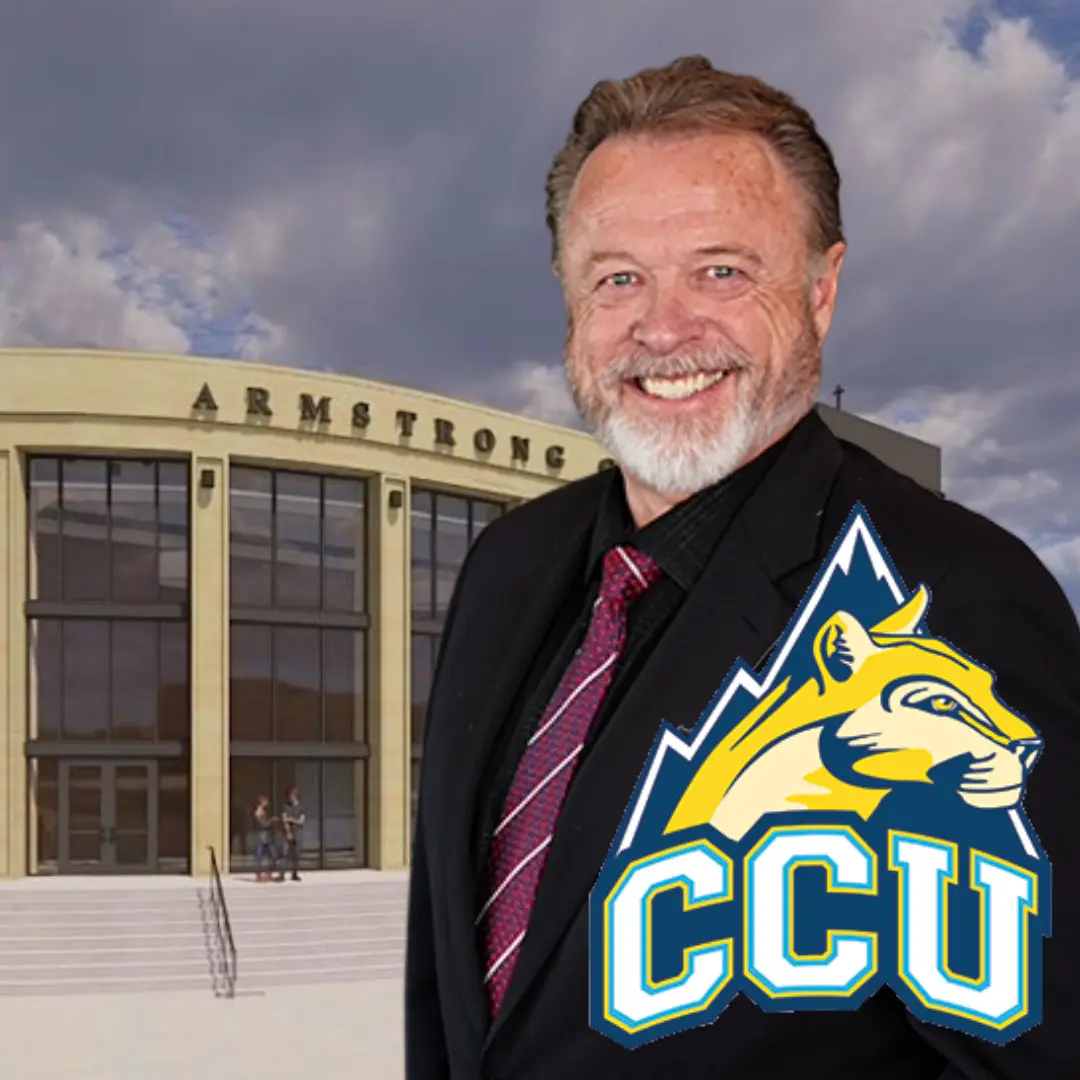

Tami Bandimere sits down with Dean Steve Taylor inside Colorado Christian University’s Armstrong Center — a long-awaited “promise fulfilled” space that finally brought CCU’s School of Music back to the heart of campus. Along the way, Steve walks through the decades-long journey that led to the building’s opening in October 2024, and what it changes when students can go from dorms to rehearsals without racing across town.
They also zoom out to the bigger picture: why the performance hall is built to serve the whole university (concerts, speakers, big events), and how that flexibility helps CCU build a wider platform
SPEAKER 09 :
From the day we’re born, we are scarred and torn We’ve been scared to sing out loud But we don’t care no more, cause we know life is short
SPEAKER 06 :
Hey everybody, it’s Tami Bandimere. And on this episode of Living It Loud, I’m going to introduce you to somebody that, if you ask my mother, he is the voice of Christmas for her. But I’m sitting in the office of the Armstrong Center at Colorado Christian University, and I’m in the office of Dean Steve Taylor. And Steve Taylor is the dean of the School of Music, the professor of music of the School of Music of Colorado Christian University. So thank you so much for taking time. I mean, there’s no students here. So this is it’s quiet. And I said to him, I said, you know, if you’ve got a quiet spot that we can go to, well, you’re not kidding. I don’t think there’s anybody in this building today, is there?
SPEAKER 04 :
No, there’s not. I think everyone’s gone home for their Christmas break to see their families and friends. And it’s, yeah, it’s quiet around here, but it’s a beautiful day.
SPEAKER 06 :
Yeah, it really is. It doesn’t even really feel like Christmas. But so the Armstrong Center, you know, let’s talk about that. And then we’ll go back to how you got involved with Colorado Christian University. But this project has been in the books for a long time, hasn’t it?
SPEAKER 04 :
Yeah, it really has. Years ago, well, maybe even towards the beginning of my time here at CCU, when I first started at Colorado Christian, it was Colorado Christian College. And shortly after that, it merged with Colorado Baptist University and became Colorado Christian University. It was actually the first year of the merger between Rockmont and Western Bible College. That merger was the year I began teaching here. Very part-time. I only had maybe three or four voice students. And we were in a small, well, smallish farmhouse on the east side of the property, which obviously is not here anymore, with an outbuilding across the road from us where the band met. And at that point, the band was, I think, a keyboard, a guitar, a trombone, and a trumpet. I think that’s what the band consisted of back then. And in any case, from there, we moved into another church building, which was not really Now there’s some campus housing where that was on Alameda. And then in the late 90s, the university purchased a property on Garrison Street, and it was the former Lakewood Church of God. And so we thought we were in just the greatest palace ever because finally we had a real home and we were able to – do everything in the building that we needed to do. Renovate it and put the things in that would make it into a true school of music. And we were able to get our accreditation nationally as a result of that. But even as late as, or as early as perhaps, the late 1990s, there was talk about a new music building, something that would get us back on campus again. We’d been off campus then at that point for a short amount of time, but in that building, they still, the desire was to be back here so our students could be better integrated into the main campus. So really the thought of it was 25 years ago. The reality started happening after the passing of a great friend and president of the university, Bill Armstrong. And then they started talking about how to honor him the most and what kind of legacy building would do that. And Bill had certain things that he just loved. And one of those was the arts. The other was great books. And the last and certainly the most important was music. He loved Jesus and he loved to worship. And so then the concept began of trying to put those three things together in a legacy building to honor Bill Armstrong and to put it on the center of the campus to become kind of the focal building, the central building of the campus, which, of course, was unbelievably exciting for us. And so the fundraising started and we started talking about spaces and what that would need to be to properly have a school of music. And about, I don’t know, I guess five years ago, they began in earnest the construction of the building. And of course, at that point, we all went through COVID and we all went through all the supply chain shortages. And And worker shortages, and there were delays after delays for other reasons as well. And so the project took longer, much longer, I think, than any of us had anticipated. But yet, the whole idea of it was so exciting, and we had pictures up in the old building all the time, and telling people, this is going to be our home soon. And so finally, when the doors opened for us in October of 24, it was… More than an answer to prayer to me. It was a promise fulfilled. And from that point on, we’ve just been owning it, growing in it, adapting it, and finding out what needs to be done and using it. And it’s been quite a wonderful thing for us.
SPEAKER 06 :
And using it, you have. In fact, since the building opened up, I have been to four different performances here, three of them. And one was actually not even a music performance. It was like a seminar kind of a thing that was in the – where we – We just came here for the Denver Brass and you’re part of the Denver Brass. And so how fun for them to be at your home where you where you are at to have that. So this building is not just music. It’s performance, isn’t it?
SPEAKER 04 :
Right. And they considered the McDonald Performance Hall as the central piece of the building to be really a multi-use, across-university use space. So it was designed specifically as a concert hall, as the best that it could be, and it is marvelous sound. 498 seats and the sound designed to be for a concert, but it is also set up to be a great venue to bring in guest speakers and have special concerts, guest artists come in. So it’s definitely shared by the entire university. Although I’ll say that we probably, well, not probably, we use it more than anyone else.
SPEAKER 06 :
But how neat to have now the students all in the same campus. They can walk from their housing area straight to the School of Music. You and I were talking, I remember when my daughter was here for school and she was a RA and a resident assistant. And many times I saw her little green Volkswagen go up and down Garrison Street and she wasn’t the one driving her car because, you know, when the winters are here, that’s hard to get. I mean, it doesn’t seem that far away, but it was far away. It was off campus. So have you noticed that that you’re getting more music students because of the fact that it’s on campus or did that even matter?
SPEAKER 04 :
Yeah, that’s the hope, that’s the goal. Certainly the other difficult thing for our students when we were remote or further away from campus was just the 10 minutes between classes. It was really hard for our students to manage to get from the main campus to that building in 10 minutes. And then to get back and not be late for their classes here. So it really is a game changer. The hope has been that now that we’re here and central to the campus, that non-majors would be more inclined to participate in our ensembles and lessons. and we can kind of really truly throw our arms open and recruit from the entire student body. And to that point, when we had our big Christmas celebration concert just two weekends ago, there were probably 160 different students that were part of that. And that would represent about 12 or 13 percent of the entire student undergraduate population, which is pretty wonderful. Of course, we want to get it to 20 percent if we can. But, yes, I think we’ve seen a wonderful uptake in student participation and even just simply student willingness to consider it, you know, because we’re here. So.
SPEAKER 06 :
I’m trying to think when it was that we actually, our paths actually crossed. And I think it’s probably through my parents, because my mom and dad… like Bill Armstrong, love music. And CCU has always been excellent as far as the performances and the things that happen here. And so a little over 10 years ago, we started an endowed scholarship program. with my mom and dad’s name on it for students in the music department because they love getting invited to programs. And it’s not just Christmas. It’s throughout the year. It’s also musical productions as far as, like, plays. and that kind of thing, and they love that kind of thing. So it is not just music. It’s all of those things, and that probably gives you even more, knowing that it’s all right here, and you can walk down from your office right down there. It gives you probably a lot more flexibility, and your mind probably thinks, even, we could do this. Now we can do that, right?
SPEAKER 04 :
Absolutely, and to that point, this fall, we will be starting a brand new degree program in music theater, which we’ve never had before. We’ve had a minor in it, but now we have a facility that’ll support it. We have a minor in dance, and so music theater. My goal at some point is that we’re no longer a school of music, but that we’re a school of the performing arts, all to the glory of God, where we embrace all of the performing arts music, theater, dance, and those things that cross over like music theater, that any Christian that desires to be trained excellently to glorify God through the gifts they’re given in the arts will think of CCU as the place they want to come. That’s really my goal. I don’t want them to have to go to a state college to receive that kind of education. I really want them to think and to come to a place where God is honored and the arts are brought through that Christian lens of wholesome entertainment, but excellent entertainment that would also affect the world and the culture for Christ.
SPEAKER 06 :
And you have been here for how many years?
SPEAKER 04 :
Okay, well, now I’m going to give things away a little bit. My wife and I, Vicki, have been married for 42 years, and we married in 83, and 85 is when I first set foot on the campus and started teaching voice very, very part-time. At that point, I was in worship ministry and also nearly full-time in performance. And so that was all a part of our lives. And I’ve never left. So things, as our family grew and as God moved us around in terms of focus in our lives, the performing side of it started to be overtaken with the teaching side. And I became really invigorated by the idea of touching the future. Years ago, I had a professor in college that told me that he was disappointed in me. And I’m a people pleaser. I thought, why? Why are you disappointed in me? And he said, because with all the gifts that you have, you don’t want to teach. And I thought, well, it’s not that I don’t want to teach. It’s that I’m going to perform. But that started in me, this thought that, well, maybe I should think about teaching. And that has become the centerpiece now of our lives together.
SPEAKER 06 :
Hold that thought. We’ll be right back. More with Steve Taylor.
SPEAKER 09 :
Got some famous friends you’ve probably never heard of. Back in Rutherford County, our crowd is sick and…
SPEAKER 01 :
Hi, this is Curtis Stone. You name a dish and I’ve prepared it thousands of times. But even I can’t cook enough to feed all of the 17 million kids in America who are struggling with hunger. That’s where the Feeding America nationwide network of food banks comes in. They gather surplus food to give hope to hungry kids and their families. We call them food angels and you can be one too. Earn your wings at feedingamerica.org.
SPEAKER 03 :
A message from Feeding America and the Ad Council.
SPEAKER 06 :
So when we had to take a break and I had to cut you off, you were talking about how you moved into the teaching portion of music. Right.
SPEAKER 04 :
Because of my professor’s influence, while I was doing graduate studies, I went ahead and took all the education courses that I would need to be able to be a teacher. Didn’t student teach because I knew I wanted to perform, but I took all the courses, and so I knew how to be a teacher. And as that became part of my life here at CCU, the idea of touching the future, of encouraging Christian artists on their path in performance or even in education, became so rewarding and fulfilling to me that that became more the focus of our lives together. And I would say it was probably the late 90s where I joined the faculty as a full-time instructor. And so that started me on that path. And for the last 30 years, I’ve been a professor here at CCU to God’s glory.
SPEAKER 06 :
And I love that you talk about the next generation and that kind of thing, because that’s one thing that whenever I’m on campus here, there’s just, there’s some kind of an energy. There’s that youthfulness, of course, because it’s all young people, you know, young people that are here that are going to school and are making new friends and are, you know,
SPEAKER 04 :
just hanging out together and and there that’s got to be exciting to to see that and to see that youthfulness absolutely i think that um we we created a motto in the school of music several years ago which is passionately pursuing excellence to the glory of god and this generation um I think they dream more and they have more passion than perhaps some of the previous generations have had. And I think there’s a real openness, particularly right now, for students that want to follow those passions in the arts want to be out in the world representing Christ in what they do. And it’s even more exciting to me now than it was when I first started teaching, because I just see an openness to our message, to our students. And I will tell them, you know, that the world won’t say to you, oh, you’re a Christian, come on in. They’ll say to you, are you any good? And they don’t really care if you’re a Christian. They want to know if you’re any good. And so our goal truly is to graduate students of excellence that can have an impact in the world. And to that end, we have some incredible faculty that God has brought here to help us train these students.
SPEAKER 06 :
Would it be fair to say that the School of Music, and I know this probably makes you kind of go, huh, that the School of Music was basically just kind of laying dormant until you came along and decided to take it to the next level? Because it sounds like… I don’t know if there was somebody here that was already doing what you were doing or CCU saw something in Steve Taylor that said, that’s the guy. That’s the guy we need to be the head of our music program because it just seems like it’s such a vibrant department. And of course, you know, it’s music. So it’s not like it’s supposed to be quiet. It’s not like you walk through this building and there’s students practicing and singing and that kind of thing. And it’s a fun building to be a part of. I think…
SPEAKER 04 :
The best way for me to describe it is that I just was able to start to ride the wave that was already going. Dr. Alan Shantz was my predecessor and already had a vision for a real school of music and for what that could look like. and really became a mentor to me in administration. That was not something that I studied in school. I studied education and performance, but never administration. And so he taught me so much about leadership and how to be the administrator of a school of music. But I feel like I was, I came at a moment in time that was, God, It was all God. It was that moment when I was the most open and when the school was starting to rise and just gave me that opportunity. So I really do. I really blame God for all of that. And I thank Alan Shantz for it. I think I stand on the shoulders of a giant when I think of Alan.
SPEAKER 06 :
He really was my guide. Speaking of standing on the shoulders of giants, though, you’ve been here long enough that you have had students now that you probably are looking at them going, Oh, I’m so proud of them. They’re doing this or they’re doing that. So do you have any standouts that you can share that you can say, Oh, I’m so proud of that young lady or that young man?
SPEAKER 04 :
You know what? They’re… Over 30 years, there’s a lot. And it’s hard to zero in on just a couple. I’ll go back. I will tell you of a couple. But I think I want to go back a little bit to some of the things that I would tell my students. And I would tell them that they had to be better than me. that in order for us to move forward, in order for us to continue to really invest in culture, that they have to be better than me. So I would always really encourage them in that way to, not as a way of competition, but a way of trying to give them a parameter and to say, you know, I am because God made me this way, but you need to be better. And you need to move the cause of Christ forward from where I’m able to take it. Because I feel like that’s where it was. I was handed a baton, and now it’s time for me to hand that to someone else. And they need to continue on and carry the work forward. So they’ve got to be better. And so, yes, I have a few that I think of right offhand. We have students in every aspect of the arts right now that are graduates. I have a young man, Matt Peterson, who lives out in Santa Barbara right now, that has stood in for me at several things here in town when I’ve not been able to do a performance for whatever reason with Blue Gospel Scripts. Things like that. But he’s out in Santa Barbara. He’s he’s very active on the West Coast and the opera out there. And he just became an affiliate faculty member at Westmont. So I’m very proud of Matt for that. He’s doing a great job. I have a young lady who actually is related to me. She’s my cousin’s daughter. studied voice with me, and she just went on as the understudy cover for Mary Poppins at a very large regional theater. And I’m very excited for her and for all of the opportunities and performances that she’s doing in music theater. So that’s a couple, but there are so many if I took enough time I could make a huge list.
SPEAKER 06 :
Mm-hmm. Well, and speaking of theater and that kind of thing, you yourself have been involved in some theater productions as well. And and as you’re listening to Steve speak, you know, he’s a great narrator, too. He’s got a good voice for that. And so I could go through all the things that you’ve that you’ve done because I’ve got a whole list here. But you’ve been at Carnegie Hall three times. And you also, most recently, I’m assuming most recently, in 2021, you were voted the best performer in a musical by Broadway World for the Denver region for your role as Tevye in Fiddler on the Roof. So do people reach out to you or do you go, I’ve always wanted to be Tevye on the roof or how does that, how does that work? Because this is your job, you know?
SPEAKER 04 :
That’s a really great question. That’s, that’s, that’s a great insight. Um, yeah, at this point in my life, um, I guess, I don’t say there’s any sense of pride. My reputation is such that people reach out to me. And I don’t really go beyond to try to seek out other things at this point. And I will say the university has been very supportive of me through the years in being able to continue as a performer. Way, way back, and I’ll give you just a little quick example. synopsis of my performing life. I began performing with Central City Opera. Now, I will say that opera really wasn’t necessarily, when growing up, it wasn’t part of our family. And when I went to the university, University of Denver, it was really an opera-based school. And the first opera that I ever saw was when they were recruiting me to go there. And I was fascinated at how hard it was. And I thought, man, I want to do that because that is so hard. And so that kind of became my path. And long story short, so I started with Central City Opera. And while I was there, I received the opportunity to go to New York. I wasn’t married at the time, to go to New York and to work with Charles Strauss, who is the man who wrote Annie and Bye Bye Birdie. They were putting up a one act at the First Alder Children’s Theater of New York. And they asked me to come and live there, be there, help them put that up, work with Charles Strauss. And it was something I’d always wanted. You know, I always wanted to go to New York. And I prayed a lot about it. A lot about it. And I really felt God telling me that I wasn’t ready to do that. that I needed more time, more time with him, more time to deepen my faith. And so I turned down the opportunity, which people think that was madness. Most people go to New York and try to get a job. I had a job. I just had to go. And there was that voice in me that said, don’t do that. And because of that, my wife and I got married. I have four beautiful children. I have an incredible opportunity to, to touch the future with these students here. And my life could not be richer. I really feel like if I had gone, that would have been for me. And this is what God had for me. And I’m so grateful. Um, so to, to, to kind of wind back that, that back around the performances in Carnegie hall. Um, I feel like we’re God’s little gifts to me. Um, You know, his way of saying, I know you always wanted to do this. And I said it wasn’t right. And so I’ll let you go ahead and sing a carnival.
SPEAKER 06 :
I love that. We’ll be right back.
SPEAKER 05 :
God’s wisdom produces behavior that is morally pure, chaste, and modest. God’s wisdom produces relationship, not estrangement. God’s wisdom does not demand its own way, but rather functions by influence. God’s wisdom is not rooted in pride, but rather in service. God’s wisdom is marked by kindness, generosity, and helpfulness. The wisdom that is from above is first pure, then peaceable, gentle, willing to yield, full of mercy, and good fruits, without partiality and without hypocrisy. James 3.17 This is taken from God’s Way Day by Day by Charles Stanley.
SPEAKER 06 :
So when we left before the break, Steve Taylor was talking about how God gave him the gift of being able to go to Carnegie Hall and being able to perform there. But you’ve had quite the opportunity. Most recently, our family just came. We were part of the Denver Brass, and you did some stuff with that. You have been part of a quartet called the Legacy Quartet. And honestly, now that I think about it, you know, that’s probably even back the first time that I ever met you because my dad is such a Southern gospel lover. And I just remember having you out at the racetrack to sing Well, you sang the National Anthem for us as the Legacy Quartet, plus you did it as a soloist. You also sang in the Racers for Christ service. And you even had my dad sing with you at one point, which was a shocker to all of us. Here we are sitting in chapel at Raisers for Christ at the Mopar Parts Mile High Nationals. And I don’t know if it was you or one of the other guys that said, hey, we have a special treat for you. John Bandimere is going to sing with us. All of us as family kind of went, huh? Yeah. And he did a pretty darn good job, didn’t he?
SPEAKER 04 :
He did great. He did great. Yeah, Legacy Quartet was something that came into my life early 2000s. And Legacy Quartet was founded by an incredible bass named Norm Huxman. And so I joined them. At that point, and through the quartet, we’ve traveled all over the world. We’ve actually toured Cuba and Korea and Australia and Canada and all over the U.S. But when we got the call to sing out at the racetrack, and that wasn’t the first time I met your dad, but that was one of the early times. I remember distinctly saying, why don’t you sing with us? Oh, well… And it did take much convincing for your dad. And I remember him coming to my office in the basement of the old music center with the quartet, and we went through a couple of songs, and we were all keeping it hush-hush so that it could be a wonderful surprise. And it was. It was absolutely great. I remember the tent very well. I could tell he was just waiting for that moment to get invited up. He was so excited and anxious to do it. It was wonderful. The quartet was a great part of our lives. COVID kind of messed us up when we had to shut down and not perform. Then our first tenor moved to Montana, and it made it difficult for us to continue that ministry. But it was a really important part of my life and our family life and our married life.
SPEAKER 06 :
Yeah. So you talked a little bit about opera. And, you know, for those of us who aren’t really in the opera world, I mean, that’s just a whole other thing. But is there a Van Halen side to Steve Taylor? I mean, opera seems very formal and very, you know, very kind of specialized. But behind closed doors, is there a Van Halen side to Steve Taylor? I mean, there’s all different kinds of genres, you know. And I even on my playlist, I have everything from Barry Manilow to, you know, Taylor Swift to Van Halen. I mean, it goes everywhere. But is there some kind of music that you really are like, I love that?
SPEAKER 04 :
That’s a really wonderful question, too. Yeah. Wow.
SPEAKER 06 :
And you’ll still go to heaven. It’s okay. Yeah, it’s all right.
SPEAKER 04 :
You know, of course, so my career really started… Even before opera, even before doing opera professionally, I worked at Boulder Dinner Theater and Music Theater. Music Theater was always a part of my joy. I did my minor in theater. I’ve had a lot of experience, even took dance, you know, so I could be that triple threat idea that they talk about. So music theater was something that was always exciting to me. It was a little freer in expression. It was a little freer even in performance. In opera, it’s such a high art form, and it is so exacting musically that you have to be nearly perfect. And music theater I found to be less perfect. And so I always really, truly enjoyed that. So going into opera and going into oratorio was something that I could do, and I loved it because of how hard it was and how much it challenged me. My love still is in music theater, which is why when I had the opportunity to do Tevye a few years ago, that became… definite yes for me wasn’t the first time I had the pleasure to have you great character real human and so that was that was something that was wonderful for me because it was also expression of faith but if I think about you know what is it that I really probably go back to my high school days and and it’s kind of funny the other night we were I was listening to all these old rock and roll songs from the early 70s, even the late 60s when I was just a kid. And my grad kids were in the kitchen with us, and we were dancing around, turning it way loud and singing all these Led Zeppelin and… you know, in a God of the Vita and all those songs. So, so there’s definitely this rock and roll side to me. Uh, the problem with rock and roll, well, not the only problem, but the problem for me is that most of those guys are screamers and they have really high voices. And so it’s hard for me to do that because I’m a baritone. Um, and so, uh, it wasn’t really something I could do like in terms of trying to pursue that. Um, But certainly, I have a playlist.
SPEAKER 06 :
There’s a cut-loose side of Steve Taylor.
SPEAKER 04 :
Oh, my gosh, yeah.
SPEAKER 06 :
Good. So with all this AI stuff going on and that kind of thing, let’s go back. Have you ever written music? Have you ever written a song? No. Because now I’ve realized that, you know, you can go on to AI and you can plug in certain words and things and then you can pick music and that kind of thing. And I can be a composer. And I can barely answer emails. But because of AI, you know, but before AI, did you ever write a song?
SPEAKER 04 :
Yeah, you know, I… I tried a couple of times, and I remember a very famous conductor that once said that he wished he’d composed more, because once he did a performance, the performance was done and over with, and that was lost to eternity. But the music that he wrote would live on through other people performing it, and so he wished he’d composed more. There’s a side of me that thinks that. I wish that was something that I… I did. But I’ve never really felt compelled. Honestly, I’ve never really felt talented enough to write. It’s a wonderful thing to be able to do it. I don’t know. Maybe I will. I’ll start thinking about that now that you said that. Maybe I should start seeing if I can write some music. As far as the AI thing goes, I’ll tell you just another really quick story. I was in Nashville. a year or so ago, visiting the Contemporary Music Center. And we were talking with a gentleman who was a part of the, I don’t know, Country Music Hall of Fame. And what he told me, this is secondhand, so take it for that, was that they had just completed a project a few years earlier where they’d gone through all the old recordings, they’d scrubbed them all, they’d taken out all the extraneous noises and made them sound perfect and crisp. And when they got done, nobody liked it. Because people like to hear the humanity of People like to hear the little slide-off intonation problems or the slide of the fingers on the guitar or the pick noises, and that people like to hear the humanity. And I think that’s why there’s this resurgence of people wanting the vinyl recordings. You know, they want to hear that. And sometimes the digital side of us takes us too far towards perfection, and we realize that’s not attainable in performance. And so we want that… Sometimes we’re happy when somebody makes a mistake. It makes us feel like, ah, we can engage with that. We’re human. And I think that will be the downfall of AI. I think AI will be too perfect. And that although there’s a fascination with it at this point where you can do something, wow, look what I can do. And I did that in five minutes. But I think at some point people will acknowledge that and say, well, I I need the heart. I need the humanity. I need that special, I don’t know, whatever you want to call it, that connects us together that you don’t get from something that was artificially generated. And I think live performance as a result of that will also become, I hope, more and more valuable. yeah would i like to write yeah that would be that would be fun but i would not turn to ai to do it i i would really keep it um as flawed school as flawed as i am and and i think that’s the beauty of of art yeah when you have students that come um to ccu and they want to be a part of this it’s my understanding that they have to go through an audition process is that correct
SPEAKER 06 :
And so that… My son did theater, and I remember the first audition he ever did, and he… I don’t think he slept for four days. I mean, it was just… It’s a little terrifying, you know, that somebody’s going to… And it’s not so much judge you, but listen to you from a higher level and maybe, you know, give feedback and that kind of thing. So… How do you make a student feel comfortable, and how do you make them feel like, I mean, you know, they might be the next Steve Taylor. You don’t know that, but again, you know what I’m saying. They’re typically 18 years old or so, so they’re young, and this is the first time maybe that they’ve ever had that opportunity.
SPEAKER 04 :
Yeah, the audition process can be really terrifying. For me, I try to sit with them and talk with them for a while, get to know them, find out what their desires are, find out who they are, where they came from. what they’re feeling called to do, to set them at ease, first of all, for that. But secondly, through the years, I think we’ve kind of changed our audition process. We used to have a more rigid, I think, set of criteria that we would use to assess students. And what I’ve come to believe is students can come with varying or really wide variety of not just skill level, but of knowledge. And so what I tell students at this point is, bring me what you do. Bring me what you’re most excited about. Bring me what you’re the best at. Let me hear that. Instead of me telling them, I need you to prepare this piece and this piece. And it becomes a test then. And I don’t want to test. When the students come, I want to see them. I want to see them. And I want to hear them and hear what their passion is and what God is doing in them. And then the assessment really is one of How can we move you? Where can we go from here? And so I really try to set students at ease about auditions that way, that I really want to hear them at their best, and they don’t have to do anything artificial for me.
SPEAKER 06 :
Well, that will be right back with Steve Taylor.
SPEAKER 09 :
Ain’t nothing but a good time How can I resist? Ain’t looking for nothing but a good time And it don’t get better than this
SPEAKER 02 :
The music that makes you move on our sister station, 95, three FM and eight, 10 AM legends of the sixties and seventies.
SPEAKER 06 :
So we’re back with this last segment with, uh, Dean Steve Taylor school of music here at Colorado Christian university. And, um, Over the years, what are some of the, we talked about AI, we talked about some of that kind of stuff. What are some of the things you’ve noticed as changes in the music department? You know, things that have made things easier for you? I mean, obviously a brand new building makes it so much easier, but there’s got to be other things that you’ve noticed over the years that you’re like, wow, if I would have had that back 25 years ago, you know, So are there certain things?
SPEAKER 04 :
That’s a really great question. I think truly it is, as obvious as it sounds, it’s the internet. It is the ready availability of information without having to have knowledge. And back in the olden days, you had to have knowledge. You know, you had to learn something. It had to become internalized. And to me, The biggest change I see is that isn’t necessary today. You don’t have to have the knowledge. You just have to know where to get it. And you can search it, use Google or whatever, and get what you need without ever having to have the knowledge itself. So to me, that’s probably the biggest change. Even more, I mean, maybe AI will be the next revolution. But I think the whole idea of the availability of knowledge the digitation of music is probably the biggest thing. There was a time when someone would write a piece of music and they’d have to write it all out by hand. Now you can set up a keyboard and play it and it will print it for you. It’s all there. So even at that piece of it, it speeds up the process. Music is, I think, more disposable than it ever used to be. And I think it’s intended to be that way. I think it’s intended to be, you know, it’s here for this moment and then we go on and we do the next thing. So I think in terms of the music industry, that’s probably, to me, the biggest revolution is that music now is much more accessible now. Which isn’t a bad thing, but I think it’s also much more disposable. And we’re always looking for what the next thing is. And that’s, I think, part of our society, too. I think it’s pretty endemic of who we are.
SPEAKER 06 :
And when you’re dealing with young people, they come in with all that high-tech kind of stuff already. And you’re the one that’s behind the eight ball, so to speak. They come in and everything’s on their phone and everything. and they’ve got it all figured out or think they do.
SPEAKER 04 :
Yeah, no, it’s true. I mean, they come in, the songwriters, already knowing most of the software that we’re going to be using and already using it and already experimenting. Actually, it’s great because they’re already down the path, but we come alongside and say, this is how that could be a whole lot better. Mm-hmm. And this is what will make that marketable. This is the hook that you need that will cause you to be able to make a living. And so we can do that. And so that, in some ways, it’s great because they’re coming in with some of that knowledge. I just said that they aren’t coming with knowledge, but with the knowledge of how to use the software. But then we can certainly move them along and tailor them to where they want to go. No pun intended.
SPEAKER 06 :
So is there something about you that would surprise people?
SPEAKER 04 :
Huh.
SPEAKER 06 :
I mean, you’re such a, you’re a kind of a public figure, so to speak. You’re the, you know, Dean of Music, and you’re in, you know, productions around. But do you, is there a hobby? Is there something about you that people would go, I did not know that?
SPEAKER 04 :
Well, let’s see. Certainly there are some hobby things. I am a bit of a gearhead, which is why I really enjoy hanging out with you and your family. Being young and performing, we didn’t have a lot of money, but I always had an eye for little sports cars. So I got into Fiats. I probably own five different Fiats. In fact, I have one right now that I need to start working on. But I used it as an opportunity with my son. So we bought one with a blown engine, and I got an engine, and we put the engine together and put it in the car, and that became the car that he drove in high school. It became something that we really truly enjoyed together, something that my son and I could do and be proud of. In the early part of our marriage, I worked part-time as a carpenter. And so the first couple of years, that was like my time in the wilderness with the Lord. I was like, Father, what am I doing building houses or putting a roof on? I thought you wanted me to go into music, and here I am. But there isn’t a house that we’ve owned that I haven’t been able to work on. And God has used all those things in my life to shape me and to give me even a greater understanding of humanity, of people, everything from working on cars to building houses to enjoying family and truly.
SPEAKER 06 :
And working with students and moving them. Because there’s got to be challenges as well. It’s not all beautiful music playing all the time in your life. There’s got to be challenges.
SPEAKER 04 :
Yeah, and I’ve hit some of those challenges even myself in the last few years. I’m going to digress just a moment and say that my mother, who just went home to be the Lord, was a very strong influence on me in that she sang hymns around the house all the time. And I learned so much about God through those hymns. And so that was very important to me, not only what I learned from the texts, but that singing was a good thing and how it made me feel. And it moved me in that direction. And I remember, I don’t remember if it was mom or if it was Sunday school or wherever I learned it, but the saying that all that’s done for self will pass, all that’s done for Christ will last. And that’s always been in my mind. I’ve never… Never gotten away from it. And so I have felt like so much of my performing life and what I do and even how I work with the students is a matter of testimony. It’s a matter of testifying. And my prayer is when I go to sing that I will testify. that people will hear it, that they will see it, that something will be moved inside of them. And for me, that’s the highest thing, not just to sing beautifully or to have an opportunity to perform, but that because of something that God has enabled me to do, that it causes someone to feel something.
SPEAKER 08 :
Mm-hmm.
SPEAKER 04 :
And hopefully what they’re feeling moves them more towards Christ. And so I feel that way with my students. And that’s what I talk with them about as well. You know, it’s not just the gift that you have. It’s not just making it the best it can possibly be so you can offer it back to God as a more perfect gift. But it is truly so that you can affect the lives of the other people that you’re with and to be a testimony and to testify to the grace and mercy of God. And that is really what drives me.
SPEAKER 06 :
Well, and we were talking about that a couple of days ago because I had mentioned to you that when you sing, the way that you sing is not just a song. It’s a story. You’re telling a story. And so I’m assuming that that comes from that theater as well, that theater piece of you. Of course. And just being able to connect with people. And really, my mother, every time that you sing O Holy Night, at the CCU Christmas program. She’s in a puddle. She’s just, you know, and it’s because it’s such a moving song. And I’ve never seen her do that with anybody else. And so that’s just a really special thing. That’s a blessing to me.
SPEAKER 04 :
I feel like… I feel like what I have right now is… my bonus round. I’ve been through a couple of different forms of cancer. And most recently, two years ago, I was diagnosed with thyroid cancer. And for those that know anything about that, that’s all wrapped around the larynx, all wrapped around your voice. And it’s possible when you have thyroid cancer, if you have the thyroid removed, which I did, that it could take your voice. and God gave me an unbelievable surgeon. The surgery for me was supposed to take two hours, and it took six. It was very involved and difficult, but my surgeon the whole time had a little electrode on the vocal nerve to make sure that my voice was still working and took such great care of me. It was truly, she was an angel of God. But the road back has been hard. It’s been two years. And things just simply change because the thyroid isn’t there anymore. And I feel like that every opportunity now that God gives me to sing, I’m going to take it. I’m going to do it because he’s given it to me. And I will give it everything that he has given me. everything I have to testify and to be a witness to my students and my family and my friends. So I do feel like that I’m in the bonus round now. Everything that happens now is just extra little joy that God’s given me, kind of like getting to sing in Carnegie Hall. It’s the extra now, and I praise Him for that.
SPEAKER 06 :
And I love what you said about your mother, you know, being a young child and that kind of thing. One of the things my dad taught us, my brother and sister and I, was Psalm 100. And so years ago, he taught us all five verses of Psalm 100. And so when you built the Armstrong Center and you built the McDonald Performance Hall, you sent out things for names of the backs of the seats. And I bought one, and mine was Make a Joyful Noise. I love that. Because that means something to me. So, you know, I think a lot of those things we can go back to, you know, our childhood and that kind of thing. When you were a child, did you see yourself doing what you’re doing today when you were young?
SPEAKER 04 :
Well, I have three brothers. And when we were little, Dad had us singing as a quartet. And we were in the stars, Kiwanis Club, Stars of Tomorrow, Talent Show and all of that. And so my other brothers went on to other things. But I always, I always loved singing. I always had the passion for it and always felt like that was what I was going to do. So for me, and that’s not, I mean, I feel really fortunate. I don’t think other people get to do that. I had that passion as a kid, as a young adult, and I was able to pursue it and keep on with it. Yeah, it was from the beginning.
SPEAKER 06 :
So you weren’t going to be the singing fireman or the singing policeman.
SPEAKER 04 :
No.
SPEAKER 06 :
You kind of were on the trajectory.
SPEAKER 04 :
I was definitely on that path and singularly focused at that point. And it wasn’t so much that I was just, you know, I’ve got to do this. But it was like, that’s all I can do. I can’t do anything else and be happy. The only thing that’s making me happy is to do this. And so we did it. Yeah.
SPEAKER 06 :
Well, we’re getting towards the end of this interview, and I just want to thank you again. You’ve been a good friend of our family for years, and when I call you and ask you to sing the National Anthem, you’re typically right there. So thank you. Thank you for doing that.
SPEAKER 04 :
You’re welcome.
SPEAKER 06 :
Have a Merry Christmas.
SPEAKER 04 :
Thanks. Can I sing one song really quick? Sure. This is what my mom would sing, and this is why it affected me so much.
SPEAKER 03 :
Make me a blessing, make me a blessing. Out of my life, may Jesus shine.