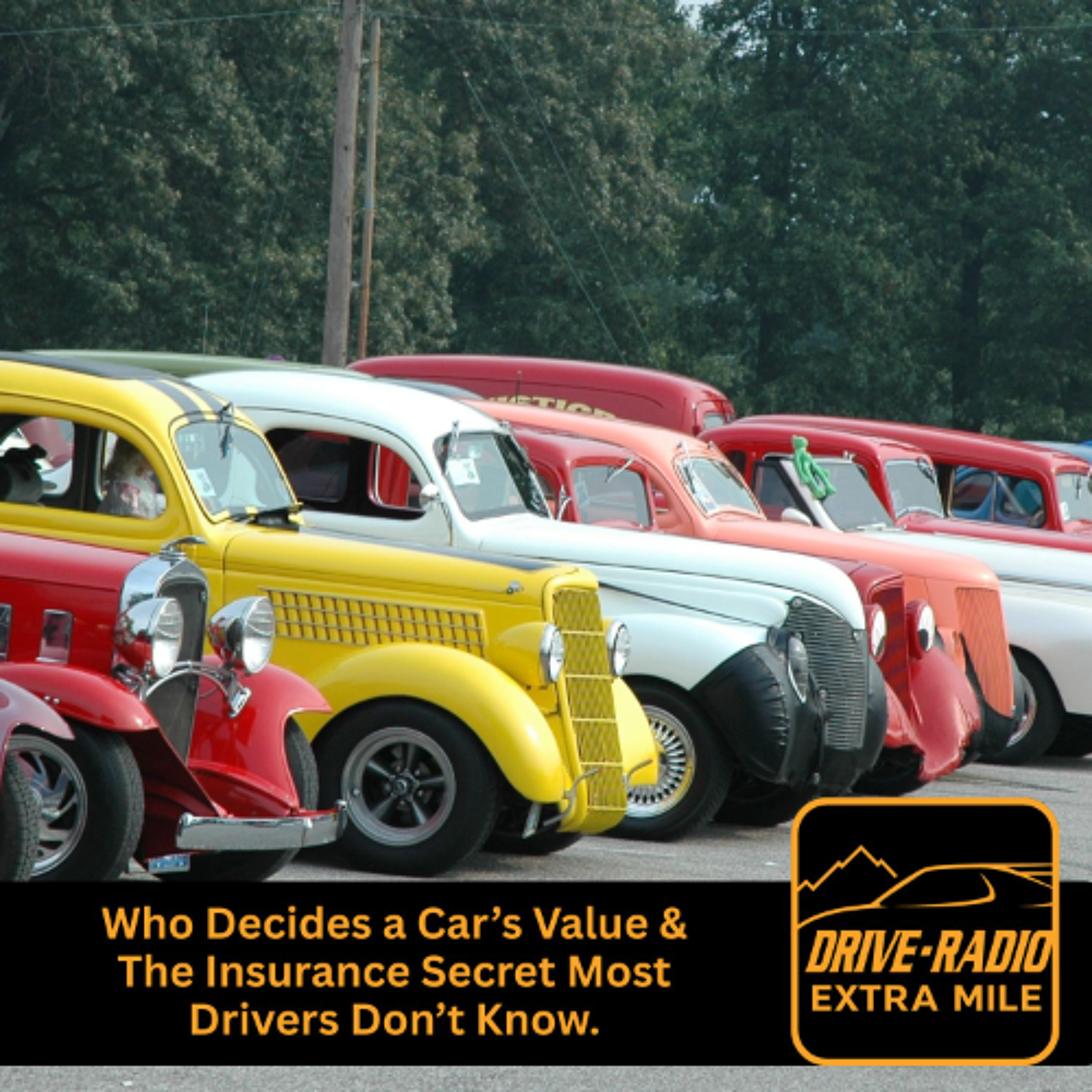

Most people think they know what their car is worth—until reality hits.
In this episode of Drive Radio: The Extra Mile, John Rush sits down with Burke Payne of BP Appraisals to break down the truth about vehicle value, from daily drivers to classic collectibles. The conversation exposes how insurance companies operate, why most people leave money on the table after an accident, and how a professional appraisal can completely change the outcome.
They dig into diminished value—what it is, why it matters, and how one case jumped from a $6,000 offer to over $17,000 with the right documentation.
The discussion also
SPEAKER 05 :
This is Drive Radio, The Extra Mile, with your host, John Rush.
SPEAKER 08 :
welcome back another edition of drive radio the extra mile and again appreciate y’all listening any questions you guys ever have i know this is a pre-recorded hour that we do but a lot of you still have questions you can text those questions in 307 282 22 again 307 282 22 but let’s get at it we have got burke payne with us bp appraisals burke welcome how are you today sir I’m doing excellent. All right. So you texted or emailed me, I should say. And this ties in perfect because we actually had Burke on from a previous show we had done a few months ago as we got going into the extra mile. And I just played him last week. So we’re going to go back to back with Burke, which works out perfect, actually, because those of you that listened last week, Might even have a few questions that we’ll dovetail into today. So for all of you listening, first off, Burke, let’s introduce you, get new listeners that chime in on a weekly basis. So Burke Payne, BP Appraisals, what all do you guys do?
SPEAKER 07 :
So we specialize in automobile appraisals all the way from your daily driver to your classic hot rod sitting in the garage.
SPEAKER 08 :
Okay. Now, you also do some other things that can involve estates and things like that with firearms, correct?
SPEAKER 07 :
That’s correct.
SPEAKER 08 :
Okay. So for those of you listening, you name it, we’ve got you covered across the board on all of that. So if there’s ever anything you need along those lines, please talk to Burke. And then, you know, we’re going to get into things today with, you know, just why do you need an appraiser? What’s diminished value? Some of those things that I know we talk about on a continual basis, but Burke, it amazes me how many people… I will run into at times where they’ve had some problem. They’ve got an accident or something’s happening, and frankly, they’re really getting taken advantage of by, quote-unquote, the system, which you and I will talk about today, and it’s really no fault of their own. It’s lack of education. That’s why you and I are doing this today. They just don’t know any better on how to get things handled.
SPEAKER 07 :
Absolutely. The insurance companies really – They specialize in settling these claims for as low as they possibly can.
SPEAKER 08 :
Yeah, and for those of you listening, really quick, Burke, for those listening, please, we’re not talking, and I’ve said this before, not talking down to or about insurance companies or agents or even independent adjusters that are out running around, not public adjusters, but independent adjusters that actually work for The insurance companies, and again, we’re not putting these folks down, Burke. That’s not at all what I’m trying to get at here. The reality is, though, to your point a second ago, the system is designed to, in a way, work against us.
SPEAKER 07 :
Absolutely. And they use the need for us to get back into our vehicles differently. is one of the ways to settle these claims so quickly.
SPEAKER 08 :
Exactly. Exactly. Okay, you recently, and this is what you really emailed me about, and we want to talk about some today. You just got back from a nice conference. I want you to talk a little bit about that and what was involved there and just some of the details. I found it fascinating, so I’ll let you share that with the listeners, though.
SPEAKER 07 :
Absolutely. So as part of our commitment to our clients and to the industry in itself, We belong to the ASA automotive specialty groups, which is a group of automotive appraisers who, I’m trying to think of a correct, we’re peer reviewed. All of our appraisals are peer reviewed. We have to do continuing education. And we have to meet really high standards to be a part of this group. And This group is the top of the top when it comes to automobile appraisals. The people that are in this are ones that you would see on car shows all the time doing appraisals for very well-known celebrities and that type of thing.
SPEAKER 08 :
Well, and I want to add, too, because you sent me a sheet on this where I was able to read through some things. This even includes IRS compliance and legal defensibility. In other words, when you give an appraisal that somebody might be using for tax purposes, you have to be able to stand behind that, right?
SPEAKER 07 :
That’s correct. And part of the standards that we’re held to are the standards that the IRS holds and appraiser to.
SPEAKER 08 :
Okay. All right. Which I’m guessing, I mean, this is your world, not mine, but I’m guessing that’s different than just, you know, another non-accredited appraiser, I guess you could say. And I’m not sure exactly how that works, whether that’s even, I guess, let me ask this. Is it a legal thing, you know, state by state that appraisers have to be accredited? Or can you just say, hey, I’m an appraiser because I’ve got X experience?
SPEAKER 07 :
So in the state of Colorado, there is no accreditation or licensing, and that’s one of the reasons that I joined this group was because I wanted to have that educational background behind me.
SPEAKER 08 :
Okay. I wondered about that because it’s like, not to get way off track here, but for those of you listening, home inspectors are the same way. Now, there are some programs and things that, like you, Burke, inspectors can go through to where they’re accredited and they’re vetted and so on. But in the state of Colorado, you and I, tomorrow, Burke, could start a home inspection service and throw our sign up and off we go because in Colorado, there’s nothing that says you and I can’t do that.
SPEAKER 07 :
Yeah, that’s correct. It’s the same way with automobiles. You know, the Joe Blow car salesman can decide that tomorrow that he’s going to become a car appraiser without having the background and the education to be able to, one, have legal defense in court, you know, where I’m an expert witness in automobile, classic automobile appraisals, motorcycle appraisals, and RV appraisals. So with that kind of backing, when my report goes into court, because I’ve already been established as an expert witness, that puts an extra weight on my appraisal.
SPEAKER 08 :
Okay. All right. And again, for those of you listening, please, big deal. And I, gosh, a lot of you guys listening, you listeners, I should say, male, female, families, and so on, I’ve referred to Burke because there’ll be times where somebody will ask me, you know, what’s the value of XYZ, Burke? And While I have a pretty good idea, especially on vehicles, what some things are valued at, I’m not you. I’m not the expert. I watch the market trends as much as I can, but no offense. I’ve got a lot of other things that I do on a daily basis. I keep fairly good track of things, but I’m not you. I’m not delving into a particular car, a brand, mileage, things that might be unique to that particular car. And I guess this is a question for you. When it comes down to actually doing a – full certified appraisal, especially on like a classic car or even an insurance claim, which we’ll get into some of that and the differences in. But what are we looking at time-wise for you to get all that done?
SPEAKER 07 :
It’s probably a good, probably 15 to 20 hours of actual investigation work, not including the typing, the
SPEAKER 08 :
Okay. And again, for those of you listening, that’s why you’re not seeing me do that. I just, you know, as much as I wish I had that kind of time to do what Burke’s doing, and I want to try to help as many as I can, reality is, Burke, I don’t have that kind of time. And it’s why we partner with… you in this particular case. And we’ve got lots of partners that we partner with across the board from the, you know, the attorney, doctors, and so on, you know, car guys, etc. We’ve got a lot of folks that make this show happen on a weekly basis. But when it comes to the appraisal side, I don’t have that time, nor am I accredited. And frankly, I don’t know that this point in time in my life, I even got the time to go do that.
SPEAKER 07 :
It’s definitely time consuming. We definitely spend a lot of time either in class or just watching the market, which is also good. I mean, I love going to auctions and that.
SPEAKER 08 :
Yeah, but to your point, it’s because of those things that you’re able to keep tabs on what’s going on. And again, for all of you listening, and this applies, we’ll break some of this down and get into some of the different areas that this applies to, but some of you listening where you’ve got classic cars, maybe you’ve inherited something, maybe you think you might be inheriting something. Maybe you’ve got your own collection. You’re trying to establish some values as far as estate purposes go. I mean, Burke, there’s all sorts of scenarios, and I think folks don’t really understand at times how important having an appraisal is so that, I mean, let’s face it, Burke, at the end of the day, what we’re really trying to do is do a job for our listeners whereby they’ve got a standard to go by so everything’s fair at the end of the day. Am I saying that correctly?
SPEAKER 07 :
Absolutely. That’s exactly what we’re looking for. If you’ve got a five-car collection that you’re thinking that you’re going to need to give to your children or grandchildren, and you want to be fair and you don’t want to sway the scales in one way or the other, you get the professional approval. You know right where the market’s at. You know where it stands. You know what it’s going to look like. You know, I can’t guarantee what it looks like in the future, but I can say based on the past experience in this market, this is likely what it’s going to.
SPEAKER 08 :
Okay, so with all that said, talk about this actual event you went to, because some other things I find fascinating I wanted you to share, and some of this is just a little bit of entertainment, if you would, entertainment value, I guess I should say, in regards to Mercedes and some things that are going along those lines. So if you would, share some of that with our listeners, because I enjoyed reading about it, and I’m sure they would enjoy hearing about it as well.
SPEAKER 07 :
So we got the privilege of actually having this conference at the Mercedes-Benz Distribution Center.
SPEAKER 09 :
Okay.
SPEAKER 07 :
And attached to the distribution center is the Mercedes-Benz Classic Restoration Center. And so the first day we got a tour of a million-square-foot facility that used to actually build World War II bombers in it. Kind of ironic now that the Germans own it. But we got to tour this facility. We got to see how these cars come in basically off the boats. They’re transported to the facility, how they’re checked in. They go through them. They do an exterior inspection of them. And then they’re processed to the next destination, whether that’s, you know, to a client specifically or to a dealership.
SPEAKER 08 :
Okay. Million square feet. By the way, million square feet, that’s huge. That is a large facility. Let’s just say that.
SPEAKER 07 :
Oh, yeah. It was amazing. I mean, you could have, well, they literally, they told us that if the weather is bad outside and they have a plastic Mercedes that they need to put the miles on, they will drive it around the interior of their car. Wow.
SPEAKER 08 :
Wow. That’s cool. I mean, honestly, that’s really cool. And by the way, a real treat because not everybody, myself included, gets the opportunity to see those things. That’s really cool.
SPEAKER 07 :
It really was, and the behind-the-scenes tour that we got at the Classic Center was just amazing. They’re working on cars, every day they’re working on cars. They’re doing complete frame-up restorations on Classic, and then they’re doing just drivable components on Classic. And what was funny is they were telling us, they don’t throw anything away. Not a single part ever gets thrown away because they might need to use it or a piece of it on the next build.
SPEAKER 08 :
Okay, good to know. So they must have a really outstanding inventory system whereby they’ve got things cataloged and they know where each one of those type of parts are that you just mentioned and so on, which I find just fascinating. That’s cool.
SPEAKER 07 :
Absolutely. One of the things that kind of struck me was the way that they were basically putting a car… back together and the way that everything was labeled with the with the vehicle number the you know what part it was and it was all on tables on you know white butcher block paper everything’s so clean and pristine i mean you could have you you could have had lunch on the floor and not had a problem
SPEAKER 08 :
Amazing. Again, that’s a sight to see. What a privilege for you to do that. Now, with all of that and the tour and everything else, and not to put you on the spot, because for those of you listening, we do all this ad lib. Burke and I do a little bit of emailing back and forth, and here we are. We’re talking, and I like it that way because it’s more raw. It makes for a better time together, Burke. And so I have no idea what your experiences were like. But what do you find, what one or two things did you find the most fascinating in all of that, besides the fact they save all the parts?
SPEAKER 07 :
I think the most fascinating thing for me is just the meticulousness that they have of putting those back together. They went as far as the seat cushions for Mercedes used horsehair at one time. Well, they found a substitute for the horsehair. They actually use coconut husk. And they buy it in sheets, just like you would buy a hyperallergenic coconut husk. mattress, that’s what they buy. They use it for seat cushions. They can adjust the height of the seat cushions because taller guys have a problem fitting in some of the gull wings and that. So they’re making the seat cushions a little thinner so that us taller guys can at least enjoy a gull wing once in a while.
SPEAKER 08 :
Amazing. So they really are, in this particular case, attention to detail, which, you know, that goes along with what you’re doing. I guess what I’m trying to get at here is, you know, what you guys were learning there is their attention to detail, what that does, how that goes into the valuation of the cars that they’re actually going through and rebuilding and probably giving you guys some education on, hey, this is a really good rebuild versus some of the others that might be out there that aren’t quite that good.
SPEAKER 07 :
Absolutely. Understanding the difference between a factory rebuild and a, for lack of a better term, shade tree mechanic rebuild. Seeing the difference. One vehicle, they actually used dry ice to clean the frame of the vehicle. And you could actually still see the color changes in the weld from the factory. back in 1956. So it was just, you could tell that that was all original because of the way the wells
SPEAKER 08 :
Okay, so I’m imagining with all of what you learned there, which could be applied, by the way, to a lot of other vehicles and the valuation and so on, and this is where, as an appraiser, I’m guessing it’s really sort of – maybe dicey isn’t the right word, but it becomes more gray because in a lot of cases, you don’t know what’s underneath some of what’s there. You can’t see all of the underlayment, for example, of – body work and frames. I mean, you can get a pretty good idea. I know there’s tools that’ll tell us what the mill thickness is and so on. But at the end of the day, you can’t see some of what you got to see. And I’m guessing that’s where some of the challenges are in your end of things when it comes to valuations.
SPEAKER 07 :
Absolutely. Trying to see, like you said, what’s under the paint. You can hide a lot with paint. You can. I’ve seen some really bad examples of of hidden Bondo under paint five years later. When it came out, you wouldn’t have known it. But five years down the road, that Bondo shrinks and cracks, and then all of a sudden you’ve got two inches of Bondo in the quarter panel.
SPEAKER 08 :
Which, for lack of – or maybe to kind of jump into this really quick, which you and I don’t think we’ve ever talked about this, but for those of you that are out there listening, whereby you’re either acquiring a car or you maybe have built a car, you’re trying to get it appraised, and this is more of a question for you, Burke, maybe a statement as well, but – How important is it to, to me, I think this is hugely important, but how important is it to document, picture, take, you know, take as much as you can in and build really a binder, if you would, on the build as to who did what, when, how, the person that did it, you know, what’s their knowledge level and background in the industry and so on. I mean, I’m guessing that for you as an appraiser, some of that makes a huge difference.
SPEAKER 07 :
Absolutely does, and it makes a huge difference when it comes to selling it, too. When you hit the auction with it, having that documentation is going to drive the value up because there aren’t the hidden questions of, is there two inches of bondo in the right front quarter panel? Or is this an OEM quarter panel, or is it an aftermarket quarter panel where the metal
SPEAKER 08 :
Yeah. You know, those type of documentation… Oh, no, it makes a huge difference. And real quick, some of the things I’ve learned of late, because as we all know, too, this is something else I wanted to throw in for those of you listening. Things change. And what I mean by that is we’re now entering into another time where in the collision world, especially on the restoration end of things, we’ve got much better primers and fillers and things like that than what we did even, Burke, five years ago. So where I’m going with this, folks, is all of you listening… I was I’ve been following a guy on social media whereby there’s a new special type of primer that makes sanding and getting your lines correct and and getting all of the sand scratches out and so on. And it’s becoming in its art, as you know, Burke, very much so. These guys that do those types of cars, it’s very artistic in the way they do it. My point is, is there’s better tools and technology today than there was even five years ago. And to me, that would be really important to know as an appraiser as to how that restoration was done.
SPEAKER 07 :
Absolutely, because it’s all about, is this new old stock? Is this, like I said, a remanufactured part? One of the things they were telling us in the Mercedes plastic restoration center was that when they’re stamping the quarter panels in that, after so many, those stamps actually start to deform. And they can actually kind of tell based on how they were deformed when that actual fender was stamped so if you think about you know a mercedes you know front front fender you know piece that they’re stamping from 1956 how informed is that now yeah great point great point all right hang tight guys we’re going to come back on a lot more to talk about with burke burke before i let you go what’s the best way for folks to get a hold of you The best way is just get a hold of us either by text or phone call at 720-295-0108. All right.
SPEAKER 08 :
Let’s do this, folks. We’ll come right back. You’re listening to Drive Radio, The Extra Mile. Don’t forget the text line 307-282-22, 307-282-22.
SPEAKER 01 :
Now is a great time to take advantage of Geno’s Auto’s best discount of the year. Save up to $50 on servicing your vehicle. Mother Nature is starting our warm season prematurely, and it’s a good time to prep your vehicle for an early summer. Cooling system maintenance, your radiator, hoses, and belts combine to keep your vehicle cool when it’s hot outside. The refrigerant in your air conditioning system gets contaminants, evaporates, and breaks down over time. That refrigerant needs to be able to absorb heat to be able to cool your vehicle’s interior. Genos is celebrating over 43 years in business, serving Littleton, Colorado. We invite you to check out all our Google reviews. We offer loaner vehicles so you can drop your car off and pick up when ready. Save up to $50 on servicing your vehicle now through the end of the month. Give us a call or go online to schedule an appointment. Genos is AAA approved and located at Bowles and Platt Canyon. Stop in or visit us online at genoautoservice.com.
SPEAKER 06 :
How great is the free nationwide peace of mind warranty from your Napa Auto Care Center? 24-month, 24,000-mile protection. Great. Honored by more than 13,000 Napa Auto Care Centers nationwide? Great. Travel with confidence knowing that if you have a problem, help is just a toll-free call away. Oh, and did we mention that your Napa Auto Care Center’s peace of mind warranty is free? Get this great warranty at your nearest Napa location.
SPEAKER 05 :
This program was recorded earlier for broadcast at this time. No phone calls can be accepted.
SPEAKER 08 :
And we’re back. Drive Radio, The Extra Mile. Burke Payne again. BP Auto Appraisals. Actually, BP Appraisals, because you do, again, other things outside of auto. We’re talking auto just because of, of course, you know, Drive Radio and all of that, Burke. But on top of just learning through the experience you had at this conference and being at the Mercedes-Benz Classic Center, I think it’s called, Mercedes-Benz Classic Center USA, which I don’t know if I ever asked you, where was that located at? It was in Long Beach, Long Beach, California. Okay. So around on the coast. Very cool. Besides the things you mentioned in the last segment, what else did you learn being there?
SPEAKER 07 :
So in the conference, we talked a lot about the market, what was going on in the market. We talked that basically with the cost of restoration right now, and everybody knows the costs are outrageous right now when it comes to restoration, the cars in the state, say 3, 3 negative to 4 range, the market’s really softening them just based on the cost of restoration. Kind of where the sweet spot looks right now is taking that 3 plus vehicle and having it massaged up to a 2. That seems to be where the kind of market sweet spot is right now.
SPEAKER 08 :
Okay. Okay. And for those listening, because this is something that I, I mean, I’ve been around this enough and been around you enough to know what that means, but give us what those numbers mean. And it’s, it is, what is it? One to five? I can’t remember.
SPEAKER 07 :
Yeah. One to five. So five is your project car. Five is your, you know, your basket case, for lack of a better term.
SPEAKER 09 :
Okay.
SPEAKER 07 :
Four is… You know, runs and drives but has some issues, maybe some mechanical issues, you know, some obvious dents, paint that.
SPEAKER 09 :
Okay.
SPEAKER 07 :
Three is, you know, runs and drives probably, you know, gets taken to the local car show, you know, where it probably doesn’t win but it probably gets some attention. Okay. Threes are local car show winners. Twos are… like excellent, almost concourse, you know, not quite Pebble Beach, but we’re getting close. And then, of course, ones are Pebble Beach.
SPEAKER 08 :
Right. And for everybody listening, and Burke, you can chime in on this, but there are, in my opinion, maybe I’m wrong, but there are very, very, very few number one cars out there. Am I correct in saying that?
SPEAKER 07 :
Absolutely. And you see them at Pebble Beach, those kind of shows. The Audrain, those, you know, that’s where you’re going to see your number one.
SPEAKER 08 :
Yeah. Yeah, Bear Jacks and some of the auctions like that, you might see some number ones even rolling across the auction. And for those of you listening, by the way, those are the ones that are bringing really big money that, unfortunately, Burke, everybody that sees that car thinks their car is now worth that money, and they’re not because they’re not number one cars.
SPEAKER 07 :
That’s absolutely true. And that’s what it, you know, sometimes that’s the hard truth that I have to tell people. because people watch Barrett-Jackson and Mecham, and they’ve got that car in the garage, and they’re like, oh, that one just went for $1.5 million. Mine’s got to at least be a million. And I get out there, and it’s like, I wish I could say it was, but unfortunately it’s not.
SPEAKER 08 :
Yeah, and really, folks, I’m not trying to be mean or rude to anybody, but Burke, that car that went across the auction a million bucks, you might have a car that’s worth $20,000 or $30,000 in relation, and I’m not exaggerating when I say that.
SPEAKER 07 :
No, absolutely not exaggerating at all. And the other thing that we talked about was a restoration on a vehicle is not necessarily an investment.
SPEAKER 08 :
True. A lot of times it’s a hobby. Yeah, relatively rarely, or I should say rarely, is it an investment. There are those times, and I saw this at Barrett-Jackson when I was there in January, where you could look at a car, ask some guys, how much money do you have in that car, time, et cetera, and you watch it go across the auction block, and some of these guys were making… You know, a couple hundred grand, Burke, when it was all said and done. That is not, I repeat, that is not the norm. There are some unique cars that you know if you get your hands on it and you can go through the proper restoration, yes, you can make money. But, Burke, that is few and far between. Most restorations are losers.
SPEAKER 07 :
That is absolutely true. We talked about it. It’s a hobby.
SPEAKER 09 :
It’s a love.
SPEAKER 07 :
It’s the love of doing it. I’m going to make a million dollars. Because if you go into it with that type of mentality, you’re just going to be crying at the end.
SPEAKER 08 :
Well, and, you know, I’m glad you said that because this sort of, you know, brings some things, you know, back down to earth because I think one of the things, at least I’ve run into this doing the show as long as I have, I know you have as well doing what you do, and that is that person that inquires and they’ve got a car that they either see in the neighbor’s house or maybe they’re inheriting it, maybe their aunt or uncle or grandparents or even, you know, folks might have that car. And so they look at it, they look at the auctions and things like you just said, and they think that they’ve got what they need. consider to be a number one or two car, which is probably more like a number three and a half to four car, depending upon how well it’s been taken care of. And they just don’t understand or grasp the great chasm of difference there is in price from one end of that to the other.
SPEAKER 07 :
Absolutely. And that’s the thing, that chasm of price, as you put it, it can work both ways, though. You could have that That number three car sitting in the garage, you’re like, oh, it’s just the 65 Mustang, but there could be something special about it that makes it a higher value vehicle.
SPEAKER 08 :
True. No, you know what? Great point. And by the way, that’s where – plug in Bert because he’s here today, but that’s where you come into play. So for all of you listening, please, I mean this sincerely, before – You venture out on any kind of a sale on something either you own or a family member owns or it’s a part of an estate or you’re trying to help your neighbor out. Before you venture down that path, at least employ Burke. Find out exactly where that car is at or at least the range that that car should be sold or bought at, which, by the way, those can be two different numbers, and Burke can explain all of that. But at the end of the day, it’s best to have – that old saying, Burke, knowledge is power – you’re providing them that knowledge that gives them power.
SPEAKER 07 :
Absolutely. And it, we’ve really found that for people that are doing sales and I, and I followed through with some of my clients that have been, that have asked us to do appraisals for a vehicle sale. We found that handing a potential buyer an 86 page document, including all the, all the pictures of it up close damage, all that kind of stuff. There’s, They know what you have, you know what you have, and it makes meeting in that middle, in that sweet spot, so much quicker and so much easier.
SPEAKER 08 :
Yep. Yeah, and the other thing, too, that I would mention, and Burke, I want you to talk about this as well, and that is this, maybe misconception is not the right way to say this, but this idea that, well, you know, I had it appraised three years ago, and that’s what it appraised for then, and it should be worth that or more today. Burke, you and I both know that nothing could be farther from the truth.
SPEAKER 07 :
Absolutely. The market is fluctuating all the time.
SPEAKER 08 :
Sometimes monthly, as you know.
SPEAKER 07 :
Yeah, absolutely. And a lot of times it’s media-based. So what we found really drives value in vehicles is what did the vehicle mean to the public in general? Got it. What did the vehicle mean to the individual in themselves? And what did it mean to the media? So take a 57 Chevy, a classic, a Bel Air, 57 Bel Air. Everybody knows that vehicle. Everybody knows the fins. It’s an iconic vehicle. What did it mean to society? You know, you’ve got these, you know, that was kind of the piece of resistance in the 70s. You know, everybody wanted one. And so that very much drove up the price. And what we’re seeing is, as those media influences and the the influence on society wanes, the price also diminishes.
SPEAKER 08 :
Well, and I say it bluntly. Unfortunately, the folks that really enjoyed that car, Burke, they’re aging out. I mean, like my dad, who passed away this past October. I mean, that era of individual that really loves those cars, because personally, that was never a fan favorite of mine. I’m 61. You guys know the era that I grew up in. A lot of my, you know, Cohorts maybe thought that was a great car to own. I never was a big fan of, if there’s any car I liked at all, it was a 56, not a 55 or 7. That was my favorite. But even then, I never owned one because, I’ll be straight up honest, Burke, they weren’t great cars to own and drive. So for me personally, I never did. And my point is, and you just said it, that age group of individuals, it’s supply and demand, it’s economics, that age group of folk that really loved cars Those cars, they’re no longer around. And here’s what I always have to remind everybody of, Burke, and this is something I think that people tend to forget. The people go away, but the hard asset, the car, unless there’s a total and an accident or it’s stolen or something along those lines, those cars stay in existence. They don’t go anywhere.
SPEAKER 07 :
Absolutely. And like you said, with the aging out of the market, we’re seeing an influx of those vehicles into the market. And it’s actually causing the price to go down also.
SPEAKER 08 :
Because the supply is increasing. The demand is going down. The supply is going up. And you all know how that works. If supply goes up, demand goes down, prices drop. If it’s the reverse and there’s less supply and more demand, like the number one cars we were talking about a moment ago, that’s why, Burke, they bring so much money.
SPEAKER 07 :
Absolutely. It is about supply and demand. And right now, the market is getting, maybe not flooded, but definitely getting an influx of those 50s era vehicles. Because the younger generation, you know, my generation, your generation, it’s not our favorite car.
SPEAKER 08 :
No, no, we are muscle car guys. I mean, for you and I, we were looking at, you know, 67, 68, newer vehicles into that early 70s, if you would. You know, probably that 67 to 72, 73 range. That’s kind of what, you know, you and I grew up with. And that’s the car personally for me as a classic. I do and would prefer that. to own, and unfortunately, you go back even past the 50s, and for some of you listening, I’m sorry to say this, but there’s a ton of super nice, you know, 32 Ford Highboys, 34 Fords, you know, 32 3-windows, 32 5-windows even. I mean, there’s a lot of those cars floating around, Burke, that, by the way, probably had hundreds of thousands of dollars invested into them that I’m not exaggerating, you can buy for $25,000 to $30,000 today.
SPEAKER 07 :
Absolutely. And like we said about the media, you know, think about
SPEAKER 08 :
American Graffiti right what did that do to that particular group that’s right vehicle that’s right good point you know that everybody wanted one that’s right everybody wanted you know and and well and really really quick not to you know not to belabor this but but to your point you’re exactly right the media sites you had American Graffiti which what you and I grew up with but now what kids my kids have grown up with is you know Gone in 60 Seconds and Fast and Furious whole different generation of media or, or an outlet, I guess you could say, and what was focused on in those shows. And it’s not the cars you and I are talking about.
SPEAKER 07 :
Absolutely. And that’s, you know, that’s it exactly. And even if we, part of our connoisseurship with this, with this conference that we went to, as I went to the Peterson museum and they had the fast and the furious vehicles there on display. And watching from, trying to watch from the outside and just be a spectator of what the market was doing or what the influence was, the crowds around those vehicles was huge. was way larger than the crowds were around. Even some of the concept cars of the fifties and sixties. Wow.
SPEAKER 08 :
Which to me, those are really, yeah, I’m one of those where though I would have been around those because, you know, I, I understand the value of, but, but, Again, and I think this is where, you know, folks in general, you know, again, they watch TV, they watch Meek, and they watch Barrett-Jacks, and they sort of get this misguided idea of what some of the values are, and they’re not tuned in to what, you know, you are and even I am to a certain degree. They’re not watching some of these things, and so they – they get this idea in their head that these things are worth X amount of money. And the reality is, unless it’s a 69Z28 that they only made X amount of and it’s all numbers matching and everything is done correctly, and I’ll get into a moment whether it’s a full rotisserie build or all stock and really nice as a stock vehicle, which sometimes can bring more money than even the rotisseries can. I mean, at the end of the day, there’s a huge difference there in – what I think we’re trying to do today is for all of you listening, educate you on this because there is a vast difference in all of this.
SPEAKER 07 :
There’s a huge difference. And just like you said, in the quality of the rebuild, you know, is it, is it a complete frame off? Is it, you know, are they making it just drivable?
SPEAKER 09 :
Right.
SPEAKER 07 :
You know, one of the, one of the vehicles at the Mercedes classic was one of the junkyard Mercedes that was purchased in Barrett Jackson.
SPEAKER 08 :
Okay.
SPEAKER 07 :
And the owner of it, didn’t want anything done to the exterior of the vehicle, but the entire underneath, all the bushings, everything was redone. You know, it was amazing underneath, but on the top, it looked like it was sitting in a junkyard. And I understand the philosophy behind it. I really do.
SPEAKER 09 :
Right.
SPEAKER 07 :
And, you know, because of that, that iconicness of it.
SPEAKER 08 :
Right.
SPEAKER 07 :
You know, that’s going to be a media starlet.
SPEAKER 08 :
Yeah. And that’s where for some of you, this is the other thing I’m going to recommend that you do. Some of you may acquire some of these cars and think, okay, yep, I want that car. It’s been in the family. I’m going to keep it in the family. It’s more of the love of the car, and I understand all of that. Well, when it comes to the value of it, though, this is where I think, Burke, you come into play as well. And what I mean by that is there are some cars where, depending upon what it is, you may not care for its paint, its paint condition, and all of that, or even the color of it. but you may be best off doing the mechanical end of things and getting all of that up to speed, but leaving the rest of that alone, including the interior, if there’s a few tears here, there, whatever, but if it’s all original, you may be better off just leaving it alone.
SPEAKER 07 :
Absolutely. A lot of times when certain buyers are looking for certain cars, they’re looking for the rawness. They’re looking for what they should look like today. Take a Corvette. Corvette owners are very meticulous about Corvette has to be Corvette.
SPEAKER 09 :
That’s right.
SPEAKER 07 :
And if you take a late 70s or I guess early 70s Corvette, by now the paint’s crackling. It’s got micro fractures in the paint.
SPEAKER 09 :
That’s right.
SPEAKER 07 :
If you go and have that painted with new technology, it’s going to look beautiful. But you devalued it. I admit it. But you’re going to devalue it.
SPEAKER 08 :
Right. That one is definitely a loser because what you spend to paint it, $20,000, $25,000, which is what it would take to do that car correctly, you’ll never get that back out of that brick, not even close. In fact, to your point, you may not only lose money on the 2025, you may devalue the entire car by doing so.
SPEAKER 07 :
Absolutely, because it’s going to turn off those buyers that are about the originality.
SPEAKER 08 :
Well, it’s me. The guy you’re talking about is me. I would much rather buy a car that’s got all of that originality to it that may not be exactly perfect. It may have some dings and dents here and so on, which, by the way, with paintless dent removal, you might even be able to handle and do some things that way and still make the car look very well without even touching anything. That’s a whole other conversation probably for another day. But I’m one of those, Burke, where I would rather buy it all original versus somebody that’s gone in and maybe didn’t even do it correctly.
SPEAKER 07 :
Absolutely. You know, you think about the difference between, I mean, to date myself, a Earl Shrive paint job or a professional, you know, collision center paint job, the difference in those two paint jobs. You know, for those that don’t know, Earl Shrive was, I remember as a kid, it was $99.95. In by nine, out by five. Right. And the paint was not the greatest. I mean, I had a couple of vehicles painted by Earl Shrive.
SPEAKER 08 :
It was a really quick way to get color on it and do whatever you wanted to do with a sail or whatever, but it was by no means show quality, not even close.
SPEAKER 07 :
Absolutely. And if you think about, you know, like take a classic car like a, like a Mustang, a 65 Mustang, or even different years, if you’re going for that classic concourse condition restoration, one, your painter needs to know where the overspray should be at.
SPEAKER 08 :
That’s right. That’s right, because it has to be original. That’s exactly right, Burke. Good point. Yeah, because people forget those cars were not built to the same standards of even the cars of today are. You’ll find a new car today having much, much, much better paint and being finished better than what they were back in the, you know, 60s, 70s, 80s, even 90s, Burke. I mean, the reality is they’re so much better today than they were then. But that doesn’t matter because, to your point, that originality of the car is where the dollars are at.
SPEAKER 07 :
Absolutely. You know, think about some of the paint issues that have gone on over the years. You know, the 99 boards with the clear coat that peeled off like, you know. Dead skin.
SPEAKER 08 :
Good point. Good point. So, again, folks, for some of you, before you even think about digging into a restoration or having something done, especially, especially, folks, on paint, body, that kind of stuff, even interior work, by all means, please see Burke. Now, I want to throw one thing else out there as well. And I know Restomods, in some cases, Burke, they’re doing very well. That’s the one I still have a hard time understanding. at times wrapping my head around because it’s like this car is not even close to being original. I get it. It’s cool. It’s a driver and all of that. But to me, I’m a purist. I want that car back to its original form. Yet there are some resto mods and depending upon who and how they were built are bringing pretty decent money, which I just find honestly, Burke, that’s the one I cannot wrap my head around. And I don’t know how you determine what their values are.
SPEAKER 07 :
They’re challenging. We’ve definitely had some challenges, some restomods that go against the grain, like putting a Chevy small block and a Mercedes. How do you value that? It’s one of those things where I guess knowing the market and knowing what people are looking for is basically how I do it. By going to these conferences and collaborating with the other elites in the appraisal group and learning from them and them learning from what I’m doing. We share that information and share what we’re seeing going on in the market. One of the things we talked about was how important car clubs are to the values of vehicles.
SPEAKER 08 :
All right. Hold that thought. I want to come back and talk about that because that one I want you to explain a little bit more. For those of you listening, always have any questions at all, you can text us 307-200-8222. Burke, before we go to break, one more time, how do folks get a hold of you?
SPEAKER 07 :
Best way to get a hold of us is either text or call my direct number at 720-295-0108. You can also get on our website and ask for a start your appraisal on our website, and I’ll get a hold of you and get back to you.
SPEAKER 08 :
All right, guys, we’ll come right back. This is Drive Radio, the Extra Mile, heard right here on KLZ 560.
SPEAKER 06 :
You need to count on your vehicle several times each day. That’s why NAPA Auto Care Centers count on nothing less than the knowledge and skills of ASE certified technicians to maintain and repair your vehicle. NAPA Auto Care Center technicians study and pass rigorous testing to stay trained on today’s vehicle technology for both domestic and import vehicles to give you confidence in a job done right, on time, the first time. Visit your NAPA Auto Care Center today. Find a location at NAPAonline.com.
SPEAKER 02 :
Have you ever had to clean out a parent or relative’s house and thought, where do I even start? For many families, that happens suddenly after a move, an illness, or the loss of a loved one. It can be incredibly overwhelming. Taking time to declutter now can make life so much easier for you and for the people you care about. Reach out to Paula with Neat Freak Solutions, a professional organizing service helping people throughout Southeast Wyoming, Northern Colorado and surrounding areas. Paula will work with you to simplify your home, downsize your belongings and make your spaces easier to live in. Together, you’ll go through things one step at a time, deciding what stays, what can be donated and what can finally be let go. Because clutter isn’t just about stuff, it’s about stress. If there’s a space in your home that feels overwhelming, Paula is here to help. Call 307-222-9539. That’s 307-222-9539. Or visit neatfreak.solutions to learn more. Neat Freak Solutions. Less chaos, more breathing room.
SPEAKER 05 :
This program was recorded earlier for broadcast at this time. No phone calls can be accepted.
SPEAKER 08 :
Welcome back. Drive Radio Extra Mile, KLZ 560. Burke Payne with us, BP Appraisals. And Burke, we left off that last segment talking about car clubs being really the lifeblood of some of this value retention that’s in some of these vehicles. Explain why that is. Because that one, again, that’s another one where I’m not sure I understand that one. So even me, explain that.
SPEAKER 07 :
So basically what we talked about was the fact that a car club, and particularly a car club that does events, Does driving, does the community work where, you know, they bring new people into the fold. So, you know, let’s take, you know, let’s pick a firebird club. And the firebird club is the driving club. And they announce, hey, we’re going to take our firebird that we’re going to drive. And someone walks along and they’re like, hey, I’ve got that firebird in the garage, but man, I can’t get it running. Someone jumps in and says, hey, you know, talk to this person, do that. It keeps the car alive and it keeps the interest alive.
SPEAKER 08 :
OK.
SPEAKER 07 :
And it keeps that it keeps them from disappearing into obscurity.
SPEAKER 08 :
OK, good point. Never thought of it that way. Good to know. I would have never. I mean, now that you explain that, that makes total sense. I wouldn’t have thought that way originally. That makes total sense, though.
SPEAKER 07 :
Well, and think about what the Mercedes Classic Center does there in Long Beach. They keep all the parts, right? If I’m looking for a part for my Firebird, what better place to look for it than people that own Firebirds?
SPEAKER 08 :
Good point.
SPEAKER 07 :
You know, that’s, you know, I mean, I think about my garage right now. What do I have in my garage? What I’m building? Yeah, I’ve got extra parts, you know. So if someone came to me and said, hey, you know, I just bought a 52 Chevy sedan delivery and I need, you know, the chrome pieces. Do you have them? I’m like, oh, I got a whole bunch of chrome pieces. Come on over and let’s see what I got, you know.
SPEAKER 08 :
Good point. I hadn’t, I hadn’t thought about that. That makes total, total sense because that community, I guess you could say that networking starts to happen and you can do things and find things that you wouldn’t do otherwise. Talk about, and this is another one that I’ve never been, you know, just have never been into that world. I don’t understand it. I suppose I could learn it, but it’s just never been a big interest of mine. And that is the Japanese classics. And I know it’s happening on the motorcycle end of things as well, but talk about that on the car side, on the auto side.
SPEAKER 07 :
So one of the things that we’re seeing is a lot of the Japanese cars being the right-hand drives being imported into the United States. And just one of the things we talked about, the media influence of the Fast and the Furious, bringing those vehicles in and the draw of them. And that’s the generation right now that grew up with Fast and Furious is starting to get that disposable income. They’re starting to get settled. They bought their house. They’re You know, they’re thinking, OK, what do I want? What did I want when I was a kid? That was the car. So that’s really driving the market.
SPEAKER 08 :
It really is. Now, one thing I was going to talk to you about as well, again, didn’t preface you on this, but I talked about this on my daily program a few weeks ago. And that is the wealth transfer that’s starting to happen from the baby boomer generation to the next generation to Gen X generation. And there are estimates that it will be as little as $85 trillion and could be as much as $150 trillion that is going to transfer Burke from one generation to another. Some of that, of course, is cash and stocks and bonds and investments, but it can also be, you know, first, second, third homes, cars, like we’re talking about, jewelry, watches, guns, and so on. Question for you. is that wealth transfer going to help some of what we’re talking about with some of these different eras of cars, or is it going to actually make it worse because it’ll flood the market with certain things?
SPEAKER 07 :
It’s going to be a two-edged sword, to be honest with you. It’s going to be, there will definitely be an influx of vehicles into the market, but that’s also going to make the buying opportunities better. Like you were saying, you might be able to pick up A vehicle that someone spent $150,000 on, restoring it for $20,000 or $30,000, and it’d be something that you wanted. And that’s where the market is right now is the driving it. People are buying cars not necessarily for investment, but for the enjoyment of the drive.
SPEAKER 08 :
Makes sense. And you know what? I’ve got some cars like that where it’s like, you know, if they go up, great. If they don’t, great. I’m still going to enjoy the car one way or the other. I didn’t buy it for the quote-unquote investment aspect. I bought the car so you could own it, drive it, have fun with it, and so on. And that’s where, again, for those of you listening, If you ever figure out and have that crystal ball to determine what vehicle is going to really go up in value – now, Burke, I know there’s going to be certain vehicles that are going to go up in value no matter what. I can guarantee it. I can bet you all the money I have that it’s going to go up, for example. You take an LS6, you know, 70 Chevelle or a 69 Z28. Yeah, that car right now and in probably the next decade, no doubt that car is going to continue to go up because there’s just so few of them out there. And guys that want them have the money to buy them.
SPEAKER 07 :
That’s supply and demand. Back to the supply and demand.
SPEAKER 08 :
Yep. So there are. There are some where you can pretty much bet what the car is going to do. But, Burke, there’s others where it’s like, you know, this is a really great car. I could buy it. I could have fun. I could drive it. But I have no idea if that car is going to increase or decrease as time goes by.
SPEAKER 07 :
Absolutely. I mean, like you said, that’s where the crystal ball is. The biggest thing is that, and they even talked about it in the Mercedes Classic Center, is that if you don’t drive these cars… They wither away and rot. True. Those bushings need to be, you know, flexed. The oil needs to go through the lines. You know, the brake fluid needs to go through the brake lines. They have to be driven or they’re, you know, some people, you know, put things in their garage and they’re like, oh, you know, in 20 years it’ll be worth more and I’m not going to, I’m going to put car cover over it. I’m not going to do anything for it in 20 years. Chances are you lost money because in 20 years now that, car has gone from a driver car to a project car because it can’t be just fired up and driven.
SPEAKER 08 :
Great point. And that’s, you know, it’s even a great point to myself where, you know, you end up with enough cars where now you’ve got to figure out time how to drive each one, which I do a pretty good job of. And I also will tell a lot of you listening, too, that the conditions of where you’re storing that, is it heated? Is it not? Is it in just more of a shed type, you know, atmosphere where the temperature changes are vast? And the more you can keep that like a museum climate controlled, you know, the better off you are. And not everybody has that. that opportunity, Burke, they just don’t. So again, folks listening, please. First things first, if you ever have a question on what is something worth, you know, talk to Burke, we’ve been talking classics a lot. But you know, we’re kind of that timeframe of the year, Burke, where classics are a big deal, people will be thinking about going out maybe buying one or acquiring one or taking the one they’ve got and fixing it up and maybe getting it out or maybe they’ve inherited one. And so it’s time of the year where I wanted to talk about that anyways. But before we close things out, we’ve got about 10 minutes left here. I want you to talk about the whole diminished value end of things and what you can do for folks in an accident. And by the way, folks, it doesn’t have to be a classic. It could be your daily driver. It could be a 2020 Honda Accord. I mean, Burke, it doesn’t make any difference. Pick your car. Once it’s been in an accident, it’s got diminished value.
SPEAKER 07 :
That’s correct. It absolutely does. The question becomes how much diminished value is there. If you take a 2005 Ford Taurus that gets in a wreck that has 300,000 miles on it, you’re not talking a lot of diminished value at that point. It’s pretty much used up. However, you take a 2025 Taurus, Land Rover with 1500 miles on it and do $40,000 worth of damage. I can tell you if the insurance company offers you six grand, you better call me because, you know, I mean, we just finished one for $17,000. Wow.
SPEAKER 08 :
Yeah, and for all of you listening, please, this is another one where I cannot stress this enough. A lot like the classic cars that we’ve been talking about in the education there. Burke, I cannot tell you how many people I talk to where they’ve had an accident, and I’ll have a conversation with them, and I’ll say, well, did you get any diminished value out of the insurance company for that? They look at you with this deer-in-the-headlight look like, what are you talking about? I’m like, well, you know the vehicle’s not worth what it once was. Huh? Yeah, it’s going to show up on a Carfax. You’re not going to get the same value out of that. If you go to trade that car in, it’s going to have, quote, unquote, diminished value, meaning it won’t bring what it once did. Did you get compensated for that from the insurance company? And literally, Burke, they look at me like I’m an alien.
SPEAKER 07 :
Yep, and there’s a lot of misnomers about diminished value. Some of it is that you can only get diminished value when you sell the vehicle. Right. But that’s not true because you’re going to get it at the time of the accident. Right. You’re not going to wait until you sell the vehicle to try to go back. In Colorado, the statute of limitations is about three years on diminished value. Okay.
SPEAKER 09 :
All right.
SPEAKER 07 :
And so if you wait. you know, four years to sell your vehicle thinking that I have to wait until I sell it to get my diminished value, then you’ve already lost out.
SPEAKER 08 :
Yeah, you lost out. And folks, believe me when I say this, it does matter because folks like me who, you know, I’ve been in the auto industry my entire life. And when I look at a vehicle, I was helping one of my family members buy a car not too long ago, Burke. And the first thing I did is when she was looking to buy something, I said, OK, send me the Carfax. And the first thing I looked at is how many accidents has it been in? And if there was any, I’m like, nope, don’t buy that car. Skip over, go find something else. There’s going to be a car out there accident-free where you don’t have to worry about any of this, and that would be my recommendation. I don’t care how small or how large the accident is. Move forward. So I’m a great example of I’m not buying a wrecked car.
SPEAKER 07 :
Absolutely. And the other side of it, and that was something that we had quite the heated discussion in our conference about, was is there secondary diminished values? Say, let’s take the Range Rover for instance. The Range Rover gets hit again at 5,000 miles. Is there additional diminished value?
SPEAKER 08 :
I would say there is, yes.
SPEAKER 07 :
Logically, yes. However, the kind of way the market is going is if a buyer will buy a car with one accident, they’ll buy a car with two accidents. So there isn’t the addition. We’ve kind of narrowed down that there really isn’t a second bite at the apple. So to that point, that’s one of the reasons that you really need to make sure that you get a good diminished value report. For us, to go back to the Land Rover, the gentleman’s insurance offered him just over $6,000 for it. We wrote our 48-page report. brought it in at over $17,000, and they wrote the check that day for that amount based on our documentation of the diminished value. Wow. Now, he could have got $7,000 for diminished value. Most insurance companies have about $1,000 that they’ll allow their agents to play with. And so, you know, some people are like, oh, I got $1,000 more. But how much could have you really gotten? And one of the things we do for people is we offer basically a free offer review. You call me up or you get on our website and send me the information from your insurance company and I’ll look at the numbers. And I’ll call you back and I’ll say, hey, this is what I’m seeing. Hey, your diminished value is Probably not going to be, you know, financially feasible for you to hire me.
SPEAKER 09 :
Right.
SPEAKER 07 :
But here’s what to tell them. Tell them you want $1,000. If they offer you a check for $750, take it and run.
SPEAKER 08 :
Okay. Good to know.
SPEAKER 07 :
You know, or… Or they offered me $6,000 diminished value. Well, it looks like your diminished value is about $11,000 more than that. So maybe we should invest the money and move forward with a diminished value appraisal or even a total loss appraisal.
SPEAKER 08 :
Makes sense. All right. Again, good to know on all of that. And all of you listening, please, any accident before you do anything at all, please talk to Burke. One last thing I want to get into, Burke, and I know you guys cover this. We’re going to have to have you back because we won’t get all of this in in the couple of minutes we’ve got left here. But the fact that a lot of cars right now aren’t even getting fixed. because the value of the used site is so high, they can take that thing to co-part, the insurance company can, and be better off when it’s all said and done, and write you a check for a total, making sure that it’s the right check, by the way, which is where you come into play, but the reality is they’re not getting fixed like they once were.
SPEAKER 07 :
No, they aren’t. A lot of them are getting scrapped. A lot of them are getting parted out. Parts are expensive. The number of times I’ve seen different computers in cars when I plug my OBD reader in and the VIN pops up as a different VIN than on the dash because they had to have the computer replaced. Yeah, they’re not getting fixed. And the cost of restoration, the cost of paint, the cost of the collision repair center, they’re The value, so at about 60 to 70% of the actual cash value is where they’re going to total that vehicle out at.
SPEAKER 08 :
Okay.
SPEAKER 07 :
All right. And sometimes an appraisal from us actually gets your car fixed.
SPEAKER 08 :
Might change it. Yeah, that’s exactly right. Good point. Good point.
SPEAKER 07 :
A couple incidents have happened where maybe not quite a classic yet, but say like a late 90s vehicle gets hit. And the person’s in love with the car, and they want it to get fixed, but they’re on that threshold, doing appraisal with us. All of a sudden, the insurance company’s like, okay, we’ll fix it. It didn’t meet that threshold.
SPEAKER 08 :
One last time before I let you go, give us your number.
SPEAKER 07 :
Once again, 720-295-0108. You can call, text. Pretty much 24 hours a day. I don’t answer it if I’m asleep. But we also have our website, which is BP Auto Appraisals. You can get right on there. You can start your appraisal right there on the website. I’ll look over the numbers, give you a call back, tell you where I think we’re at, and we can go from there.
SPEAKER 08 :
Burke, as always, I appreciate it greatly. Thanks for all your support, and I appreciate all you do and all your knowledge. You’re a vast wealth of information for us.
SPEAKER 07 :
Well, I certainly appreciate it, John. I appreciate the whole community. Every time I’m at a car show, someone stops and says, I heard you on Rush’s show. I got this question. Awesome. We’re more than happy to answer questions and help people out.
SPEAKER 08 :
That’s great. Burke, I appreciate it, man. Have a great rest of your day. I appreciate you very much.
SPEAKER 07 :
You do the same, sir.
SPEAKER 08 :
We’ll do it. All right. And again, that is BP Auto Appraisals. Give Burke a call. And again, we’ve been listening to this last hour of Drive Radio the Extra Mile right here on KLZ 560.
SPEAKER 04 :
The views and opinions expressed on KLZ 560 are those of the speaker and do not necessarily reflect those of Crawford Broadcasting, the station, management, employees, associates, or advertisers. KLZ 560 is a Crawford Broadcasting God and country station.