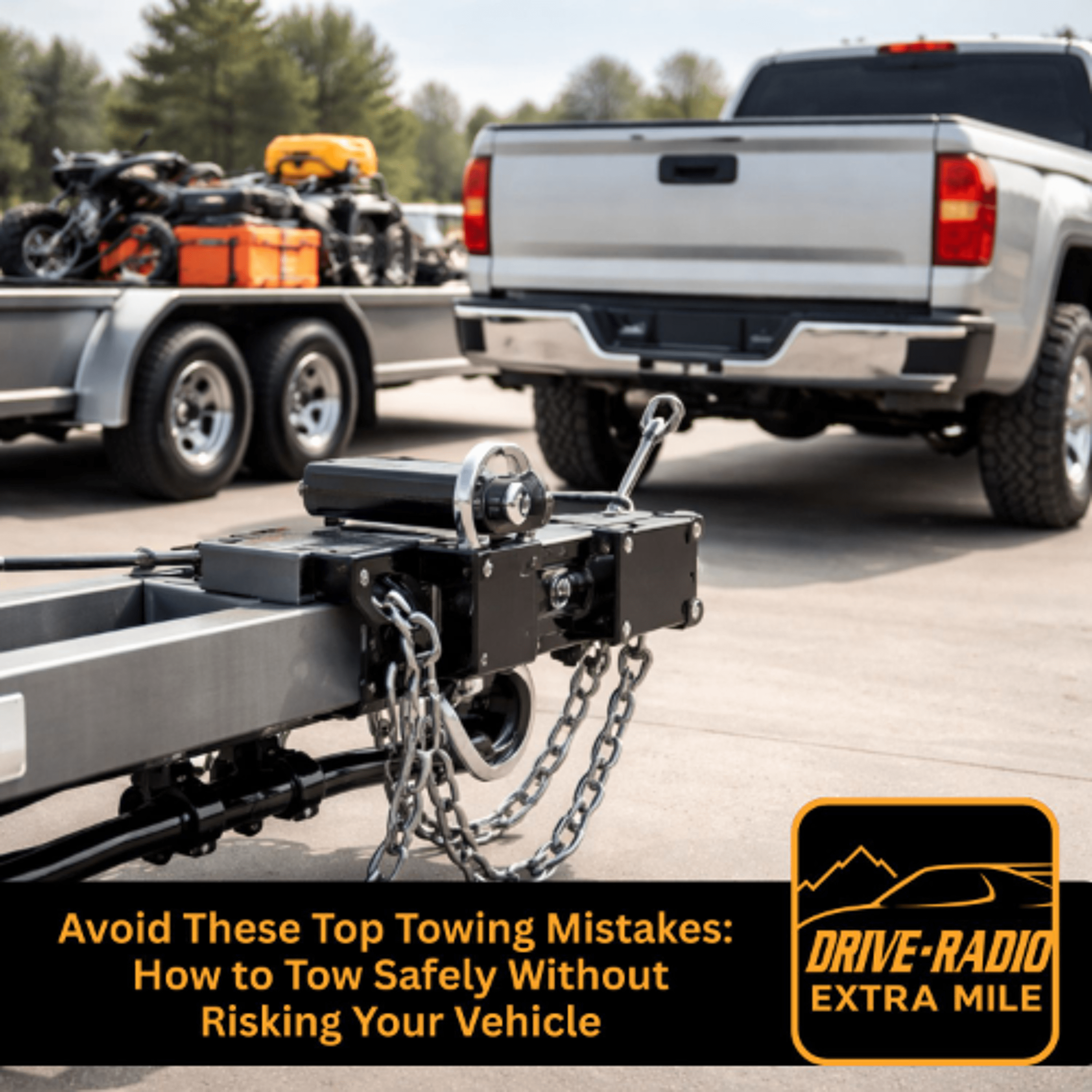

In this episode of Drive Radio, The Extra Mile, host John Rush delves deep into the world of towing, tackling myths, misconceptions, and the stark realities as experienced on highways across the nation. Joined by his engineer, Luke Cashman, John addresses a crucial aspect of vehicle safety that largely goes unregulated: towing. From RVs and U-Hauls to everyday trailers, discover the essentials of proper equipment, the surprising gaps in licensing requirements, and the importance of knowing your load. With anecdotes and practical tips, this conversation aims to transform novice tower listeners into well-informed masters.
SPEAKER 06 :
This is Drive Radio, The Extra Mile, with your host, John Rush.
SPEAKER 02 :
All right, another edition of Drive Radio, The Extra Mile. Appreciate you guys listening, by the way. Today’s topic, we’re going to talk about towing. And this is a topic that came from actually you guys just this last Saturday as we were talking through Drive Radio. I had a couple of text messages on, hey, maybe on the next Extra Mile you guys can discuss towing or you can discuss towing. I say guys because Luke Cashman is with me today, my engineer, and he can join in on this as well. And there’s a lot of facets to towing. Now, i know i always say this i’ll do my best to get all this in in the roughly 54 55 minutes we have for the extra mile if i have to carry this to a second episode i will because there is a lot to cover in towing but i will do my very best to get through you know at least as much of the towing sides of things as i can there is in my opinion a lot of Luke, let’s just say myths and misconceptions, I think, when it comes to towing. And one thing I want to get out of the way right off the bat is You will not hear some of these things from a lot of the places that sell trailers. Nothing against them, but typically a guy trying to sell you especially an RV, a recreational vehicle, whether they be a bumper pole or a fifth wheel or whatever, some of them are really good at helping you with what kind of a tow vehicle, tow rig you need and how it needs to be set up and so on, although I will say this straight up, most don’t. And again, not trying to be mean or rude to any of those individuals. And if you’re somebody that works in that, I’m not trying to be mean or rude along those lines. I’m just simply explaining that in some cases, you guys don’t do the greatest of job of explaining to people what they really need to tow with and or even how to tow. It’s sort of like, Luke, I think towing is one of those things where, by the way, unlike a lot of other things, You don’t have to have any special licensing. You don’t need to go through any courses or classes. I mean, we require motorcycle riders to even have a motorcycle endorsement before hopping on two wheels. There’s some basic things you need to know about riding a motorcycle and so on. And by the way, I see a lot of people riding motorcycles that do it incorrectly. That’s a whole show in and of itself. But regardless, there’s a lot of things regarding towing that there’s no licensing for. It’s like having kids. There’s no real instruction manual or test to have kids. You can just have them. Well, towing is kind of the same way. And by the way, this is pretty much true. I don’t think there’s any state in the 50 states that we have that require any kind of testing or testing. courses that you have to take to actually be able to tow a trailer. If you want to tow a trailer, you get whatever equipment you think, keyword, you think you need, you throw a trailer on it and off you go. And trust me, as somebody that travels I-70, I-25 a lot, Man alive, especially as you head into the weekends, especially as we get closer and closer to summer, why I wanted to do this particular topic this weekend. Oh, my word. Guys, I see everything. I mean, Luke, there are times where I watch some of these people trying to roll up the I-70 corridor, and I’m not joking. I’ll even sometimes look over at whoever’s riding with me, my wife or whomever, kids, whatever, and I’m astonished at times at some of the things you see people trying to go up and over the hill with.
SPEAKER 04 :
It is shocking that you don’t need any special licensing for it. You strap a couple extra thousand pounds on the back of a Toyota Corolla and, you know, cook 80 down to 225. It’s scary.
SPEAKER 02 :
It’s a scary notion. And we can go even way on the larger side. So Luke just explained something that happens and people can go rent U-Hauls, do all sorts of things. To U-Haul’s credit, they’re pretty good about making sure you have the right tow rig equipment. that you’re actually going to be towing a particular trailer with. So I’ll give U-Haul some credit. They’re pretty good. In fact, there are some things they will not allow you to tow with, depending upon the vehicle, the trailer, and so on. So I’ll give U-Haul a little bit of credit there because they actually, throughout the years, have gotten a little bit better on that end of things. But that doesn’t keep somebody from borrowing a trailer or buying one.
SPEAKER 04 :
Towing isn’t just a fifth wheel or an RV. It’s the people who are strapping pallets to the back because you’ve got a project in the yard. It’s people who are moving across the state. It’s a pretty big breath.
SPEAKER 02 :
Yeah, I’ve seen some of those of late, by the way, some of what Luke just explained, I have seen. And I was gonna say, we can go all the way to the other extreme. This is where again, there’s no licensing, you could have, you can go out and buy a, well, really any size truck you want, as long as it’s for private use, there is no CDL, you know, commercial driver’s license required. Again, no testing, no nothing, as long as you’re using it for private use only. and it’s not used in a commercial application, you literally can go get a pusher diesel motorhome, and I’m not exaggerating because of the laws, you can go put two trailers behind that pusher diesel motorhome if you want, a big nice enclosed trailer and a boat behind that if you so desire, and you can just truck on down the road. No experience needed. Everything I just said, no experience needed. You need a regular Colorado or any other state’s driver’s license. To go do what I just said. As long as you are licensed and have registration and insurance, knock your socks off. Terrifying. It actually is. If you think about it in the way that I just said, and Luke just said that in my ear, it’s terrifying. Yes, it really is. So one of the things that I want to discuss today is, first things first. Number one, and this is in my notes, know what you’re doing. And what I mean by that is, what are you needing to tow? And why? And then what vehicle do you have to actually tow that trailer with? So, for example, Luke just mentioned, you know, OK, you need a you need a little utility trailer. You’re going to go to a big box store and you’re going to, you know, grab a a, you know, I don’t know, some topsoil or whatever the case may be. You name you’re going to go grab a barbecue and stick because you don’t have any room in your car. So you need a little trailer to go do it. You know, so be it. Great. OK, fine. So be it. You know, there’s a lot of lightweight trailers that will do fine doing what I just said. Now, this is actually a topic in and of itself as well that I’ll brush on. Not all trailers are created equal. And what I mean by that is there’s some really good, solid trailer manufacturers out there that do everything correctly. They’re high quality, everything from the way the trailer is built to how it’s wired to the lights they use, how the lights are even protected, and on down the line we go. I mean, they are very, very, very well put together. On the same token, there’s a lot of junk on the market. And when I say junk, I mean absolute junk. These things are thrown together. I don’t know how they even meet specifications to even be towed. They’re absolute garbage. You can tell that by the minute you start looking at even the trailer coupler itself, which I’ll get into some of that today. I mean, you start looking at some of the basics of the trailer, and you think to yourself, how in the world is this thing even going down the road? So, folks, believe me. there is everything in between as well when it comes to trailers. And some of you are asking, well, okay, so how do you know the difference? Again, I could do an entire extra mile just on trailers and the quality of as many trailers as I’ve bought throughout the years, whether it be for me personally or in the business end of things. And as a company, just as a side note, some of you are thinking, okay, so what qualifies you for this? Well, number one, I’ve been towing trailers since I started driving because my dad always had trailers and we just used them for different things and so on. So I’ve been towing trailers and doing things along those lines literally ever since I started driving. Horses, you name it, I’ve pretty much towed it all. And then I’ve towed gooseneck trailers, fifth-wheel trailers, the whole nine yards. I’ve never been a semi-truck over-the-road trucker, driver, anything along those lines. But when it comes to trailers and towing and so on, yes, I’ve done a lot of that throughout my years of driving. On top of that, as a company, because of what we do in our fleet, we probably own – I don’t know, a couple dozen at least. And some of you are thinking, really? Yeah, I mean, because there’s trailers for all sorts of different things. Flatbed trailers, dump trailers, landscape trailers. I mean, you name it. There’s all sorts of different trailers even in my business that we use. And by the way, every one of those suits a different purpose. And this is the other thing that I see people make a lot of mistakes on that hopefully I can get to this is, is the trailer sized properly for what you’re hauling on it? And I think in a lot of cases, people forget how much certain things weigh. So, for example, and granted, a ton is a ton is a ton. So if you get a ton of dirt, it’s the same as a ton of rocks is a ton of feathers because 2,000 pounds is 2,000 pounds. It doesn’t make any difference. How they stuff it and get it in is two totally different things. But remember, 2,000 pounds is still 2,000 pounds. Now, where it gets dicey, though, is you go fill your trailer up with – Gravel, pea gravel, for example, pea gravel is going to be heavier than river rock. Fill dirt will be heavier than those other two because there’s no air, there’s no space in between. It’s like that old analogy where a professor takes a jar and he fills it full of fairly good-sized marbles and then asks the class, is it full? And the class will say, well, yeah, it’s full. Well, then he takes smaller marbles or smaller particles, sand, for example, and fills up the jar and asks the class again, is it now full? And they’ll look at it and say, well, yeah, it’s full. Then he takes water. And pours that in last, which, by the way, it’s still absorbing all of that water. Then he fills it up and then asks the class, is it now full? And, of course, at that point, yes, indeed, it’s full. Everything is now taken up, air, everything. It’s all done. And my point is a lot of people forget that scenario of what I just said when they’re hauling things. They’ve got a box trailer, for example, and it’s a certain cubic inch, if you would, as to how much space is there. But then they forget that the more dense the material, the less air is around it, the heavier everything gets. And a lot of times it’ll be based upon scoops or things like that. It’s not necessarily being weighed. I know there’s a lot of places out there, landscape supply companies and so on, where they weigh you coming in, weigh you going out. But there’s a lot that just rely on, okay, we gave you one and a half scoops. and they sell it to you based on that or you’re throwing in things on your own or you’re in your backyard filling it up with fill dirt or whatever the case may be and people tend to forget that the less air that’s inside of that load the heavier things get so point being know what you’re hauling and do you have the right equipment to do so and i’m one when it comes to trailers and the rigs and i’ll get into both of these throughout today’s hour I’ll just say it this way. I don’t want to underkill it. I want to overkill it. I want more than I need. So if I know, for example, I need to haul a three-ton load at 6,000 pounds, you know what? I want a trailer rated for seven or eight. I don’t want a trailer rated for six. I want it overrated. If I know that I’m going to haul X amount of weight behind a truck and the truck’s GVWR is, you know, 11,000 pounds, well, you know what? I don’t want to tow 11. I want to keep that around 9 or even 10 at the most. I want to stay under what that rating is. And so many people, unfortunately, it goes the other direction. They’ll say, well, I’ve got a truck that, you know, I’ve got an F-150s rated for 10,500 pounds, so off I go. Well… Not so fast. It’s still an F-150. It still has F-150 brakes. It still has F-150 drivetrain and so on. And tires, by the way. It’s got F-150 tires, meaning it doesn’t even have 10-ply tires. And in some of this, again, I’ll try to cover as much of these things that I just mentioned as I can because all of those things matter. Problem is we only have an hour, and I don’t know if I can cover every one of those aspects in an hour. But this first opening, my biggest thing is – You have to know what you’re getting yourself into. What are you doing? And, folks, the reason I say this is we all see examples. And, fortunately, there’s usually not deaths that occur from some of these accidents. But, man, you guys, there are so many things out on – social media youtube and so on that show different trailer type accidents i saw several this past week it’s funny i start talking about this then my feed starts filling up because that’s just how that works you know can you talk about something your feed fills up with it i mean i have seen things where sailboats come off of trucks and fly across the jersey barrier and the median I have seen vehicles towing another vehicle where everything comes loose or things start fishtailing, which I’ll get into in a moment, and then all of a sudden things start to go awry. And if you’re driving down the highway and you’re somebody that’s behind that, it gets really dicey really fast. So my point with all of this on the intro side of it is know what you’re doing. The last thing we want is for, A, you to have any kind of problems. But, you know… to coincide with that we don’t want to cause other people problems as well and let me tell you what i as somebody has told a lot of trailers over the years and even at times have had some issues with the trailer itself whereby something might break or come off and this is where safety chains come into play if you don’t have all of that hooked up correctly you now become the main accident for other people which you don’t ever want to be And this is where I’m just going to say it straight up. If you’ve never towed a trailer and you’re thinking about doing it, there’s a lot of people that will get into RVing first time ever. You know, I’m going to go buy the rig. I’m going to go buy the RV, whatever. We’re going to go RVing. Okay. You know what? Great. I have no problem with that. If that’s what you want to do, you do you. I’m okay with that. But know what you’re doing. Unfortunately, this is one of those areas that we were just talking a few minutes ago, Luke and I were, there’s no instruction for this. It’s hard to go out, and to my knowledge, and if somebody knows and can text me this, text line, by the way, 307-200-8222. If any of you know whereby somebody can take a class on towing, I’m all ears. I’ll pass that around all day long. To my knowledge, when it comes to the light-duty end of things and light-duty towing and hauling, I don’t know of anybody that gives courses in that. When you go get a commercial driver’s license, there’s all sorts of courses on how to drive a semi-truck with an 18-wheeler, big box behind you and all that, or flatbeds, whatever. They’ll train everything. I don’t know of anybody that does that on the small scale. I think most people just assume, what’s a trailer? I can tow it. And believe me, there’s a lot more to it. In fact, if you want to see anything entertaining… Go look up on YouTube, boat ramp fails. Boat ramp fails. And the reason why I say go look it up because it’s entertaining is most people don’t know how to back up a trailer. It’s way different going backwards than forwards. Because a trailer doesn’t necessarily want to go straight. It always wants to turn, so you’re constantly negotiating with the trailer as to what direction it heads. And if you really know what you’re doing, it’s easy to put things into the right spot. But if you don’t… It’s not too easy. And before some of you big truck over the road truck drivers make fun of guys with little trailers, it’s much easier to back in a semi with a fifth wheel type apparatus on it than it is some of the tongue type trailers, boats and so on, because they don’t tow the same way. That’s something else, again, I’ll try to get into. But two completely different ways of doing things when it comes to trailer towing. But I’m serious. If you want some good entertainment. and you’re bored sometime, just go look up on YouTube, boat ramp fails. And there’s compilations of videos whereby it shows people trying to back the boat down the ramp to the point where in some cases, some bystander has to come on, come inside the truck and actually do the job for the person driving it because they’ve never backed a trailer up probably in their life. And they have no idea how that works because you turn the steering wheel opposite of what you think when you’re backing in a trailer. That’s a whole nother conversation But coincides back with my whole point. Know what you’re doing. There’s nothing more embarrassing than getting someplace and somebody says, well, yeah, can you back that in over here and I’ll help you get loaded up and you have no idea how to back that trailer in. And my point on that is learn. Even if that means you take the trailer that you just acquired, you did the studying, you’ve listened to my advice, you’ve got the right tow rig, you bought the right trailer. Okay, now go out to a nice empty parking lot sometime. It might even be late at night. Go to a Walmart or someplace where there’s no traffic, nobody around, a school. Schools are great, especially on the weekends. There’s hardly anybody around a school. And go practice backing up. There’s stripes and lines and so on. And you can really test your skills by putting that trailer in between certain lines and different places of the parking lot. And the more you do it like anything else, practice makes perfect. So the more you do it, the better you get. And again, there’s nothing more embarrassing than going someplace, getting someplace. Even you’ve got that RV you just bought. Now you’ve got to back it into, you know, it’s not a pull-through campsite. You have to actually back into the campsite. Nothing more embarrassing than showing up and not knowing how to get the trailer into the spot. So know your rig, know your vehicle, know your trailer. And before I take a break, on top of the rig side of it, make sure you can see the trailer. I’ll come back and talk about that in a moment because so many people will tow with a rig that might be suited really well with one exception. It has the wrong mirrors. You can’t see what you’re doing because the mirrors on the tow vehicle aren’t adequate for what you’re actually towing. Now, this topic, again, was asked to be talked about by you all. Any topics at all that you want me to cover as we head, especially down these months into summer, let me know. 307-282-22. Again, 307-282-22. We’re going to continue on, though. Don’t go anywhere. We’ll be right back. This is Drive Radio, the extra mile, right here on KLZ 560.
SPEAKER 03 :
How great is the free nationwide peace of mind warranty from your Napa Auto Care Center? 24 month, 24,000 mile protection. Great. Honored by more than 13,000 Napa Auto Care Centers nationwide? Great. Travel with confidence knowing that if you have a problem, help is just a toll free call away. Oh, and did we mention that your Napa Auto Care Center’s peace of mind warranty is free? Get this great warranty at your nearest Napa location.
SPEAKER 05 :
Thank you. Thank you. No dealer fees. Competitive financing and trades are welcomed. A 30-day warranty on every vehicle and your first oil change is just $1. Explore detailed videos of every car at RidgelineAutobrokers.com before you visit. Ridgeline also has a great consignment program to assist you in the sale of your car, truck, or SUV. So if you’re ready to buy, trade, or sell your vehicle, call 303- This program was recorded earlier for broadcast at this time. No phone calls can be accepted.
SPEAKER 02 :
Welcome back. KLZ 560, Drive Radio, The Extra Mile, again, heard every Saturday, 3 to 4 p.m., right here on KLZ. Now, I want to continue on with the mirror topic a moment ago. Now… Typically speaking, when you get into a regular full three-quarter ton truck, Ram, Ford, and Chevy, or GMC, GM I should say, most of your three-quarter tons, if not all, will have some sort of an extended mirror option. Now, they may not look like they extend, but trust me, they do. And the reason you want that ability to extend is if you get a wider trailer. Some trailers can be eight and a half feet wide. I don’t think they can go any wider than that, but I think the law is eight and a half. And let me tell you what, when you get an eight and a half foot wide trailer, you need extended mirrors or you can’t see what’s behind you. You would have no idea if somebody’s, you know, tailgating you, if you’re trying to back up, you’re trying to get into a spot and so on. Now, here’s a tip, by the way, when it comes to backing up. Something my dad taught me years ago when I first started driving a vehicle and towing a trailer. And it’s a great tip. Anytime you’re trying to back a trailer in, position yourself where you can see everything from the driver’s side. In other words, when you’re going to back that trailer in, position yourself, even if it means you have to go around a block or you have to go around a circle or whatever, and you need to reposition yourself to come back in the opposite direction, never back in where it has to be on the passenger side, back in on the driver’s side so you can see what you’re doing. And that’s a little tip that I’ll be straight up honest, most people don’t know. I have seen what I consider to be some seasoned haulers, I guess you could say, people that have probably towed trailers all over the place that don’t know what I just said. So, for example, you’re wanting to pull your trailer into your driveway. And… Your street is such that you drive down the street, but your driveway is now going to be on the right or the passenger side. Do not try to back your trailer in on that passenger side. Now, some of you are probably good enough where you might be able to do that. But let me tell you what, it is way easier. If you can go around the block and come back the opposite direction so that your driveway is on your left, on the driver’s side. Then you pull past the driveway. You can see exactly where you’re at. Everything’s on your side. You don’t need anybody help watching the other side. You back the trailer into the driveway. Done deal. Piece of cake easy. Very few people know the tip that I just said, by the way. That’s something my dad taught me years and years and years ago. And yes, there’s been many a time where I’ve taken the extra minute or two, which is all it is, to go around the block and get yourself positioned to where things are on the driver’s side versus the passenger side. And by the way, you didn’t spend any more time because what it takes to back in when you’re on the driver’s side versus the passenger side, what I took to go around the block is already saved in backing in the way I’m talking. So, little tip for some of you that most people don’t know, and by the way, that’s true whether you’re a bumper pull trailer or you’re a fifth wheel, it doesn’t matter. Now, something else to think about. The longer the trailer and the rig, the easier to back up. I know that sounds counterproductive, but trust me in what I’m saying. The longer the wheelbase and the longer the distance between the wheels on the truck and the wheels on the trailer, the easier to back in it is. The shorter all that is, the harder. And the reason for that is because when there’s a shorter distance, every little movement is magnified. Where on that longer wheelbase from truck to trailer, even car to trailer, it’s not magnified as much, meaning there’s more room for forgiveness. There is nothing harder, and I’m not exaggerating, nothing harder than backing in some short little snub-nosed trailer. They are, of all trailers, if you’re ever going to get good at something, go get one of those and learn how to back in, because you can back that in, you can back anything in. And I mean that sincerely, because every little movement is magnified on those short little trailers, short wheelbase, as opposed to the long ones. Now, going back to know what you’re towing. And this is so key. Matching the vehicle to the trailer. And this is something, again, that most of the trailer companies… will not instruct you on because no offense folks they’re there to sell you a trailer if it’s got a ball and a hitch and a brake controller you’re going to hook up and go frankly they don’t care they don’t care whether your truck’s rated for that or not they want to see the trailer gone they’re going to give you the paperwork sign it off done handled out the door you go that doesn’t mean you have the right rig to haul with so do your homework how big is the trailer what’s its gvwr in other words how much does it weigh how much will it haul and by the way there’s usually going to be a dry weight and a wet weight especially when it comes to rvs always look at the wet weight and frankly add some to it because people pack everything they possibly can into a unit so for example you’ve got a camper trailer well first thing you do is you go out and put water in it because you’re going to take water with you you just added weight You’re going to fill it up full of propane, sometimes two bottles. That’s just added weight. Oh, you’re going to put all the mountain bikes inside. That’s just added weight. Oh, instead of hauling luggage, you’re just going to put your clothes and everything in the drawer. You’re going to fill it up with pots and pans and all of that as well. You see where I’m going with this? It never weighs… what it weighed when you pulled it off the lot. As soon as you get it home, when you start loading everything into it I just said, bedding, all of that, every single thing you add is adding weight to that trailer, meaning the trailer’s heavier than what you thought. That’s why I’m always wanting to say give yourself some cushion So you’ve got the ability to have that extra weight and not have it really affect anything. The last thing you want to do is I’ll use that F-150 as an example. And a lot of them will have a 10,500 pound GVWR. And then you’re going to go haul a trailer that weighs that. No. No, sorry. You need to stay well under that particular mark. And I know I’ll have some people that will probably text me and message me and tell me that I’m wrong on that. But believe me, folks, I’ve towed trailers long enough with different vehicles and so on. And I’ll just say this straight up. There is nothing more white-knuckled scary – than having an undersized vehicle hauling a trailer that is oversized for it, and then you get into some sort of an issue with wind or anything along those lines, and all of a sudden what you thought was going to be easy becomes a handful. Nothing, and folks, believe me, I’ve done this, nothing is more scary. I mean, white knuckle puckering up. You get my drift. Scary. There’s nothing worse than that because, you know, people have died. I mean, it doesn’t happen very often, but people have died from some of the scenarios I’m talking about where you’re undersized. Trailer’s too big. Something happens. Things go awry. And all of a sudden, yeah, you’re off on the side of the road. You’re in the ditch. You’ve rolled over, whatever the case may be. That’s the last thing you want to have happen. And again, like I said, opening up, I want everyone to be safe. I don’t want anybody having any problems at all. So match the vehicle to what you’re towing. And again, rule of thumb is, I’ll use that F-150. If you’re going to go haul a trailer that’s 10,000, 11,000 pounds, even though that F-150 is 10,500, go buy a three-quarter ton truck. You know, go buy an F-250 if you’re a Ford guy. Go buy a 2500 if it’s Chevy or a Ram or whatever. Don’t settle for the F-150. And I get it. A lot of the half-ton trucks today, power-wise, they can haul that. Not a problem. They have got more than enough power. In fact, some of the F-150s and such have as much power as their three-quarter-ton counterparts do. And that’s not an exaggeration. In some cases, maybe even more as far as horsepower is concerned. Doesn’t mean that’s the vehicle you should use. So match the vehicle to the trailer. And this is a big topic and one, again, I could dedicate an entire program to. Is it gas? Is it diesel? You know, folks, only you can decide. I do get a lot of you that will message me this time of the year asking me that very question. And here’s some of the parameters that I throw out to people on do you use gas? Do you use diesel? How often are you going to tow? In other words, is this a, you know, you’re going to tow the camper to some place and then drop it and then pick it back up this fall and bring it back? Okay, buy a gas engine truck. You’ll be fine. You’ll have no issues. Or are you going to haul every weekend? Well, if you’re hauling every weekend to and from, go buy diesel. Your horsepower and towing capability and what it does and so on, much better off with a diesel than it is with a gas engine. So a lot of this, again, comes down to what are you hauling? Where are you hauling? How often are you hauling? And I’m one, again, I’d rather have overkill on the truck side than to be underrated when it’s all said and done. You’re rarely going to have a problem being overrated versus being underrated. And one last thing before I continue on. For all of you guys that actually do haul trailers and even do some of this stuff as a living, construction guys and so on, stop modifying your truck. If you’re going to use your truck to haul, stop modifying. What I mean by that, don’t lift it. Don’t put those stupid wide wheels and tires with the short sidewalls and everything on it. Don’t do that. You just screwed up the truck and its ability to tow. And I mean that. I saw yesterday coming down to the station. Today’s Thursday. Luke and I are recording on Thursday. And just Wednesday, I saw a guy hauling a dump trailer, squatted in the back because he screwed up all the suspension and everything with the lift kit. And it’s got those stupid wheels and tires on it. And I’m thinking, you’re just an accident waiting to happen. And he is. So those of you that are in that world, stop doing that, for the love of God. Buy the truck you need to haul with and haul with it. If you want to go buy a show truck to go screw around with on the weekends, then be my guest. Go make enough money in your business to go buy that other truck and go have fun. But stop using your squatted, whatever, lifted, ugly truck when it’s all said and done. Sorry, but that stuff bugs me to no end. Stop using that to haul your dump trailer around. Because number one, you screwed it all up and now you’re an accident waiting to happen. And I know I’m stepping on toes, but I don’t care because I’m on the road with you, by the way. I feel like I can say this because I’m the guy driving next to you while you’re swaying all around and trying to keep things between the lines, which is exactly what I saw yesterday. So stop doing that. Now, one other thing when it comes to knowing all this, and this is where it gets a little bit interesting. Do you need a bumper pull or do you need a gooseneck slash fifth wheel? Now, for those of you that don’t know what a gooseneck is versus a fifth wheel, those are two different things, but they operate similarly. So a gooseneck is what a lot of agricultural, farming, heavy equipment and so on, they use a ball, literally a big ball, two and five sixteenths, that’s in the bed of the truck. Sometimes they’re removable, flip over, whatever. But there’s a ball in the truck over the axle. The trailer itself has what they call a gooseneck because it looks like a goose’s neck that comes down, has a big coupler that sits on top of that ball, and off you go. So it’s still a ball hitch apparatus, but it’s in the bed of the truck. They call that a gooseneck because it looks like a goose’s neck. By the way, very efficient. I love gooseneck trailers. They are, in my opinion, one of the safest, best units out there, period. But that’s different than a fifth wheel. Not in how it operates, but in how everything hooks up. So a fifth wheel… is literally like a larger semi-truck. You see the plate in the back of a semi, of a tractor itself, and you see the trailer and how they hook up, and you basically take the trailer or the tractor, rather you slide it under the trailer. There’s a pintle type of a hook, if you would, that then slides into that fifth-wheel apparatus, and the reason they use that is because it’s faster to hook and unhook than a gooseneck. So the biggest reason why fifth wheels are used is simply because it’s faster, and they claim there’s more weight distribution and so on, although when it comes to pickup trucks and what we’re talking about, it’s debatable. There are apparatuses out there now where you can actually take a fifth-wheel RV, so we have a fifth-wheel type RV with this apparatus I’m talking about, and you can convert that to a gooseneck. Now, some would say, well, why would you do that? Because you gain bed space. That’s why a lot of guys do it. Because if you think about a gooseneck having just a single pole coming down, it’s not a pole, but you get my drift, a single post coming down on top of a ball, all of that area in the bed is open. you do a mini fifth wheel plate in the truck, and then your trailer comes up on that, you lost a third of your bed space with just the apparatus the trailer’s hooking to. So the reason why a lot of people will use the conversions is because of what I just said, you end up with more space in the bed where you can put more gear more things etc in there and not have to put as much into the cab of the truck or the trailer itself or whatever so that’s the biggest reason a lot of people will switch to that they operate the same they back the same they haul the same uh some will some will say that the fifth wheels you know the mini fifth wheels actually haul better and smoother than a gooseneck wheel again i think some of that’s debatable and i’m not going to go down the road of all of the different types of hitches and apparatuses and cushioning devices and so on that are made for the two trailers i just mentioned because there’s a ton and and again i could do a complete show on all the different types of trailers and apparatuses and and cushioning devices and so on that are out there that’s something if you want to know that directly ask me and i can walk you through that typically speaking most people buy what the trailer comes with and off they go So first things first, do you need a bumper pull or do you want a gooseneck? Now, bumper pulls, you don’t have any choice. If you’ve got a Suburban, a Tahoe, a larger SUV, a truck with a camper shell, whatever the case, you’re going to use a bumper pull, period. That’s what you’re going to use. You don’t have a choice because there’s no way for you to put any kind of an apparatus over the axle in those SUVs or pickups with camper shells and so on. So in that case, you are limited to a bumper pull. If though, and this is where it gets interesting, the heavier the trailer, the more weight that it’s hauling, the more comfortable and stable and safe it is with a gooseneck or a fifth wheel. And again, I don’t have enough time to even talk about why that is and how that works, but you’re literally positioning all the weight over the axle, not at the back end of the vehicle. You’re moving everything forward about four feet or so, depending upon short bed, long bed. You get the drift. You’re putting all of the weight, though, right over the axle, the suspension, and everything. It’s not at the back end of the vehicle. You just gain stability by doing that. The trailer is now more stable. The way it actually hauls. Now, this is something interesting that you have to think about. When you haul a bumper pull trailer, the trailer follows you. You don’t have to make wide turns and do things like semi-truck drivers and so on do because the trailer is going to follow exactly where you go. That’s the advantage to a bumper pull. If you’re using a fifth wheel or a gooseneck, it cuts across. So you do have to make wider turns because the trailer is trying to cut across because, again, that pivot point is at the back end of the wheels themselves, not the back end of the vehicle. So the trailer doesn’t follow you. It’s making its own path, per se. It’s cutting across. That’s why semis take huge, wide bursts when they’re going around a corner because that trailer is going to cut across because of the design of what I just said. whereby you look at some of the tandem trailers that are, you know, the pup trailers that are hauled where they’ll put a, you know, FedEx does this a lot. They’ll do a double or a triple trailer. Those two trailers behind, they’re just following the first trailer. Exactly the track that first trailer takes, that second and third trailer are doing, it’s like a train. They’re doing the exact same thing. Same thing happens on a bumper pull trailer. So there is advantages and disadvantages to each. So for those of you where you’re saying, well, I think I’m probably going to end up with a bumper pull because I want to make sure I can pull it with either my RV or my SUV or whatever. Okay, that’s great. Now, for heavier units, they make what they call a weight distribution hitch. I call it a torsion bar hitch. And I call it that because that’s what it has. And you’ve seen them before. It’s actually a different trailer hitch assembly, trailer ball mount that slides into your either two or two and a half inch receiver. has the ability to accept bars trunnions they’re called and it’s either a trunnion system or a bar system the bars will slip in all the way from the bottom up in the trunnions kind of slip in and you know they kind of pop in but they’re both a torsion bar type system on the tongue of the trailer will be a mechanism whereby there’s chains coming off of that bar that you hook onto this fold over device that you take another bar, you pretty much know where your adjustments need to be, and as you’re cranking that hinged piece up and over, then you put a cotter key in it to keep it to stay, you’ll literally see the back end of the vehicle race. That’s why it’s called a weight distribution hitch. You’re transferring weight from the tongue of the trailer directly to the truck itself or the SUV or whatever it is. And if you’ve got a heavier trailer, a heavier RV-type trailer or horse trailer or whatever, you want to use those, especially if you’ve got a little bit lighter vehicle where, like I was talking earlier, you’ve got the F-150 and you’re still going to haul that 9,000-pound trailer. You still want to use a weight distribution hitch. And reason is because, A, you’re taking some of that tongue weight off. You’re literally kind of making the frame of the truck and the trailer one. Think about it that way. That’s literally what those bars are doing is they’re making it one unit weight-wise, and it tows so much better when you do that. It really does. If you’ve never towed a trailer with that, and it’s a really easy test, if you’ve got bars on your trailer, go drive it with them off. Just go around the block. and see how unstable things actually are come back put the bars on and see how stable it is one other device that is important to use if you’ve got this type of a setup with a heavier trailer they make what they call a sway control and literally it is a bar with brake shoes basically inside of it where there’s a little bit of a there’s a ball that’s on the trailer hitch end and there’s a ball that goes on the side of the frame of the trailer And it’s adjustable where you can tighten, quote unquote, the brake shoes up. And what it does is it makes it tight enough It makes it tight enough whereby if the trailer starts to sway, it can’t because that brake system is keeping the trailer from swaying. Really helpful if you’re any kind of windy type situations, things where the vehicle may be trying to get pushed back and forth. I remember one time taking a trip, had a nice heavy Suburban at the time, three quarter ton, had a 24 foot bunkhouse model, fairly heavy trailer behind me. And I was going across Salt Lake City area and the wind was blowing like a banshee and Even with the sway control, it was a handful. So I go back to what I said earlier. There’s nothing worse than having that feeling of, am I in control or not? Especially when you have a trailer behind you. It’s bad enough feeling that way in a car or a truck with nothing behind you. It gets way worse when you now have a trailer behind you and you have that sensation of, am I going to be okay or not? All right, we’re going to take another break. I’ll come back for our last segment. Drive Radio, the extra mile right here on KLZ 560.
SPEAKER 03 :
You need to count on your vehicle several times each day. That’s why NAPA Auto Care Centers count on nothing less than the knowledge and skills of ASE certified technicians to maintain and repair your vehicle. NAPA Auto Care Center technicians study and pass rigorous testing to stay trained on today’s vehicle technology for both domestic and import vehicles to give you confidence in a job done right, on time, the first time. Visit your NAPA Auto Care Center today. Find a location at NAPAonline.com.
SPEAKER 01 :
Take advantage of Geno’s Alignment and Tire Rotation Special. Save $30 on a four-wheel alignment with tire rotation through the end of the month. Have you ever noticed how your tires have a way of finding holes in the pavement? Now is a great time to get your car aligned and your tires rotated. With constant alignments every 10,000 to 12,000 miles, you will experience better handling and improved tire wear. Geno’s is celebrating 43 years in business, serving Littleton, Colorado families and local communities. At Geno’s, we back up our work with Napa’s nationwide 36-month, 36,000 miles peace of mind warranty. We invite you to check out all our Google reviews to get a true snapshot of our business. We offer loaner vehicles so you can drop your car off and pick up when ready. Save $30 on an alignment and tire rotation. Give us a call or go online to schedule an appointment. Geno’s is AAA approved and located at Bowles and Platt Canyon. Stop in or visit us online at genosautoservice.com.
SPEAKER 06 :
This program was recorded earlier for broadcast at this time. No phone calls can be accepted.
SPEAKER 02 :
Welcome back. Drive Radio, Extra Mile, KLZ 560. Again, don’t forget, text line 307-200-8222. 307-200-8222. Now, real quick, someone say, well, John, okay, I understand your whole comments a moment ago about the gooseneck versus fifth wheel versus a bumper pull. How do I know what I need? Here’s my take on that. If you’re really going to haul a super heavy trailer, go get a gooseneck or a fifth wheel. your longevity, how it tows, how everything works is so much better that way. But I understand that there are some of you that have Suburbans and SUVs and so on, you know, Expeditions, what have you, that you want to still haul that RV, you know, that camper trailer, and you don’t have any ability to use a gooseneck or a fifth wheel. I get there’s that, and that’s where the weight distribution hitch and all that comes into play. Dump trailers, that’s another one where, you know, in some cases it’s nice to have the the gooseneck dump trailer because of the weight that you’re hauling. But a lot of times that’s impractical, even for the company or the business that actually owns that, because maybe the pickup truck has a bunch of gear and things in it, and you just don’t have that extra bed space, so you need a bumper pull. I say bumper pull. It’s really on a hitch. You get where I’m saying with that. We don’t call it a bumper pull anymore, but that’s essentially what it is. Back in the day, they were, by the way. Now, I’m not even going to get into pinhole hitches versus standard hitches because that’s a whole other world that most people will never haul with a pinhole hitch. That’s more into the bigger, heavy equipment, heavier trailers, and so on. And you guys that are in that world, you already know what you need, and you don’t need me to tell you what to do. You’ve already been there, done that. All right. Before you start towing, again, this goes back to knowing the vehicle. Number one, do you know that you’ve got trailer brakes or not? Any trailer that’s heavier is going to have trailer brakes. By law, it has to have them. I can’t remember what the GVWR is, but if it’s a heavier trailer, it’s going to have trailer brakes. And some will have two, some will have four-wheel. Know how to set your brake. I’ve talked about that before. I’m not going to do it here. I’ve done separate episodes. If you’ve got any questions on that, you can send me a text message directly. But number one, make sure your brakes are working correctly. And yes, you can set the gain accordingly, off or on, heavier or lighter, depending upon empty trailer or full trailer, including even what kind of road surfaces am I on. You can adjust the trailer brake to do what’s needed. And there are very smart trailer brakes and there’s very dumb trailer brakes. Controllers is what I mean. The brakes themselves, they’re all the same. But when it comes to the brakes themselves, there’s either smart controllers or dumb controllers. Know what you have. And what I mean by dumb controller is some controllers are just timers. That’s all they are. They’re literally, you hit the brake pedal, it turns, it activates the timer in the brake controller itself and that’s how it operates. The good ones have a pendulum in the brake controller where it knows even how fast are you stopping and that’s how much electricity it puts back to the trailer. Because all the trailer brakes on trailers, for the most part, I’ll talk about surge brakes in a moment, but electric trailer brakes all work the same way. There’s a magnet that runs on the backing plate or runs on the back of the drum, I guess I should say, that apply the shoes. And it’s literally done off that magnetic, how hard the magnet’s pulling. Let me say it that way. The more electricity, the more the magnet works. It’s no different than as we were kids back in the day, you’d watch guys in the scrap yards take the excavator that had the big magnet on it and they would go pick up scrap. Well, it’s the same type of a scenario in a trailer break. exactly the same apply electricity the magnets energized the more electricity you put on the more magnetic it is and the more it applies the brakes it’s that simple there’s nothing and by the way this hasn’t changed in decades literally hasn’t changed in decades now what doesn’t have electric brakes are boats and guess why because they’re in water You take a boat, put it in the water. Guess what? The trailer is submerged and there’s things that are getting wet. And what I just told you, they don’t like being wet in that manner. They can be wet going down the road with regular rain and so on, but they don’t like being submerged. They don’t work very well that way. And they build up rust and all sorts of other things. So boats will use what they call surge brakes. whereby believe it or not there’s a mechanism in the tongue where there’s a master cylinder and there’s actually fluid in that and it’s applying the brakes hydraulically just like your car does and the tongue itself moves slightly depending upon the pressure that’s on it from you stopping those are called surge brakes most boats if not all use surge brakes because again electric brakes on a boat don’t don’t work very well so Going back to, make sure you know the trailer. Make sure you know what you’re hauling. Make sure you’ve bought the right trailer for what you’re doing. Know what kind of a hitch system you need. Get all of that set up. And by the way, folks, there are a multitude of shops in any town that if they’re worth their salt, can walk you through everything I just said. And this is not the guy selling trailers, by the way. What I mean by that is there are mechanical shops, and a lot of them will be off-road centers and things like that, but they do enough with the hauling of things where they know exactly what you need to haul what you’re hauling. So if you ever have a question, A, you can ask me. But B, you can typically go to any of these types of places and ask them, and they typically will tell you what you need to do. Now, back to the whole vehicle side. If you’re going to haul heavy trailers, even in that F-150, go buy LT tires. Get rid of the passenger car tires that are typically on it and go buy 10-ply LT tires. Now, that’s different than what the truck came with, but 10-ply tires are much stiffer. That’s why the ride changes. That’s why they don’t put them on from the factory, but they’re much more stable. I mean, think of a 6-ply versus 10-ply. Huge difference in tires. But you want that heavier tire if you’re going to be hauling a lot of weight. Now, proper hookup. We’re going to go back to, in this case, doesn’t matter whether we’re talking a gooseneck or – gooseneck’s a little different. You don’t have to cross the chains in a gooseneck. On a standard, what I’m going to call bumper pull, one of the mistakes I see a lot is people take safety chains and they don’t cross them. They have to be crossed. What you want out of that safety chain is a cradle – Whereas if something were to happen and that ball in the mount system itself, something happens, breaks, comes apart, whatever the case may be, you want that trailer, the tongue of the trailer falling down in that cradle of those chains, therefore acting almost like a whole nother ball mount. It won’t be exactly that, but trust me, I’ve had this happen. It will be enough for you to get the trailer over to the side of the road safely, not damage anything. Things will be okay. You figure out what you assess what happened and then fix that and off you go. You want to cross the chains. If you just lay the chain straight from front to back, what I just said doesn’t happen. You’ll have the safety chains dragging the trailer along, but the trailer itself, the tongue is not cupped. It is literally going to fall down to the ground in most cases because that’s what the chains will do because they’re going to be long enough where it’s just going to fall right down to the ground and dig into the pavement. And it gets really exciting when that happens. Some of you are going to say, how do you know, John? Because I’ve seen it. I’ve seen these things. I’ve seen them in real life. I’ve seen them happen. So cross the chains. Now, some would say, well, what if I don’t have enough length? Well, then you need to change the chains. You figure out how to add some length, use some clevises, do whatever you need to, but you want to add enough to where you can cross those chains over for the vehicle you’re towing with. If they’re not long enough, fix it. Fix it. The other thing that I’m not a big fan of, and I have one trailer that has these and I hate it, I don’t like the hooks. So when it comes to safety chains, I don’t just like the hooks that hook in. I like the clevises that actually you put on and then screw back together like it’s a chain link. I don’t like hooks. And the reason I don’t like hooks is you get enough bouncing around or whatever, and guess what can happen to those hooks? They fall off. I don’t want that. I want a clevis at the end of the chain. And again, I have one trailer that I’m going to change. Probably do that this weekend now that I’m thinking about it. Because I want the clevis on there because I want to know that that thing is secure. And some of you say, what do you mean by clevis? You can buy these at any hardware store, Home Depot, whatever. In most cases, you want a 3-8 clevis that literally has a nut that screws over some threads. that when you hook that through the holes of the safety chain area on your hitch, you literally thread that back on, screw it back on, and it becomes a link. And now those things aren’t going anywhere. That clevis is not going to – trust me, they’re not going to come off. Now, I also will say this. Don’t buy the cheap Chinese clevises. Go buy a good U.S.-made clevis, and it’ll tell you whether they’re made here or overseas. And buy one that’s rated for what you need for your trailer. So in other words, if you’ve got a 10,000-pound trailer, you don’t want a 5,000-pound clevis. I get it. You’re going to have two chains. Five and five is 10. But buy a clevis that’s as heavy as you can get. And again, this is the safety end of things that I see so many people mess up on. Now, once we get everything hooked up and you’ve got to make sure that all of your plugs match and so on, everything’s dialed in, first things first, go up, turn the left turn signal on. You can do this all by yourself, by the way. Turn the left turn signal on and walk around. Is it working? Is the front working, the back working? Great. Go turn the right one on. Perfect. Great. Does that work? Fantastic. Now, in a lot of cases, you can be backed up against something or there’s another person maybe that’s with you. Go step on the brake or the brake light’s coming on. Great. Okay. Do you have reverse lights on the trailer? Are they working? Some do, some don’t. Lastly, this is where you’ve got to get into where you’re adjusting the trailer brakes. But the next thing I always do is, okay, pull forward just a little bit, apply the trailer brake, and is it working properly? You can know if there’s resistance there right away by doing what I just said. If no resistance, there’s no brakes. If there’s resistance, then there’s good brakes. Now, you can adjust them differently. I’ve talked about that on Drive Radio. You can do that on down the road. Now, on the trailer itself, and a lot of trailers come with a spare tire. Some do not. Do you need one? You know what? If you’re going a long distance with a trailer, yes. If you’re just, you know, tooling around town, probably not. You can typically get by and find somebody that can help you with a tire, with a blowout or whatever. But there’s nothing worse than being out in the middle of the boonies and having a trailer blowout, you know, trailer tire blowout and no spare. Now, I’ve had trailer tire blowouts with a spare, and even that’s not fun. So nothing worse than a trailer tire blowout, and people think, well, you know, especially if you’ve got a tandem axle trailer, just keep hauling it. It doesn’t work that way. soon as that trade as soon as that tire fails that axle is going down to the ground even with a tandem axle trailer and you’ll ruin the wheel if you keep driving so and that’s another one where i’ll tell people you know what get as far off the road as you can try your best to get to the next exit even if that means going really really slow because the last thing you want to do is be you know fixing a tire on the side of the road nothing worse than that now One thing I should talk about too is depending upon the age of the trailer, I don’t care if it’s new, I don’t care if it’s old, but depending upon the age, there’s more wear and tear. Of course, the older a trailer gets, make sure your coupler and everything there is working properly. And grease it, please. I know it gets messy when you’re hooking and unhooking because the ball can be greasy. And if you rub up against that, then you grease on your pants and so on. But let me tell you what, things work much better. You have less wear and tear down the road. Everything goes together better, comes apart better if the ball itself is lubricated. And I mean that. And by the way, you just use regular wheel bearing grease. You don’t need anything fancy. Just smear wheel bearing grease on it and it’ll work fine. It’s impervious to water and all of that. You can either put it on the ball itself. You can put it up inside the coupler. You can do both. You don’t have to have a ton, but you want enough on there to where things are slippery and they slide and we’re not just going metal to metal. It’s metal to metal anyways, but we want some lubrication there to help this. Now, there are certain couplers I hate. Going back to the trailer side really quick. There are certain couplers I do not like. And there’s certain styles that I do like. And I have been known to have a trailer that has the wrong type of coupler that I don’t like, and I’ve changed them. I am so fearful. Of a trailer coupler coming undone and having what I said a moment ago with the safety chains having to happen, I don’t want that. I want the most secure coupler I can have, and there are some really, really cheesy ones on the market that come from the factory on a trailer, and there are some really good ones. If you don’t like the coupler that you have and you’re fearful of it coming apart, change it. Change it. It’s that simple. Now, how do we know what our proper tongue weight and all that is on the trailer to the truck? And here’s my rule of thumb. And I know some might argue with me here, but I would rather have too much tongue weight than not enough. You will never have a out-of-control trailer sway issue with too much weight on the truck. You will if there’s not enough weight on it. So, for example, you’re going to throw your, I don’t know, tractor, your mini excavator, your lawnmower on a smaller trailer, whatever the case. You want to position things where there’s more weight on the front of the trailer than there is on the back. It’s kind of a 60-40 rule. You want to put about 60% of the weight ahead of the axle and 40% behind. And a lot of that you can just gauge by looking. If you’re pulling things up and you can see the back of the truck start to squat a little bit, great. You’ve got some tongue weight. If on the same token you pull up and you see the back end of the truck raise, well, that means you’ve got too much weight on the back of the trailer, and that’s a bad situation. You don’t want that. We want some tongue weight. It makes things tow and haul easier and safer when it’s all said and done. Now, driving tips. Let me get into this for a moment. Go slow. We’re not in a race. If you’re hauling a trailer, we’re not running a race. And folks, I can’t tell you how many different contractors I see running around town, I-70, I-25, in the left lane doing 80 plus. No. No. Sorry. Wrong. Those of you that are doing that, wrong. Sorry. No. That’s not how this works. You shouldn’t be doing that. I don’t care whether it’ll do it. That’s not the place for it. Get over in the right-hand lanes. Do the speed limit, which in most cases around here is going to be 65, not 80. Sometimes 55. But do the speed limit. We’re not racing with a trailer. You know, I don’t care if you’re late or you’re behind or whatever. That’s when things can go awry and accidents happen and so on. So we’re not racing anywhere when it comes to the trailer itself. Now, on top of that, most of your trucks, including even some of your F-150s and such, will have a tow haul mode. If you’ve got a trailer hook behind it, use it. Your smaller SUVs and such, they will not have that, but your bigger SUVs and trucks will have a tow haul mode. The minute you hook up, engage that. And by the way, when you go to shut, let’s say you go, you get a bite to eat, you park in a parking lot, whatever, you come back out, guess what? As soon as you turn it back on, you’ve got to re-engage the tow haul. It will not automatically come on. Now, some trucks… late models if you’re plugged in will depends on the vehicle how you’ve set it up and so on but in a lot of cases you have to tell it to actually make itself come on all right i did not get into the trailer aspect of things i i knew this would probably take us two episodes i will do that in this i had a question for rvs and trailers to actually cover that i don’t have enough time today so next week luke and i will cover how to handle the whole trailer end of things, wheel bearings, brakes, all the things I talked about, lights, wiring, and so on. We will get into that in the next episode. Again, any other thing you want to know about, please send me a text message, 307-200-8222. This has been another episode of Drive Radio, The Extra Mile, heard right here on KLZ 560.