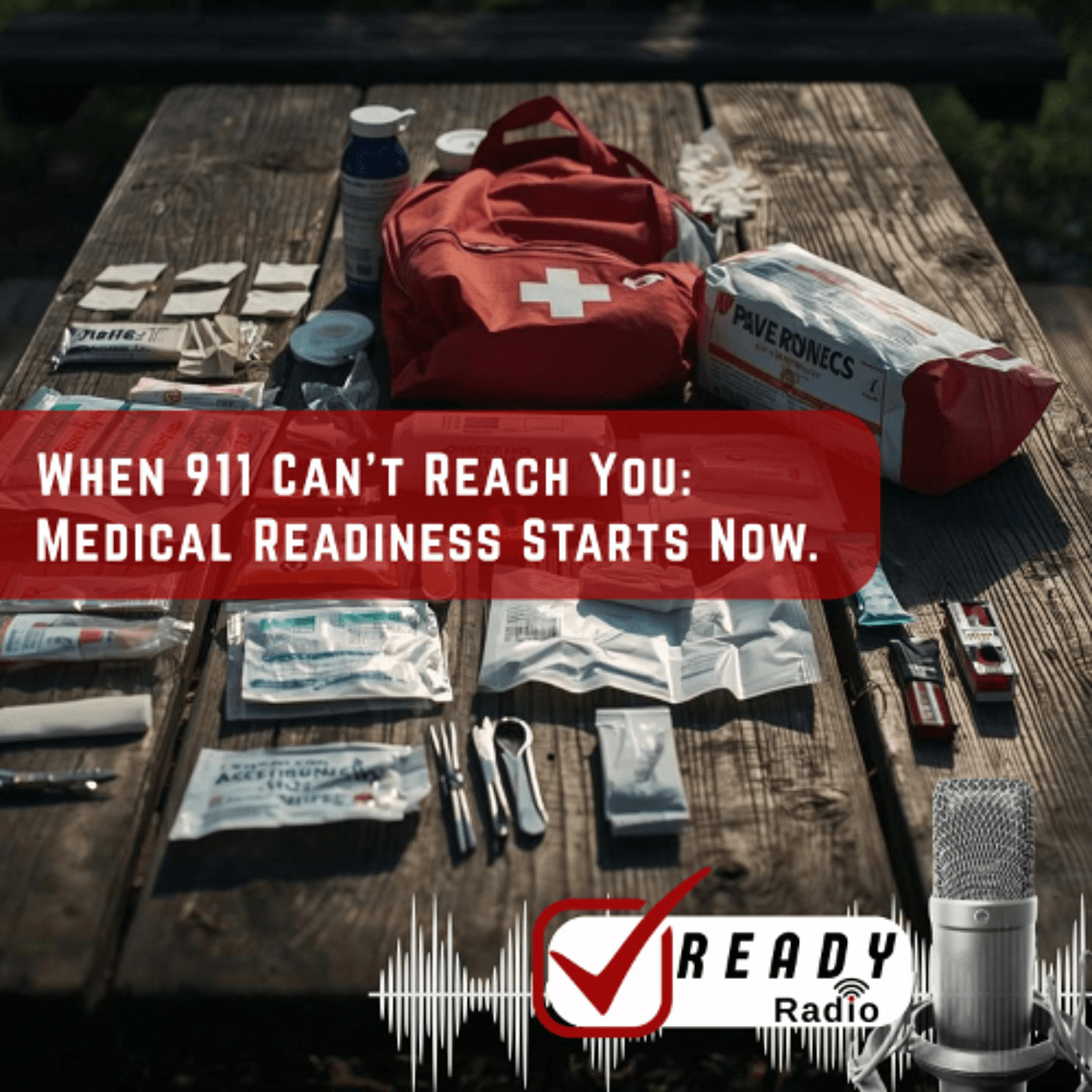

This episode of Ready Radio focuses on the part of preparedness most people say they’ll figure out later—medical readiness. John Rush walks through what you should realistically have on hand at home and in your vehicle, especially for the “what ifs” where help is delayed and you’re responsible for stabilizing a situation long enough to get someone real care.
The conversation hits practical “stop-the-bleed” priorities (tourniquets, pressure bandages like Israeli-style compression bandages, and hemostatic gauze), why bargain first-aid kits aren’t built for real emergencies, and why hospitals/pharmacies can get overwhelmed fast. John also gets into medication planning (including the “do
SPEAKER 08 :
This is Ready Radio, preparing you to be ready for anything, now.
SPEAKER 07 :
Here’s your survival guide for Ready Radio, John Rush. And it’s Ready Radio, KLZ 560. Thanks for joining us today. I appreciate it greatly. Listening to a replay, we appreciate that as well. Don’t forget the text line where you can always send us questions, information, which a lot of you do, which I appreciate greatly, 307. 200-8222. Again, the text line 307-200-8222. You’re always welcome to call in during the show if you would like. 303-477-5600. Bill is not with me today. He’s been with us here for the past several months and enjoyed talking to Bill, and he fills in and does a great job when I’m not here. But he is actually out of town, I believe, celebrating his wife’s birthday. So, Bill, if you’re listening, hope you guys are having a great time and appreciate all that you do to help us today. And mainly because Bill and I talked about this last week, I thought I’d go ahead and dovetail into last week’s conversation. And that is the medical preparedness sides of things. And what I mean by that is, you know, what should we all have on hand? And this is true whether we’re at home, you know, whether we’re traveling, not traveling, you know, just different things that we should have. Period. At any given time, you know, power on, power off. And I’ll get into some of the different scenarios. But it’s something that I’ve I guess maybe as I get older and start looking at, you know, the fact that, you know, you want to be prepared for everything. You know, we always say the what ifs of life. There’s also other things that I want to be able to be prepared. You guys know me. I want to be self-reliant. I don’t want to have to rely on others. Now, I get it. If I cut my finger and need to stitch it up, yes, I’m going to have to rely on somebody else to help me with that. And I understand that. And there’s going to be certain things that you have to have somebody else to help you with. But and I guess really in that case, depending upon the circumstances, could you, you know, could another person in your family help sew you up if need be? I guess you can. Would it hurt? Yeah. Could you get through it? Well, they did it long before, you know, Novocaine and things like that existed. So the reality is, yeah, I guess you could. Anyways, yes, we do need help at different times. But I think one of the things and this is, you know, which is so near and dear to me and you guys know this from Rush to Reason on The Daily Show. I’m afraid that we have now several generations, not just one, but several generations that are very soft. And what I mean by that is so soft that if they had to go out and find their own food, frankly, folks, it’s not happening. They’re not going to find it. They’ll starve. And I think that’s where some of the predictions of if there’s some sort of a major EMP, the power is off, extended length of time and so on, 30% of the population is dead within 30 days. And then it continues to trickle. That number trickles up after that because more and more people die on down the road. Because again, in most cases, they just can’t fend for themselves. And you guys know that I listen to a lot of audio books about sort of this end of the world scenario things. I’m listening to one now that’s based up in Canada. And to make a long story short, EMP hits. Part of the family was out in the wilderness. Part of the family was home on a big ranch. And it’s a story about how you know, basically the folks in the wilderness had to come back down and find the folks at home. And, you know, yes, some folks have died and they’ve lost some family members and they’ve struggled and people are trying to steal the things that they do have. And again, just things that we talk about here on a routine basis. And some of that I learned from listening to these books because I don’t think these books are that far off when it comes to what’s going to happen in a time like that. So today, yes, I wanted to cover some of the medical preparedness thing. Now, I also will say that in these books, it’s one of the areas I think they cover fairly well. And I think most of these authors know that most people, most families, don’t have much in the way of what’s needed if there’s some sort of a medical emergency. And I’ll get into some of those things later. might be today, but I think these authors have things pretty correct. And one of the things that I’ve noticed in almost every single book, one of the themes that is pretty constant through all of them is when somebody gets sick, somebody has some sort of an infection, a problem, whatever, the medical attention is very lacking. They just don’t have the means. Just a regular little first aid kit isn’t going to handle, for example, a gunshot wound or you fall and you break your ankle or you break your leg or anything along those lines. I mean, and this is where trying to get everybody to think a little bit more broadly on, okay, How would I handle certain things that come along? And I stole some things off of AI today, which, by the way, AI, especially on the preparedness thing, I know it’s a lot of folks from the left are involved with AI, but I have found it to be pretty spot on when it comes to some of the preparedness things that I study up on a routine basis. And basically what they say here is, You can live without power. You can live without Internet. You can live without or you can’t live, though, without stopping the bleeding. And that, by the way, very true. You can live without a lot of things. You have to have food, water. And, yeah, if you’re bleeding out, you’ve got to figure out how to get it stopped. So one thing to remember when, again, where these authors, I think, get things very correct is a lot of people think, well, I’ll just run to the hospital. Something happens during one of those times, I’ll just run to the hospital. Remember, you’re not the only one doing that. And depending upon what the disaster is, hospitals are going to be overloaded. I mean, they get overloaded right now just with normal daily events. I mean, we saw them, quote, unquote, get overloaded with COVID. And I’m not going to get into all the details because I talk about that with Dr. Kelly on Thursdays a lot. But, you know, some hospitals became overloaded. Those same hospitals can get overloaded just on a regular basis depending upon what’s happening. Is there an outbreak of a particular, you know, bug, flu? Has there been major accidents? things like that and yes they can be overloaded rather quickly and remember too that the supply chain even though it’s better now than it probably has been especially through covet it still isn’t perfect there are still times and some of you know what i’m meaning by this where you’ll go to order something it’s not available that that item doesn’t exist whether it be from amazon or your local store or whatever that particular item just isn’t it’s out of stock it’s not there And so we’re still struggling at times with some of those things. The pharmacies, and again, one of the things the books get right. I know I keep saying that, but this is another thing these authors have right. First thing that gets rated are pharmacies. Immediately. I mean, within probably 48 hours of a major event where people know, OK, this is the end. There’s a major EMP. You can tell that the rest of the country is blacked out. The pharmacies, they’re getting looted. There’s going to be gangs there. There’s going to be everybody possible there trying to get whatever they need. And, you know, the high need drugs are going to go first. Painkillers, insulin, antibiotics, those are going to go first. Your other ancillary things that some folks might not even know what they are, what those drugs do, those will be secondary. But most everybody knows what penicillin, amoxicillin, Augment, and all those sorts of things, they know what those are. And they also know what oxycodone and Vicodin and all of the other painkillers are as well. So remember, those things are going to get overrun quickly. People thinking, well, I’ll just get that refilled. No, you won’t. In fact, some of you, and fortunately, I know I say this from time to time, and I’m not by any means boasting in this, but fortunately for me, I don’t have to take any drugs to stay alive, which I’m very thankful for. I’m not on any type of blood pressure medicine, statins, anything, which I wouldn’t be anyways after talking to Dr. Kelly, but I don’t have to take anything daily to stay alive. I’m very, very fortunate, and I feel very blessed because of that. There’s a lot of folk my age who, even younger than me, that have to take something daily to stay alive. I don’t. So those of you that are in that predicament, though, and this is not a judgment, by the way. Things happen. People have different illnesses and things that come up, you know, from diabetes to whatever. I mean, I get it. There’s different things that have to be taken daily for certain people in their lives to stay alive. Do you have enough? Do you have enough? That’s the question that I have for some of you, where if you’re somebody that does require certain medications that you need to stay, you know, either to stay alive or stay healthy. You know, maybe maybe staying alive is is one mode of this, but maybe just to stay healthy. Maybe that, you know, is mental health or some other things along those lines. Do you have the ability? Do you have enough on hand to handle any kind of an outage? In other words, it’s not going to get refilled. That’s one of the things that these books don’t get into, which I wish they would. And I haven’t looked up the stats on this. I don’t know how many Americans are on some sort of a antidepressant or something along those lines when you talk about those things across the country. It’s a fair number. And, again, no judgment. I’m not judging anybody that is on those. I’ve got dear friends that are on those, and I’m not judging any way, shape, or form. That’s not the case here. What I’m saying, though, is do you have enough to get by if there’s some sort of an issue? And I’m guessing that for a lot of folks, the answer is probably no, because all you can get is whatever your doctor will provide you. So my answer to that is try to find some alternative sources for the things that you need. And what I mean by that is it might be medicine. It might be alternative medicines. So, in other words, you may need your prescription or maybe you need to figure out things that would supplant or replace that prescription if, in fact, that’s something that you need to live on. And what I’m getting you to do is really think through, okay, if there’s some sort of a major outage of any kind, then that’s what you need to do. You figure out what those things are. And that’s not easy for a lot of you. That’s going to take some digging and figuring out and even have some consultations with the likes of a Dr. Scott to sit down and say, OK, this is something that I really need every day to keep me moving forward. What are some alternatives? What are some things I could look at and what could I change maybe even in my lifestyle that would then overcome some of these things? And that’s a question that guys like Dr. Scott, which is one of our sponsors, those are the kind of things that Dr. Scott can talk to you about and you can kind of figure out, okay, if in fact I weren’t able to have these things, what would I be able to do? Here’s another question that AI threw out. If an ambulance can’t reach you for two hours, how can you handle that? Or could you handle that? So if you’re two hours from an ambulance… In other words, maybe you’re in town, but ambulances are backed up that much. Or maybe you’re off in some area where an ambulance is two hours away. How would you handle that scenario if an ambulance is two hours away? And I’ll be honest, I’ve never answered that question in my own life. I’m not sure. I mean, I think I’m self-sufficient enough to where I would be okay if you required an ambulance and it couldn’t be there for two hours. But, you know, I don’t have an AED machine at home. And by the way, that’s something that some folk probably should own. Probably not a bad thing to own. In fact, so an AED machine is basically, it’s a cardiovascular machine that really, if your heart stops, it starts, and it’s so simple to use. The instructions are on it. I’ve been trained in them years ago, but they’re so easy to use that people think, well, what if it just, what if it shocks you? It won’t. The whole system is designed where it knows if the heart is stopped, and it won’t even send an electrical charge unless it knows the heart’s stopped. So there’s no chance of you getting electrocuted by hooking somebody up to one of those devices. And a lot of places have them. They’re hanging on walls. We don’t have one here at Crawford Broadcasting, which, frankly, we probably should. It’s probably something that one of us here probably should recommend to ownership that, you know, not a bad thing to have hanging on the wall with the amount of people that we have coming and going and so on. Again, I’ve been trained in how to use one of those, and they’re very, very simple to use. They’re not scary at all. You literally could open it up and anybody, you know, if you can read, if a 10- or 12-year-old even could read the instructions and hook it up and save someone’s life. For some of you where you have a risk of heart failure, do you own one of those? And by the way, this is something for right now, not in an end-of-the-world scenario, but do you have one of those around your house? Where if you had some sort of a major heart attack, could somebody hook you up and would you be okay? And by the way, they’ve come down a lot in price. I think at one time, Charlie, they were, oh gosh, they were several thousand dollars back in the day. And really quick for all of you, and I didn’t have this in my notes, but really quick, let me just look this up. I can tell you really quick what one costs. They’re defibrillators, what I’m trying to say, the main name is on those things. And they’re coming down in price now. $1,800, $1,600, $1,500, maybe depending upon the brand. And for some of you companies out there where you want to buy more than one, actually there’s a device on here that’s as little as $1,399. So they’re not $100. So it’s not that cheap. It’s a quality medical device that’s going to shock your heart back into beating, make you alive again, if you would. So, no, they’re not that cheap. But the cheapest one I see, which I’d have to go through and go through the reviews here, is $1,399. Most of them are around $1,600, $1,700, something like that. And it depends on what kind of ancillary things you want with it and if you’re going to hang it on the wall with brackets and so on and so forth. You see these things positioned in a lot of different places. Different companies will have them. A lot of churches will have them and so on. And it just depends on the scenario there. But something to think about. And again, most people aren’t going to own one of these because of the expense. But if you’re at high risk, by the way, this is how I would look at it. If you’re high risk and there’s been a lot of heart failure in your family, why don’t you own one? And I think that’s a good question. If you’re somebody that’s had a history in your family of heart disease, heart illness, heart attacks and so on, why don’t you own one? Now, I get it. You can’t use it on yourself because you’re passed out having a heart attack. Somebody else has to be around to use it. So if you live alone, that’s really tough. But some of you that have family and you live with friends or whatever, then, yeah, it might be something to think about. So that goes back to that question. If an ambulance can’t reach you for two hours, how do you handle that? So I’m going to take a quick break. We’re going to come back and just talk about some of the basic first aid kits, by the way, that everybody should own and should have on hand. And if you don’t, you need to make sure you do. And this is, again, one of those things where it’s gotten to be less and less costly as time has gone by. because of the competition that’s out there. So, yeah, there’s lots of things when it comes to that that you can buy. Ready Radio, KLZ 560. Don’t forget our website is ready-radio.com. Lines are open, 303-477-5600. We’ll be right back again. Ready Radio, KLZ 560.
SPEAKER 01 :
Even in the age of AI, looking for the right insurance can be a huge hassle. Paul Leuenberger has you covered without the hassle. He works with the best in the business. Hartford, Travelers, Safeco, Liberty Mutual, Nationwide, Allstate, AIG, Chubb, Pure, Berkeley, Grundy, Hagerty, and more. He’s local, independent, and licensed in Wyoming, Colorado, Arizona, Nevada, and Texas. and he’s expanding into more states soon. Paul’s mission is simple, to find the right coverage at the best value and to treat every client like family. So whether you’re shopping for home, auto, or something more unique, don’t shop online. Call Paul at 303-662-0789 today. That’s 303-662-0789. Paul Leuenberger, insurance made easy.
SPEAKER 04 :
What if you could get over 110 lab biomarkers tested, just like Dr. Mark Hyman advertises, but for a fraction of the cost, and with a doctor who actually explains the results? At Castle Rock Regenerative Health, Dr. Scott Faulkner has recreated this powerful biomarker test panel at a substantial savings. We have a special price for both men and women. Just $689. That’s a savings of over $2,500 over the standard price. And here’s the difference. With Hyman, you get numbers on a page. With Castle Rock Regenerative Health, you get Dr. Faulkner and his team walking you through every result, showing what’s off and creating a personalized plan to fix it. What’s even better, you don’t even have to be a concierge patient to get this pricing. This is open to everyone. Think about it. Most people’s deductible is higher than this special price. And your regular doctor, if he could get approved by your insurance, would never order this many tests, let alone know what to do with them. Call 303-663-6990 today or visit CastleRockRegenerativeHealth.com. Take control of your health at Castle Rock Regenerative Health.
SPEAKER 06 :
Looking to buy or sell a classic car? Need a reliable valuation you can trust? Look no further than BP Appraisals, LLC. With over 20 years of experience in the appraisal industry, we provide fast, accurate, and professional appraisal services that you can count on. Did you know that an appraisal can also entail the forecasting of monetary earning power? An appraisal is a document with a valuation conclusion. It is not a pre-purchase inspection, a mechanical evaluation, or a recommendation to buy or sell your vehicle. It’s the actual value at that moment in time, which many need for things like estate planning, insurance, or investing. At BP Appraisals, we value your property like it’s our own. Make informed decisions with confidence. Don’t settle for less. Choose the experts at BP Appraisals LLC, where precision meets professionalism. Visit us today at bpappraisalsllc.com and schedule your appraisals in just minutes. BP Appraisals, LLC. We know what your property is worth. That’s bpappraisalsllc.com or call 720-295-0108.
SPEAKER 01 :
Are you tired of dealing with hard water, stains or just poor water quality in your home? Do you worry about forever chemicals that have been found in nearly all municipal water supplies? These toxic chemicals, which can linger in the environment and the human body for extended periods, have been linked to various health risks. Municipal water also has chlorine and lead and can have other bacteria. These contaminants can also impact your health. A water filter from WaterPros can provide clean, safe drinking water right from your tap. At WaterPros, we believe everyone deserves clean, refreshing water right from the tap. Whether it’s whole home water systems, reverse osmosis, or water softeners, Water Pros has you covered with customized, high-quality solutions tailored to your needs. Best of all, installation is quick, seamless, and done by our expert technicians. Plus, you’ll love our affordable pricing and industry-leading warranties. So why wait? Join thousands of satisfied homeowners and experience the Water Pros difference today. Visit waterpros.net or call Paul the Waterman at 303-862-5554 for a free consultation. Water Pros. Quality water. Better life.
SPEAKER 07 :
All right, we are back. Appreciate you listening. Ready Radio, KLZ 560. And again, text line is open, 307-200-8222, as it always is. Be sure to send a question if you’ve got something you want to either add to or just talk about on today’s program. You can do that even during your replay show as well. And then, of course, our main line, if you want to call in and talk, 303-477-5600. Okay, let’s talk about basic first aid kits. Again, some of this you would think would be common sense, but let’s just go through some of these because I would guess that in some cases, there’s probably – some of these items are not going to be in everybody’s medical kit, everybody’s first aid kit. So gauze pads, yeah, you’re going to have that. That’s for bleeding. Rolled gauze and so on. Compression bandages. By the way, the Israeli style are the best ones to have, which most people aren’t going to have those. That’s something you have to get separate. Tourniquet. You need one per adult, by the way. You need hemostatic gauze as well. Charlie asks, what’s an Israeli-style compression bandage? And I don’t know where that – I guess that name came from because of using it in, I guess, maybe the Israeli army or something along those lines, maybe. It’s a wider – tougher, it’s just a stronger bandage than just a regular ace bandage. That’s probably the best way for me to explain it. Luckily, I’ve never had to use one. I haven’t had any injuries of late to where I’ve had to actually use one but it’s a it’s a stronger ace bandage with like a gauze made into it so if you’re if you’re hemorrhaging for example and you need to apply pressure to a wound it gives you the ability to instead of having to put gauze down then put some sort of an ace bandage or tourniquet or something over it it’s all inclusive so it’s a heavier maybe heavier is not the right way to say it i it looks heavier to me but again i i don’t i’ve never used one so frankly i’m I’m not positive on that because I’ve never had an injury whereby I’ve had to use an Israeli bandage. But essentially, it’s got a gauze pad that’s built into it whereby you’re not just using a regular ace bandage. So, again, and they’ve been using these in the military. It says U.S. military since 2004, and I don’t know when the Israelis started using it prior to that. So I just know they call them Israeli emergency bandages. And, again, it’s designed to help seal up a wound. Let’s put compression on a wound. That’s probably the best way for me to say that. So tourniquet, of course, I just said. And then also we need the tourniquets, of course, because if you bleed out, you’re going to be – Dead. Average bleed out time, by the way, depending upon how severe the injury is, this is in my notes here, depending upon how severe the injury is, only three to five minutes. So it’s not as long as people think. You know, you see that on, you know, television and different things and, you know, how long folks bleed out and so on. Folks, it’s TV. It’s TV and movies. Average bleed out time if you’ve got a very severe wound is only three to five minutes. So something to think about as far as that is concerned. Somebody sent me to Mark did a compression compression or sorry, chest compression tool. So it goes along with your AED. So thank you. I did not know they made that. He said volunteer fire departments keep one on the fire truck as well as with the AED. Thank you. I did not know that. Good to know. So, again, something else to think about for some of you that might have some heart issues in your family. All right. Keep one in each vehicle. is what this next item say wound care yep antiseptic solution yep antibiotic ointment yep stereo strips yep burn gel blister care of course tools i mean scissors things like that you can cut tape and whatever you need to do that way trauma shears tweezers A thermometer, I guess the thermometer just to know, you know, does somebody have a fever, not have a fever? I’ll be honest, that’s not something that’s in the majority of my first aid kits. And the digital thermometers, for those of you listening, sort of like digital air gauges, have become so inexpensive that there’s no reason to own any other type of thermometer other than maybe space. I mean, if you’re really worried about space, you can still get an old, you know, mercury-type thermometer. They work fine. They’re not as fast as the digital ones are. And the new digital ones are so small that, you know, they work really, really well. So that’s something to… Think about a Sam splint, an irrigation syringe, which those are the larger syringes, which again, these and by the way, for all of what I’m talking about, you can buy all this stuff on probably Amazon or other places. So a SAM splint, by the way, is a lightweight, compact, and highly versatile medical device used for immobilizing fractures, strains, and injuries of the limbs and neck. It’s almost like heavy, heavy duct tape. Think of it that way. I mean, basically like sort of duct tape with a super, super stiffness to it. I guess that’d be the best way to say that. You can bend it, shape it, do whatever you need to to keep things in place. So that’s what they’re talking about when they talk about a Samsung. And honestly, that’s something I don’t have either. I’m going to have to go back through this and look at my own gear as well. A headlamp, we talked about that many, many, many times. That’s when you need to have, again, a headlamp, not necessarily for even walking and so on, but you need a headlamp so as it’s dark and you’re trying to work on someone and you don’t have the right lighting, you’d need a headlamp to be able to do that. And AI made a point here, which I thought was interesting. Don’t buy the $19 big box kit. Build your own. You know what? Sound advice from AI. Yeah, I would say go through that list and build your own kit. You could probably do it. It’s probably going to be a little bit more money than buying the $19, $20 big box kit, but you’ll have exactly what you need. And then what I would do, Someone would say, well, yeah, but when you get the other kit, you end up with a nice bag or whatever for it to go in. Guys, there are so many different storage devices. Again, you can get on Amazon or any place like that. You can get backpacks where you can put a bunch of medical gear in a small backpack. You can use Tupperware online. or the clear containers where you could put certain things in one or another and label it accordingly. You can buy zip-type bags, hard case bags. I mean, the list is endless when it comes to how you can separate things out. In fact, in a lot of cases, you can even get the foam inserts that you cut out different dimensions, if you would, different shapes. where you can even put certain things inside of it and keep things separate if you want to. But bottom line, figure out what you want to do along those lines. And frankly, old duffel bags, old school kids’ backpacks. Instead of that backpack that your kid might have and you’re at the end of the year and you’re thinking about just throwing it away, use it for some of this stuff. As long as the zippers are in good shape. And the straps are in good shape. You can use that to store medical gear and things like that in with no problem. I rarely ever throw backpacks out. I might give some away here and there, but I’m a guy where – one of my friends the other day, one of my good friends, actually my best friends the other day – You bought a backpack, and I’m like, you should have just said something. I have so many of them. I could have given you one. I mean, literally, I have a plethora of backpacks, more than I’ll ever use. So anyways, backpacks are one of those things I rarely ever toss because, again, unless it’s just completely worn out, you can repurpose it and find something else to use it for. Yeah. These are over-the-counter medications. I talked about this last week. And again, these are things where does everybody in their home have these? And again, you have to go through your own medicine cabinet and or however you do things in your house, pantry, medicine cabinet, whatever. Do you have things for pain and fever? Do you have acetaminophen, which is essentially Tylenol, or ibuprofen? Aspirin. And by the way, that’s, frankly, everybody, unless you’re really, well, you probably ought to have aspirin, period, no matter what, even if you’ve got a gut issue. Because aspirin, if you’re having any kind of heart issues, will thin the blood and help with that. So, yes, you should have some. And by the way, a lot of places, there is no aspirin. Trust me, I can attest to that. There are different places you will go to, and you’ll find everything other than aspirin because a lot of people don’t use it anymore. But yet, when it comes to things like we’re talking about with heart things and so on, aspirin works very, very well. Non-drowsy antihistamines. Hydrocortisone, of course, a cream. GI issues. In fact, those are very common in emergencies. So if you’ve got any kind of a GI, upper or lower, you know what you need. You know what your family needs. Have those in inventory. This one, I don’t know what this particular over-the-counter drug is. Loperamate? Do you know what that is, Charlie? I’ve got to look this up. I should have looked this up prior. I don’t know what that is. It relieves acute and chronic diarrhea. Okay, well, that’s something that you’re probably going to want to have. It’s probably sold under other brands, I’m guessing. I’d have to go look that one up to determine who makes that. Let me look at Wikipedia really quick. So basically medicine for, you know, it says here for irritable bowel syndrome, inflammatory bowel disease, short bowel syndrome, Crohn’s, things like that. Even some of you that have ulcers and things like that may be worth having that around. I don’t know what brands that’s sold under. But again, that’s something that, yes, you should have that in your medicine cabinet. And some of you probably have an off brand of that or a brand like that. Electrolyte packets. And again, Dr. Kelly talks about this from time to time on Thursdays with us. You know, use those sparingly as you would need. I mean, if you’re in a dire situation where you’re not getting good food intake, your caloric, you know, your calories are down and so on. Yeah, it would it would it would behoove you to have some electrolytes at that point in time. oral rehydration salts, absolutely, an antacid, going back again to the stomach issues, anti-nausea meds. Now, those can be over-the-counter or prescription. And for some of you, you know what I mean by that. Some of you that have surgeries and so on, you may have even hung on to some extra anti-nausea meds, and they’re not a bad thing to have around because if you get in a situation where you’re severely vomiting or doing something along those lines, then yes, you want to have some of those anti-nausea meds kicking around. Cold and flu, that’s a given. I think most families probably have that around, but make sure you have a good supply of cold and flu. That goes with a cough suppressant as well and an expectorant, which, again, makes you get rid of the phlegm and junk that you’ve actually got down in your lungs. Zinc. You hear Dr. Kelly talk about zinc a lot because it can fend off all sorts of different things that might come along, bugs and so on. Vitamin C as well. And lastly, don’t forget, and we talk about this a lot with Dr. Kelly, dehydration. kills faster than most people realize. And if you’re in a really bad scenario and you ate something that you really probably shouldn’t have eaten and something along those lines happens, at the end of the day, you’re going to need to be dehydrated because you’re going to get dehydrated. You get sick, get diarrhea, vomit, whatever, all of those things combined dehydrate you. Don’t forget, too, that in these type of scenarios, you’re going to be walking more, sweating more, and you’re going to get dehydrated as well. So make sure that you’re able to hydrate yourself well. Now, when I say that, that means, A, make sure you’ve got good supply of water. We’ve talked about that plenty in the past. But on top of that, make sure you’ve got the ability to carry water with you. All of these books I read, it’s amazing to me that not yet – Not one time have I read a single book where any of them have a bladder. And what I mean by a bladder is any of you that have ever hiked or done anything along those lines, a bladder is a device whereby several different companies make them. And sometimes you can just buy the bladder itself and put it inside of any kind of a backpack you want. But a bladder is a basically it’s a big rubberized type, you know, plastic type, very pliable bag, right? that has a hose coming out of it that has what we call a bite nipple or a bite straw on the other end of it, whereby you fill that up with water, and to drink it, it’s got a bite valve on the other end of it. You bite it, and the water flows. They’re really super handy to have, especially if you’re hiking or biking or doing anything along those lines. And what’s amazing to me is out of all of the books I’ve read and listened to, not one of them, no one ever had a bladder. Maybe one book I read, somebody had a bladder, but it doesn’t happen often. And to me, that’s an easy one. I mean, it’s because it makes carrying water so much easier than trying to have a canteen or water bottles or anything along those lines. So anyway, something to think about. Make sure that you’ve got the ability to have really good water and bring that with you as well. All right, here’s a 90-day rule of supply. This goes back to what I was talking about earlier, where if you’ve got a particular medication you need to stay alive on, this is the 90-day rule. Now, for some of you, you may think about, is 90 enough? Should I go six months? In other words, should I go longer? One of the books I just am reading as we speak or listening to as we speak, one of the elderly individuals just passed on because they ran out of insulin. ran out of diabetes meds. So you don’t want to be in that scenario where that ends up happening. You want to try to avoid that. And the problem with a lot of the insulin meds is they have to be refrigerated. When the power goes out, that’s hard to do. But these are things you need to think through. So 90-day supply rule is, of course, blood pressure meds, thyroid meds, Insulin, which I just talked about, and cooling solutions has to go with that. Some of you need inhalers. Some of you have asthma, and you need that inhaler to stay alive or to assist you with breathing at times. And remember, you’re going to be stressed, and you’re going to have things going on that you wouldn’t normally have going on. So if you’re somebody that needs that inhaler to survive… Figure out a way to have extra. Heart meds, I talked about that a little bit earlier. And this says, you know, work with your doctor on, you know, emergency refills and even travel prescriptions, which I’ll get into here in a moment. And remember, when it comes to a lot of these extras, they’re not easy to come by. This is going to take effort and work on your part. you’re not going to be able to just go out and buy this overnight. Your insurance is probably not going to supply you with these things either. So you’ve got to figure out ancillary areas or ancillary places whereby you could buy these things. And they’re out there. Not everything on this list, but a lot of what’s on the list you can buy from places like JASE. It’s J-A-S-E. I’ve interviewed them plenty of times over the years. There are places like that where you can get extra meds. You do have to go through a a qualifier you know that’s a it’s a doctor approved thing but they’ve got doctors on staff that are there to assist you and so on but to get extra of a lot of things you may need yes i would highly recommend that you do that so antibiotics that’s another one where you know what you can take what you can’t take maybe somebody’s allergic in the family to something you know what kind of antibiotics you’re going to have to have and make sure you have a good stock of those Now, a little bit of a tip there. For any of you that travel, where you go to other countries, in a lot of cases, other countries sell these things over the counter. Even south of the border, they sell a lot of these things over the counter. And some of you are thinking, what? Yeah, you can, if you want to buy a, you go to Mexico, you want to buy an antibiotic, you walk in and say, I’d like to buy that bottle of antibiotics, and you pay the money, and out the door you go. Done deal. Not hard. Now, there’s even typically a doctor on where if you tell them, well, I’m allergic to this, I need that, they’ll help you through that too. So some of you that travel, remember when you’re out and about and looking for some of these things and even telling other people that you know that, hey, I’m going to be going to such and such. Is there something that you might need? I’ll pick it up for you. Offer that so you can bring some of that back. Now, be careful because you can’t do too much of that because technically what I just said is not supposed to happen, but it happens. It happens all the time. And what I’m getting at here is if you’re trying to help somebody, a family member, friend, whatever, you know, get through these times we’re talking about, you guys can figure that out. And no offense, you know, Customs Board or whatever, they got so much other stuff to worry about with illegal drugs coming across. I doubt very seriously if they’re going to stop you with a bottle of antibiotic. Just saying. Probably not going to happen. so there are ways to help each other out in that regard and and make sure that you’re you’re paying attention to that and again antibiotics on you know for each individual person get some guidance from your doctor if you don’t have one go to dr scott he can help you with some of this stuff as well and again some of the some of the doctors that are out there you guys can get a good enough relationship where you just say hey i’m going to try to get a stock of x I want to go ahead and get a prescription now. And in the six months, I want another prescription. And six months later, I want another prescription. You can probably get that done. There are doctors out there that will help you with that. And in that case, probably could even run it through insurance. So there are ways to get some of these things done. You need to be creative about that and how you would actually do so. Don’t forget, some of you that might need an EpiPen, make sure that you have one. You know who you are. And then also, I never thought about this one. You need a pediatric dosing chart, something just to either download from the Internet, print it, laminate it if you want, have it around. That way, if there’s ever a situation where you have younger folk you’re trying to help out, how would you dose with them? Because it’s not always cut this in half or do this. I mean, any of you that have raised kids, it’s more complicated than that. So make sure you know. Now, one other thing, and I had never thought about this one. And again, this came from A.I., Print a medication list. So if you’re in this scenario and you’re looking for a particular drug or you’re at a pharmacy and you happen to be able to pick up a few things, okay, what is it you need? Print out a medication list so that when the crap hits the fan, you know what it is you’re going to need to survive on. So that’s another one of those things. And by the way, I’d never thought about that one. I’d never even mentioned that on this program before printing those things out. A pediatric dosing chart and printed medication lists. And print because, again, you’re not going to have the ability to go online. Your electronic devices, in the case of an EMP, electronic devices are not going to work. So be thinking through that. And then anything else. Again, every family, every person is different. There are certain things that you know you need. to get by in your life. What is that? what is it you would absolutely have to have to be able to stay alive. And then off we go, and start working at that and you’ll make make a grand list of these things. And again, you don’t have to go out and do all of this tomorrow. Some of you have that ability, most don’t. This is something where you’re gonna have to put a list together. And even as a family, okay, guys, as we start running across some of these things, even at some of the discount stores, and so on, let’s pick up some of these items and start crossing them off the list. That way you know what you have. Now, I talked last week, and I’m going to come back here in a moment and talk about what I think you should travel with. I explained that a little bit last week, but I’m going to add a few things to even last week as to what I think you should travel with when it comes to medications and so on. I’ll do that as soon as I come back. This is Ready Radio, KLZ 560. Don’t forget the website, ready-radio.com.
SPEAKER 09 :
Insurance agents, you know the story. A homeowner’s roof is aging, the shingles are brittle, and their policy’s on the line. But what if you could offer them another option besides a full replacement? At Roof Savers of Colorado, we use plant-based treatments that restore flexibility to asphalt shingles and extend roof lives up to five more years, all for a fraction of the cost of a new roof. RoofMax helps homeowners maintain coverage, reduce claims risks, and save thousands. And for agents, that means happier clients who keep their policies. Partner with RoofSavers of Colorado today. Call 303-710-6916 or visit RoofSaversCo.com to learn how RoofMax can help you help your clients. KLZ listeners receive $250 off their treatment. Call today and your client receives an additional $150 off through the end of December. RoofMax of South Aurora, a smart solution for homeowners and a win for insurance agents.
SPEAKER 05 :
Need new glasses fast? With Stack Optical’s on-site lab, you’ll get your prescription glasses in just three to four days. No long wait times. Hey, this is Scott Whatley, and I’ve trusted my eye care to Allen Stack and Stack Optical for the last 15 years. Eye exams are only $69. And that should be a part of your physical checkups each year. For over 50 years, Denver has trusted this family-owned boutique eye care center for premium vision care, custom eyewear, and expert repairs. See the Stack Optical difference today. Call 303-321-1578. That’s 303-321-1578. And tell them Scott sent you. Stack Optical. Since 1968, at Stack Optical, you’ll see the difference.
SPEAKER 08 :
You’re driving down the road and out of nowhere comes a bang. A huge rock just hit your windshield and now you have a star in your windshield. Did you know that chip can be fixed? But who is the best? Who has the best resins that keep developing them to work with the newest windshields? That would be Novus Autoglass. Novus, which is the Latin word for innovate, invented windshield repair in 1972 and it still leads the industry in cutting edge technology backed by more patents than any other repair and replacement company. While other glass repair services offer limited warranties, or worse, none at all, you can trust the original Novus pros to stand behind their work with a full refund that you can use towards a windshield replacement for the life of your windshield. Find a Novus location near you by going to any of our websites, ready-radio.com, drive-radio.com, or fixitradio.com. Just click on the Novus link. That’s Novus Auto Glass.
SPEAKER 01 :
Even in the age of AI, looking for the right insurance can be a huge hassle. Paul Leuenberger has you covered without the hassle. He works with the best in the business. Hartford, Travelers, Safeco, Liberty Mutual, Nationwide, Allstate, AIG, Chubb, Pure, Berkeley, Grundy, Hagerty, and more. He’s local, independent, and licensed in Wyoming, Colorado, Arizona, Nevada, and Texas. and he’s expanding into more states soon. Paul’s mission is simple, to find the right coverage at the best value and to treat every client like family. So whether you’re shopping for home, auto, or something more unique, don’t shop online. Call Paul at 303-662-0789 today. That’s 303-662-0789. Paul Leuenberger, insurance made easy.
SPEAKER 07 :
We are back. Ready Radio, KLZ 560. And don’t forget our website, ready-radio.com. The text line 307-200-8222, 307-200-8222. And you can call in as well, 303. 477-5600. All right. This is not in my notes, but I’m going to throw this out there as well. There’s some other things I’ll add, quote-unquote, for the serious preppers, some of you out there that have more ability than others. to acquire things, I guess I should say. But things you should travel with. And this is something that I explained last week to everybody. Maybe if you didn’t get a chance to listen to last week’s episode, I’m a weirdo. My wife and friends will tell you this. My kids will tell you this. Yes, I’m a weirdo. Charlie will tell you this. Yeah, I’m very, very unique in certain ways. For example, I have a travel backpack. That’s all it does. It’s specific for me when I travel. It doesn’t do anything else. When I come home, it goes on the top shelf of my closet. I repack whatever may have been used out of it before I put it back up, by the way. So if I ever need to go in a quick fashion, I pull it off, stick my laptop in it, and I’m ready to go. And in that laptop, it has everything I would need to travel with. So what I mean by that is I keep cash in it. There’s cash in my backpack. I keep chapstick. I keep gum. I keep Tylenol and Advil and any other type of painkillers that might be needed. I keep, like I said last week, a carbon monoxide tester. I have all of the extra charge cords and things I would need for any electronic device I may own. I bring that with me as well. I actually have an extra set of earbuds that I stick in there. Just if what I’m carrying isn’t enough, I take that with me as well. An extra pair of sunglasses are always in that backpack. I mean, anything I need. uh any of the other like travel lysol wipes things like that always stocked with that ready to go all i do is again shove my laptop in it and i’m and i’m ready to go so that’s one of the things i do to travel with because a i don’t ever want to forget things and i want to make sure i’m fully stocked up on things and that allows me to do that it has everything in it that i need to travel in a pretty quick manner in fact if i had the clothes on my back and had to make a quick trip someplace, could I do that just with that backpack? I could. I’ve got everything in it that I need to make sure I can get someplace and back, even with the clothes on my back. So that’s something to think about for some of you that are looking at either like a bug-out bag or what you do when you travel and so on. Mark, you’re up. Go ahead.
SPEAKER 10 :
Hey, I just heard you talking about the first aid kits, and a couple of things popped in my mind about congestion. So the one thing that I just added, for whatever reason, it’s taken me a little bit to get this item, but I went to the store and grabbed every single one of the pliers, tweezers that they had for sale, and I put them in every single one of my vehicles and in the first aid kits because for whatever reason they seemed to get lost or they’d just get rusty or something like that. So that was one thing, and I actually needed one. And I thought, you know what, I could have swore I bought these things. Great idea. And, you know, I had it. You know, I keep, like, pens in my vehicle, and I keep the – Tweezer right there next to it. But as far as like a home kit, I just wanted to encourage people to go open it. Go look in it. Pull stuff out. And because what I say is, you know, when you’re doing things muscle memory and you build that remembrance, hey, you know, this item is here, this item is here. Even if you do it like once a month, you know, you don’t have to get excessive about it once a week or anything like that. But You know, when the emergency hits, you’re not freaking out going, where did I put that kit?
SPEAKER 11 :
Right.
SPEAKER 10 :
Where’s everything? You know, and you have that, you know, stashed in your mind and just think about, okay, well, it’s the heat of the moment. Where’s this? Or do I just call 911 because I’m locking up and I can’t get anything done? Which may be the very best thing you can do because dispatch is kind of taught, you know, how to work with people that kind of get froze up. and if they’re willing to help to march through that. But the one last thing I just wanted to say, and the last time I had a little bit of an accident, which I’m not going to describe, I was told in the emergency room that it was totally wrong to use hydrogen peroxide when I was having some sort of bleeding because of a cut. And so my first reaction, because of the way I was trained, the way I was brought up, was to make sure to stop the bleeding and to use peroxide, to dump peroxide on it. And that’s the complete wrong thing to do is what I was being told, and now several doctors have also confirmed that.
SPEAKER 07 :
It’s interesting you say that. I was talking to somebody not that long ago. I think I interviewed for Health and Wellness on a Wednesday along those same lines. And, yeah, Mark, I was like you. I thought the same thing, but I was corrected here not long ago that really what they want is just a nice, clean wound.
SPEAKER 10 :
Yep, just water and soap, like regular soap. Doesn’t have to be anything crazy, but they said soap and water because the soap doesn’t do like a chemical reaction where the hydrogen peroxide will actually start to fight the cells as the cells are trying to rebuild themselves instantly. So it’s almost like you’re causing a problem while it’s trying to fix itself in that moment. And I didn’t really know that until several doctors explained that to me. They thought Man, for years we’ve been stocking up on peroxide. Now what am I going to do with all this peroxide, you know?
SPEAKER 07 :
You use that to get blood out of things where it gets stained. That’s what I use it for. It’s a great stain killer.
SPEAKER 10 :
Yeah, we still use it for laundry uses, you know, if something got on there. Right. we’ll use it as a pre-treatment. Instead of buying the pre-treatments, we just use the peroxide bottles we have, and it works great. But I just wanted to throw those three things out.
SPEAKER 07 :
No, I appreciate that, Mark. Great. No, great. That’s a great addition. I appreciate that greatly. Thank you. You got it. I appreciate you very much. Jennifer, you’re next. Go ahead.
SPEAKER 03 :
Hi, John. Like you, I am also not on any prescription pharmaceuticals, but I do have certain things that I keep around, such as ibuprofen and Benadryl and Pseudoephedrine. Now, here’s the thing. Where do I keep the majority of it? In my freezer.
SPEAKER 07 :
Oh, good idea.
SPEAKER 03 :
When you put it in a freezer, time stops. So that ibuprofen you put in 25 years ago is still good.
SPEAKER 07 :
Good idea. I never thought about that. That’s a great tip, Jennifer.
SPEAKER 03 :
And as far as any other medications… When they make them, they don’t make them in a dry thing. They don’t make that antibiotic as a dry powder or something. It’s all made as a liquid, and they have to do certain processes, and then finally they end up filtering it out. The question is, how do they get the water out? They put it in a vacuum, and they boil it away, freeze-drying it. So all your dry medications, such as antibiotics or anything like that, if it’s a dry medication… Throw it in the excess in the freezer. It’ll last your lifetime.
SPEAKER 07 :
I never thought about that. I mean, I had heard even not doing that. Most medications have probably a 20- to 25-year lifespan. But now what you’re saying is it’s really do that. It’s indefinite.
SPEAKER 03 :
Yeah, and you buy in large quantities, and one of the things I do is I break it up into smaller Ziploc bags, and I only have as much out as I’m going to probably need in the next six months to a year.
SPEAKER 07 :
That’s a great idea. I’m going to steal that from you, Jennifer. That’s a fabulous idea.
SPEAKER 03 :
Anyway, take care. No, I appreciate it. That’s a great tip.
SPEAKER 07 :
I’m stealing that. Thank you. I did not know that. Now that you say that, that makes 100% sense. And for some of you where you may have extras, and I’m like Jennifer. Charlie knows this. So does my family. I have full row fear of running out. So I always have extra of most anything. And I’m one of those guys where I don’t have one item of that. I’ll have, you know, two or three extra. I do the same thing when it comes to medications and things like that. So I typically try to have what’s needed on hand with extra just in case. And much like what Jennifer was saying, I love her idea, though, of either figuring out you know, Ziploc baggies with a magic marker and you write on it what it is. You can put that in the freezer and with whatever type of, you know, pill you’ve got and so on. I love that idea. So, Jennifer, thank you for that. And I hadn’t really thought about that. And she’s got a great point to keep out enough so that if you know you’re going to need something in the next six months or so. But other than that, now you’ve got your particular med stored for really an unlimited amount of time. Just, you know, put them in the freezer and Off you go. That is a fabulous, fabulous idea. And again, so traveling, going really quick back to my backpack. I’m trying to think of the other things that I actually have in that and, you know, simple things. You know, again, I said I have chapstick. Well, I’ve even, like Mark said, I’ve got, you know, small little screwdriver. I’ll have, you know, just little things that, you know, you can still get through TSA. I don’t ever check that particular bag. I always carry it. So I want to make sure that I’m always able to go through, you know, airport security. So don’t take anything in that’s too large. But I have, you know, pens and a pencil and, you know, even some writing paper and, you I’ll have anything like, for example, cough drops and a little bit of cold medicine. I won’t have several days worth, but I’ll have enough to get through a day or two. So if you had to go find more cold medicine, you actually could. And so I keep those things on hand just in case you were to have something work to come up. I keep some zinc tablets in there, by the way, so that if all of a sudden you start feeling cold coming on, pop some zinc in. I found that to be very effective to fend off the common cold. And Again, I keep those sorts of things in there at all times, even wipes for my sunglasses and different things along those lines. And again, I keep in there everything I need. So that I’m not having to replicate, you know, I’ve replicated, I should say that. So I’m not having to pull out of any other bags, you know, when I go to leave and I’m not having to remember, well, did I grab this? Did I grab that? No, it’s already all there. In fact, probably need to go through now with some of the consolidation that’s happened in the electronics world. USB-C has become the standard for chargers. You can almost just go in there and look and say, okay, as long as I got one or two cords for that, you could get by with charging pretty much whatever you need. Anyways, long story short, that’s how I do it. I try to have an extra backpack, and it’s not a huge backpack. Everything I’m talking about is in a very small backpack. And I’ll give these guys a plug. They’re an extremely liberal organization. but i’ll still give them a plug because they have in my opinion the best product on the planet and i’m not exaggerating in the company it’s out of oregon it’s called tom bin and it’s b-i-h-n and they make bags that’s all they make they’re a company because they’re lefties they don’t believe in hard sided luggage or luggage with wheels because these are guys that travel all over the world doing you know walkabouts and safaris and things like that so they build luggage For those purposes, it’s super heavy duty. And I’m not exaggerating. Some of the backpacks and things that I’m talking about that I own, even the briefcase that I use that I take to and from the station, I’ve probably had for more than a decade. It looks almost brand new, and they have a lifetime warranty on all their products, and their stuff just works. So if you want really, and the thing I like about their products is it’s so handy because they have so many different pockets and things and storage devices and so on that when you go to do the things I’m talking about, They can set you up on everything. Their stuff isn’t cheap, but when you think about how long it lasts, actually it is because I don’t know that you could wear their product out. It’s that heavy duty. So Tom Bihn, B-I-H-N, you can look it up online. Yes, they are extremely liberal. I’m not plugging them because of that by any stretch of the imagination. I’m plugging them because they have, in my opinion, some of the best product on the market when it comes to bags and backpacks and even carry-on type luggage and so on. And I’m not exaggerating. It really is the best product out there. Bar none. And the way they do their storage end of things is just extremely slick. And their backpacks, and I own several of, are, again, they’re the best in the business. So continue to send me text messages along these lines. I may add a few things to this even in next week’s program. So if you’ve got other things you’d like me to add and talk about and any tips like Jennifer just gave me, please do so. I would appreciate that greatly. Text line 307-282-22. And don’t forget the website, ready-radio.com. Ready Radio, KLZ 560.
SPEAKER 02 :
The views and opinions expressed on KLZ 560 are those of the speaker, commentators, hosts, their guests, and callers. They are not necessarily the views and opinions of Crawford Broadcasting or KLZ management, employees, associates, or advertisers. KLZ 560 is a Crawford Broadcasting God and country station.