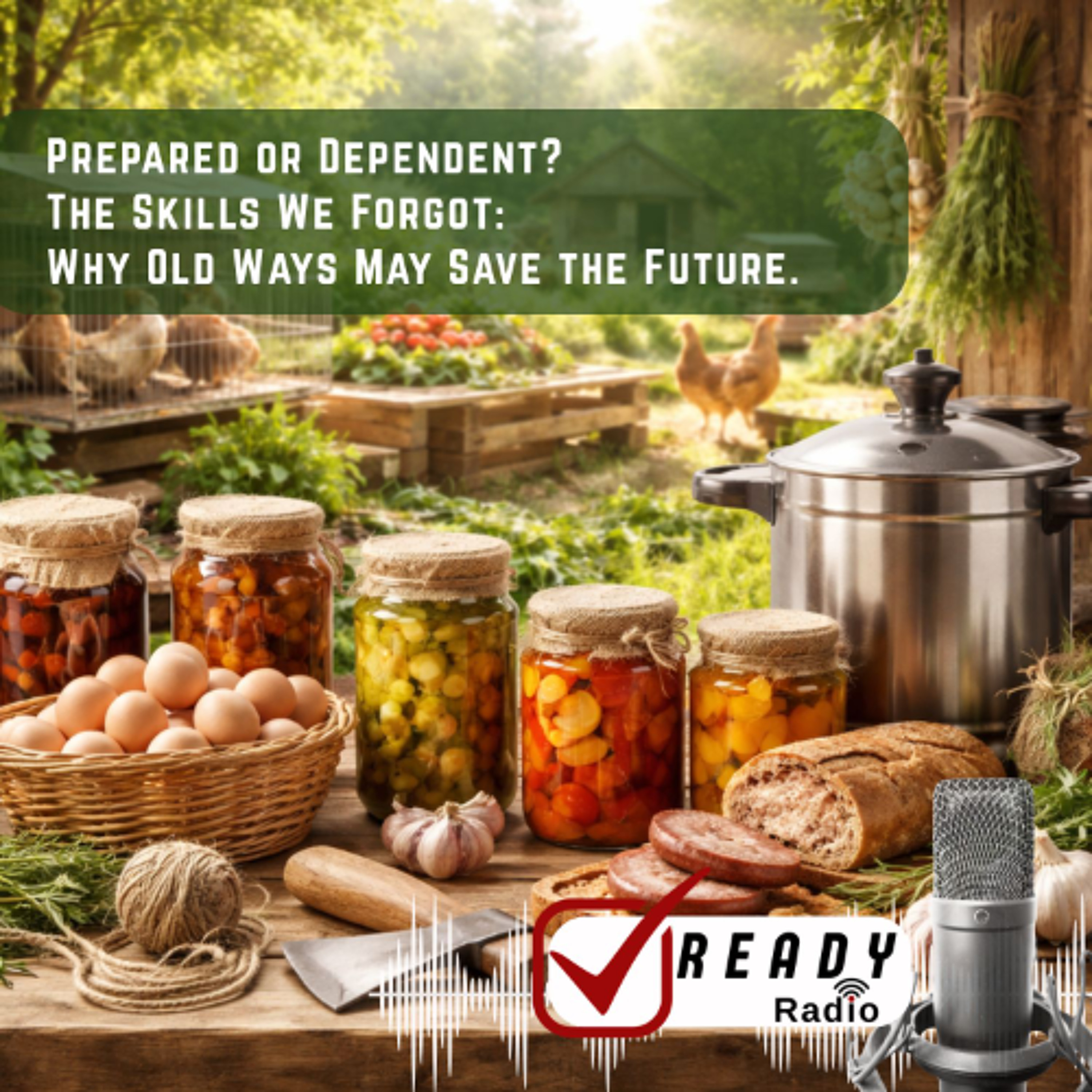




In this eye-opening episode, host John Rush engages with Jeff Bish, an expert in experimental archaeology and self-sustainability practices. Together, they share invaluable insights into the world of home butchery, cost-saving techniques, and resourcefulness. Jeff enlightens us with his journey from hiring out his butchery needs to mastering his craft, ultimately leading to a more economical and satisfying use of resources. This episode highlights the significance of knowing where your food comes from and the benefits of preparing it yourself. From tales of venison sausages to flavorful homemade burgers, listeners discover the art of crafting their own meats with
SPEAKER 07 :
this is ready radio preparing you to be ready for anything now here’s your survival guide for ready radio john rush three four seven seven five six zero zero welcome to call in and today with us we have
SPEAKER 08 :
a guest that I just thought would be a good idea to talk with, because we’re very like-minded in the same things that we kind of do, and I’ve known him for a while. So his name is Jeff Bish. Jeff, are you there? How are you doing?
SPEAKER 07 :
Yeah, I’m here, Bill. Thanks for having me on.
SPEAKER 08 :
Yeah, so, you know, you could tell a little bit as, excuse me, the guests there, the listeners, how many, you know, tell them a little bit about yourself as much as you feel comfortable doing.
SPEAKER 07 :
Well, I mean, I’m an electrician by trade, and I spend a lot of my time what I would call doing experimental archaeology, where I try and figure out things the way my forefathers did and how to go about doing those things. And then I also delve into survival, butchery, hunting, that type of thing. So that’s a little bit of my background.
SPEAKER 08 :
Yeah, and you’re originally from Virginia, but you’ve been out here for a while, so you can bring some of that experience from the East Coast over to here. A little bit different, as we experienced as we were elk hunting together this season, very different from what you’re used to. But let’s talk about this. I’d like to start with this, because I actually forgot all about this, that You’ve helped me, you know, make my own sausage. You’ve helped me buy a big bulk piece of meat and cut it into, you know, different pieces and cuts and things. And, you know, there’s a little bit of a savings there. So, you know, talk a little bit about that. And obviously you probably got that from, you know, harvesting your own animals back when you were hunting and things like that. So let’s kind of start there, Jeff.
SPEAKER 07 :
So, yeah, the main reason for going through and learning to do butchery and sausage making is a lot of it has to do with the fact that I got my first deer when I was 16 years old like a lot of people. I paid to have it butchered at the time. It cost me $35, which isn’t a whole ton of money now. I know people pay hundreds and hundreds of dollars to have it. meat butchered and uh that’s when i said you know what i got back a small amount of meat what i thought was way too small and i talked to my uncle and he started me out with the butchering and that’s you know step by step years and years and years of practice it’s kind of funny because the first batch of sausage i made it was crumbly dry didn’t work out real well And, you know, now it’s gotten to the point where I make stuff that’s as quality as anything. You get any premium butcher shop for myself. Um, I, I found mixing the sausage with pork fat, or if you’re going to use beef fat, there’s ratios and things like that you have to use. But all of this stuff, um, that’s what really caused it was, um, me being cheap for starters and, uh, Then on top of that, not being satisfied with what I got back from a commercial butcher.
SPEAKER 08 :
Yeah, that’s two things there, I think. that are very important. One, we may be in a situation where you can’t afford to have this stuff cut up. I mean, it’s getting to the point now where even going to the store, buying a steak is 20-some bucks just for like a ribeye, depending on what you get. But generally speaking, that’s about what they’re running these days. And not only that, but where’s the food coming from? And then when you’re on the sausage point of things, you don’t know what they’re putting in there. you know, when you’re able to make your own mix and, you know, you had walked me through the process and I had made some there and shared it with you and you, you know, you thought it was pretty good on my first batch, you know, all those years of you experimenting made it easy for me with my first batch because, you know, you were able to share with me all your mistakes and things like that. But, uh, yeah, I mean, it’s, it’s a, it’s a really good skill to have just in the fact that it can save you money. And two, you can actually control what you’re eating a little bit more.
SPEAKER 07 :
Absolutely. I mean, that’s definitely one of the driving factors. If you want a true beef sausage and you don’t want pork, say you don’t eat pork for some reason or another, health reasons, you can add as much fat into this as you like. And then there’s different methods that you can get used to. And the learning process is one that, like I said, when you made your first sausage, I thought it was excellent. It was a very good sausage. It took me probably 10 years of using premium venison that I harvested off the land to get anything near as good as that. And, you know, when I look back, I’m like, well, that’s a lot of meat that I ate that wasn’t very good or didn’t taste very good. It was still, you know, quality food, but it wasn’t It didn’t have that good flavor, the good binding, the good, you know, it was not a good final product. So the fact that you could take what knowledge I had learned from and then turn it into a product that, you know, if you had told me you’d bought it at a store, I would have believed you.
SPEAKER 08 :
Yeah, that was a fun process because you helped me with, you know, the tools to get, and I got all the tools. I didn’t actually buy a grinder. I actually had an attachment on my KitchenAid, so I was able to use that, and I got the big mixer thing that you shared with me, and, you know, I mean, going up to Costco and just buying some pork belly there and grinding it all up and mixing in the seasoning and stuff. I mean, I got several individual patties that actually stretch a long way. So there’s things you can do that can help with the cost and of course we have the vacuum sealed bags that we suck it down the food saver and suck it all down so it stays in the freezer a little bit longer but yeah these are a really really valuable skill and I don’t think it costs as much as people think Jeff I mean even if you don’t have a you know a KitchenAid or go out and buy a special grinder or anything like that you can still do it to some degree relatively cheap wouldn’t you say?
SPEAKER 07 :
I’d say you could do it with a kitchen knife if you really had to. I mean, you have to have the patience. That’s the big thing is you have to mince the meat and mincing is just a process of cutting into small chunks. So you can actually take a kitchen knife and probably do the whole process with that and have a perfectly fine product at the end. So That’s just about how much you want to invest and how much time you want to invest. I mean, obviously, if money is your problem and you got plenty of time, by all means, take a pork shoulder and take a knife to it and just keep cutting away until you get it down to a small enough size to where it’ll make a good sausage.
SPEAKER 08 :
Yeah. Yeah. Yeah. And, you know, pork shoulders and, and, and pork belly and all that is, is, you know, still relatively cheap, even though, I don’t know if you’ve heard this latest thing that there’s a new swine strand getting out there and, uh, over in Europe and it’s, you know, getting into the wild hogs and, you know, who knows what that’s going to bring again. It’s another laboratory thing that they’re talking about that got out, but, uh, you know, I mean, let’s talk about that real quick, because pork, you know, can be considered a dirty meat, if you will, because they’re scavenger animals, and especially in the religious community, you know, you’ve got your messianics and things like that that obviously won’t touch it, and they claim that it’s, you know, it’s an unclean meat and stuff, and what about the health risks of of pork and, you know, are we worried about a new swine flu coming through or, you know, is it something that you think is pretty, pretty safe these days?
SPEAKER 07 :
Honestly, I don’t, I don’t take too much worry in any of that. And, you know, when I was telling you how to make hamburgers with venison that I mix bacon in with it, you know, obviously I’m adding pork to a product that doesn’t need to be cooked. Well done. I turn around and, Now you have a pork product added, so you’re looking for that 165-degree internal temperature. So I feel most of the time, because that whole thing with the chronic wasting disease in deer and stuff like that, if you cook the meat and you cook it through, it’s going to be safe. Now, that being said, there are things that can taint the meat and ruin it, but we’re not eating that. And I did live for quite a while eating meat. what would be considered a kosher diet or no pork, no shellfish, things like that. And you can get the same products in beef. It just takes a little more work to understand how to cook it properly. So, yeah.
SPEAKER 08 :
Yeah. I remember when you shared that with me and I went out and bought a bunch of hamburger and mixed in some, some pork belly. And I was like, Hey, I’ve got my own bacon burgers, you know, and, realizing that I have to cook the hamburger now to a safe temperature to include the pork. And, yeah, unfortunately, I don’t much care for my hamburgers that well done. But, you know, that’s the cost of integrating the pork fat and the pork belly and stuff into the hamburger. And the same goes for, you know, rabbit or chicken, right? That was something also interesting that I picked up from this is it doesn’t always have to be, you know, beef or pork. You know, if you have an older rabbit, and this is actually something that I did. If you have an older chicken, you could do rabbit too, but if you have an older chicken and you debone it, normally a tough chicken, you know, that you’ve had for a couple of years, it’s been laying eggs and maybe it’s not laying eggs anymore. You know, you can go ahead and harvest the chicken and debone it. and run it through that grinder again. And I’ve made like chicken hamburgers, if you will, chicken patties. And I got to tell you, Jeff, they were, they were very good, very good, not tough at all because you had, you know, obviously ground them up, but they were very good.
SPEAKER 07 :
Well, I think that goes a lot to the prepping idea of using everything that you can use. So, you know, I’ve, I’ve heard people say they use their old egg laying chickens for dog food and, You can turn them into soup or, but you know, you have to figure out a way to use that to its maximum potential. If you’re not doing that, you’re wasting it. I mean, that’s, that’s kind of the way that once I, when I said like experimental archeology, our parents used everything that they could. Um, my grandmother was a depression age, you know, person and she would use everything over and over again. And, That lack of wastefulness is a skill that most people don’t have nowadays, and it really lends itself well to prepping.
SPEAKER 08 :
Yeah, and not only is it good stewardship, but it’s good on the wallet, too, because you’re not having to go out and spend money. and pay for things that, you know, you have right there. You have an alternative. You know, same thing, my wife’s grandmother, when, you know, we were going through her house there after she had passed away, it wasn’t us, but the family was going through it. They had the same piece of tinfoil that she used over and over again. I mean, and to think about that, it sounds, kind of sounds ridiculous, you know, in our mindset. because it’s like, well, why don’t you just tear a new piece of tinfoil? I mean, you could buy a roll of tinfoil for not that much, but that wasn’t their mindset. Their mindset was that, hey, this piece of tinfoil is still perfectly fine. Let’s fold it up, put it in the cupboard, and I’ll use it again next time. You know, and things add up, don’t they, Jeff? I mean, okay, so it is only a couple bucks, but a couple bucks here and a couple bucks there. at some point adds up to something that’s pretty substantial. And then it’s practicing too. And I know we want to get into this a little bit, but it’s practicing that mindset of reusing and maybe live in on the more minimal side, because, you know, there may be a day, there might be a time where you’re not able to run out and, and just buy that stuff. And then, then it’s really a, an awakening going, Oh, Hey, I need to go get some tinfoil and Oh shoot. There’s, there’s none in the stores or I can’t even get to the stores or, or whatever the case may be. So that’s a pretty good example, um, on how we make sure that we, you know, use as much as we can with the resources we have. Yeah. So you, you’ve had chickens and what other livestock have you had, uh, even where you live now currently, you know, in town, you know, what livestock has he had? Cause some people think you gotta have acres and acres, you know?
SPEAKER 07 :
No, that’s not true. I raised quail for quite a while and, That was a very rewarding experience. Quail are very quick to reproduce. So you get, you know, 60 days in. You have plenty of male birds, plenty of female birds. So you’re replacing your stock that you’re keeping. And then, you know, you’re butchering older birds. Their quail are kept in smaller cages. They don’t really get tough. And so you’re letting the birds get to larger numbers. larger sizes, then you’re butchering them. The egg production is unreal. I mean, it’s a little tedious to deal with the quail eggs, but we would take quail eggs and I would, I don’t know, I think it was 120 of them. I would crack 120 of them into the blender, blend it up, and then we’d freeze dry it. That was enough to fill four trays in the freeze dryer. So at that point, you know, now I have scrambled eggs at will, you know, anytime I want them, but they’re quail eggs. No one can tell the difference. I mean, honestly, they taste exactly the same. They’re supposedly a little bit better for you. I don’t, I don’t know if I buy into all that, but that, you know, that, that whole resource was not only reusable, but renewable. And it kept, I mean, I bought one batch of eggs and I think we had quail for 18 months before I finally decided that, okay, I think this, this has kind of run its course and, For now, I’m going to put it away for a little bit, and I’ll probably pick it back up again at some point, but I didn’t need to do it anymore. At that point, it was getting kind of tiresome to deal with the birds all the time, but, you know, that’s – it is – you know, livestock’s work no matter what the livestock is. I mean, to this day, I get up early, I go outside, I give the chickens water, feed them if they need to be fed, and, you know, I have to do that every morning, so – You know, whatever you’re doing requires some input from you. And the quail were, they weren’t huge input, but they still required input, especially when I’m hatching out my own eggs. So now, you know, I’m adding a level to that that’s, you know, I didn’t just have one generation of birds. I think I ended up doing about eight generations of birds there. So over the 18 months, yeah. What’s the lifespan of a quail? Well, in my household, it’s about 120 days. It’s 60 days to having laying birds again. And then you take the new birds that you have and you replace, you know, the old birds if you have enough. I mean, I also started out with a much smaller number of birds. And by the time I was said done, I had, you know, my laying pins full. I had my brooding pin full and everything was, you know, one after another. I just moving birds from one pin to the next and then, from the last pin to the freezer. So the cycle is very quick.
SPEAKER 08 :
Yeah. And one of the advantages of quail versus… Chickens are a large bird. Obviously, you get larger eggs and larger meat, but they need more space. They need a bigger coop. They need higher perching roosts, and they need nesting boxes where the quail is much more smaller. They can be raised in compact cages, don’t require roosts. and often do better without them, actually. You know, on a chicken, you get about four to six eggs a week in peak conditions, but the quail, they start laying pretty fast, don’t they? And there’s also a big rate of how often they lay in difference to a chicken, right?
SPEAKER 07 :
It is. It’s not uncommon for an egg-laying quail at its prime to give you two eggs a day. That’s not uncommon at all. Really? And then on top of it, I think they’re at full maturity at like 60 days. So if you time it right, you’re taking 30 days of eggs, putting the next 30 days or the next seven into the incubator. It takes 28 days to hatch them out, another 60 past that, and you’re rotating. Like I said, I rotated the stock. So I had a stack-type coop for them, and you just move them from the brooder – to the next section and then to the next section will be laying pins or, you know, of course you got 90 hatchlings. By the time they’re ready to lay, they’re also ready to butcher. But I would always replenish my brood stock just because I wanted to have the larger birds. They’d still get a little bit bigger up until that 90 days or 120 days. So taking your larger birds and butchering them along with, the ones that you’re not going to keep. I mean, you get 40 males. I only needed three for my setup that I had. So, you know, at one point you’re butchering quite a few birds and, you know, I have, I have three kids. They thought it was great. They thought the meat was wonderful. It’s a very fine, fine flavored meat. Uh, the birds are pretty interesting. They do get a little bit mean sometimes. And once they get mean, I don’t know what you can do to fix that. They’ll, I had one group that was killing – they were killing each other, and that’s about the time I stopped. I’m like, okay, I don’t – I’m not going to sit here and deal with this. It’s the same sort of thing with bees, which we’ve had those before too. You can get into an aggressive hive, and there’s really not a whole lot you can do to fix that at that point. So you can try and requeen it or something like that, but it doesn’t always calm the bees down and cool them out, so – depending on how bad it is. It’s sad. I have an aunt that keeps bees. She had to get rid of all hers because they’d gotten aggressive. Some people say Africanized. I’m not so sure they were. She’s in Tennessee, so it’s possible. But at the same time, a hive can go aggressive, and then you have to pretty much get it off your property or do something with it because you’re going to get stung.
SPEAKER 08 :
Yeah. Yeah, that’s interesting. But, you know, when you look at the pros and the cons between the chickens and the quail, yeah, you know, the quail egg is about the third of the chicken egg. And obviously the quail itself can be, you know, much smaller, you know, probably still even smaller than a Cornish game hen. But, you know, I think the fact that it’s, you know, six weeks, you know, given six to eight weeks, from time from birth to maturity is, is a pretty fast turnover rate rate versus like, you know, chickens can take 16 to 24 weeks to even start laying, um, you know, and, and they eat less food and they’re also a lot quieter too. I think this is something that people miss. So, you know, if you’re in an HOA and maybe they don’t allow you to have chickens, we kept a coil, in our garage in Castle Rock where we couldn’t have chickens on the outside and nobody knew any different. Now I will say this, Jeff, and maybe it was my setup. Maybe it was, you know, the conditions of my cages that I had made, but they were quite stinky though.
SPEAKER 07 :
Yeah. So I actually kept them inside my house. The dust, the dust was incredibly bad there. The smell, I would clean them weekly. And that kept the smell down. I would use cedar shavings in the pans. But all said and done, the dust was incredible. If you’re allergic to birds, obviously this isn’t a good, you know, if you’re allergic to dust, allergic to birds, it’s not a great thing to try. And, you know, here in Colorado, it’s dusty anyways. It seems like, you know, you wipe down a surface and it covers in dust. Well, having the birds inside the house, that really, that really added the dust load up. And I, you know, there was a lot to it. I don’t have windows in my garage or that would be where they were at. I didn’t want to, I didn’t want to use artificial lighting over top of them. So I had a place with a floor that’s a linoleum or tile tile floor. And I put them over top of that in case they did make a mess. The only thing I ever had a problem with there was the watering system got stuck and And I had to clean up a mess of water on the floor. But that’s the only time I’ve ever had to really clean up a big mess. I mean, it’s still dusty, though. So there’s considerations to having them inside. Outside would be ideal. Or in a building where they don’t really need hot. They don’t really need protection from the hot and cold. What they need is protection from the wind and the chill factor. So they need a place to be out of the wind. But they’ll feather out just like chickens do. And, of course, feathers will thin out in the summer. They do fine. And in the weather, as long as it can get reprieved from the wind and the blowing snow and all that, you know, they got to have a place to shelter. Gotcha.
SPEAKER 08 :
All right. Well, we’ll continue this conversation, but right now we need to take a break. So if you have any comments or questions about quail or anything else you’d like to chime in with, the number is 303-477-5600. We’ll be right back after the break.
SPEAKER 01 :
Even in the age of AI, looking for the right insurance can be a huge hassle. Paul Leuenberger has you covered without the hassle. He works with the best in the business. Hartford, Travelers, Safeco, Liberty Mutual, Nationwide, Allstate, AIG, Chubb, Pure, Berkeley, Grundy, Hagerty, and more. He’s local, independent, and licensed in Wyoming, Colorado, Arizona, Nevada, and Texas. and he’s expanding into more states soon. Paul’s mission is simple, to find the right coverage at the best value and to treat every client like family. So whether you’re shopping for home, auto, or something more unique, don’t shop online. Call Paul at 303-662-0789 today. That’s 303-662-0789. Paul Leuenberger, insurance made easy.
SPEAKER 02 :
What if you could get over 110 lab biomarkers tested, just like Dr. Mark Hyman advertises, but for a fraction of the cost and with a doctor who actually explains the results? At Castle Rock Regenerative Health, Dr. Scott Faulkner has recreated this powerful biomarker test panel at a substantial savings. We have a special price for both men and women today. Just $689. That’s a savings of over $2,500 over the standard price. And here’s the difference. With Hyman, you get numbers on a page. With Castle Rock Regenerative Health, you get Dr. Faulkner and his team walking you through every result, showing what’s off and creating a personalized plan to fix it. What’s even better, you don’t even have to be a concierge patient to get this pricing. This is open to everyone. Think about it. Most people’s deductible is higher than this special price. And your regular doctor, if he could get approved by your insurance, would never order this many tests, let alone know what to do with them. Call 303-663-6990 today or visit CastleRockRegenerativeHealth.com. Take control of your health at Castle Rock Regenerative Health.
SPEAKER 04 :
Looking to buy or sell a classic car? Need a reliable valuation you can trust? Look no further than BP Appraisals, LLC. With over 20 years of experience in the appraisal industry, we provide fast, accurate, and professional appraisal services that you can count on. Did you know that an appraisal can also entail the forecasting of monetary earning power? An appraisal is a document with a valuation conclusion. It is not a pre-purchase inspection, a mechanical evaluation, or a recommendation to buy or sell your vehicle. It’s the actual value at that moment in time, which many need for things like estate planning, insurance, or investing. At BP Appraisals, we value your property like it’s our own. Make informed decisions with confidence. Don’t settle for less. Choose the experts at BP Appraisals LLC, where precision meets professionalism. Visit us today at bpappraisalsllc.com and schedule your appraisals in just minutes. BP Appraisals, LLC. We know what your property’s worth. That’s bpappraisalsllc.com or call 720-295-0108.
SPEAKER 01 :
Are you tired of dealing with hard water, stains or just poor water quality in your home? Do you worry about forever chemicals that have been found in nearly all municipal water supplies? These toxic chemicals, which can linger in the environment and the human body for extended periods, have been linked to various health risks. Municipal water also has chlorine and lead and can have other bacteria. These contaminants can also impact your health. A water filter from WaterPros can provide clean, safe drinking water right from your tap. At WaterPros, we believe everyone deserves clean, refreshing water right from the tap. Whether it’s whole home water systems, reverse osmosis, or water softeners, Water Pros has you covered with customized, high-quality solutions tailored to your needs. Best of all, installation is quick, seamless, and done by our expert technicians. Plus, you’ll love our affordable pricing and industry-leading warranties. So why wait? Join thousands of satisfied homeowners and experience the Water Pros difference today. Visit waterpros.net or call Paul the Waterman at 303-862-5554 for a free consultation. Water Pros. Quality water. Better life.
SPEAKER 08 :
And we are back. Again, this is a live program, so if you want to call in, 303-477-5600. And today we have Jeff. Bish with us, so we’re just having this conversation because we’re very like-minded, and he’s into the prepping and the readiness that we talk about in the show a lot, and he’s just an average person that may be just like you as a listener, and we’re just kind of picking his brain as to what he does in his own life and the things that he likes to look at, and I really like that term. Say that term again, Jeff, what you called it, the ancient archaeology, or what was that again? Because I really like that.
SPEAKER 07 :
It’s, uh, applying, applying old ways. I, you just mentioned it and it’s eluded me. So, um, experimental archeology. So there you go. What I was going to say is, um, prepping prepping always has that, you know, that stigma with it and everything like that. I’ve been called a prepper before, but my family comes from, you know, North Carolina, Virginia. mountain areas, Pennsylvania, it’s not called prepping there. It’s just the way of life, you know, the canning, the food, you know, they, they have certain harvest seasons. This is, this was well known with farming people, but I was an adult before I ever learned how to can anything in my thirties actually. And so what ended up happening was where my grandmother had, you know, cans and jars of all this food and, I didn’t have that, and I didn’t really have the resource. She had quit canning and moved from the farm to a smaller house. That’s a whole other story. But having that massive amount of food preservation background, I had none of it, so I had to figure out how they did it. And luckily for canning, the information is still out there. It’s still modernized. It’s available. But there’s other things. in this world that we don’t have as much information as what you think you would have. There’s a handful of videos on how to salt cure an actual ham on YouTube, whatever. That is something that I have yet to try, but it’s on the list. So, and, and until you actually do it, you don’t know you, you really, you have secondhand knowledge. So I’ve watched the videos right now. I have secondhand knowledge. Do I think I can do it? Yeah, I think I could do it. But, you know, it could be a disaster. So, you know, that’s one of those things why I say you have to, the experimental archaeology, you have to put your hands on it and try it until you do. You don’t know. And I’ve had things turn out badly. Maybe I just didn’t quite have the right timing or something or, you know, there are things that go bad from time to time. Yeah.
SPEAKER 08 :
Yeah, and that always goes to my saying that knowledge is not power. It’s only potential power. It’s not until you actually put it into practice and experiment with it like you had just stated that you really gain that knowledge. This works, this doesn’t work. this kind of work, you know, maybe I need to tweak here, tweak there. And then through that process, that’s when real knowledge comes in. It’s information times experience that is what equals knowledge. And, you know, you made up a very, you brought up a very valid point that, you know, I remember my grandpa, my grandma and grandpa were very much the same way. Shoot, Dave and my dad grew up in a time period where they didn’t even have a refrigerator, that everything was in a footlocker, and they had it layered with salt and grease and fat and stuff, and that’s how they preserved their food. their hog that they had butchered for the year. And, you know, it’s really sad. And this should be a lesson to us, right? Because it’s really sad that we have lost that information when it was right there at our fingertips. But for whatever reason, we didn’t deem it necessary. And our parents probably got a little lazy, too, because they saw the progression of technology. And they’re like, yeah, you don’t really need this anymore. You got… you know, McDonald’s and you got electricity and you got, you know, running water and refrigerators and all these cool gadgets that make life easy. And so it’s a little bit of a failure on their part too, that we didn’t carry these traditions, these skills, you know, forward into the next generation. And, you know, it’s a good lesson for us because now we’ve got that challenge of, hey, as we start to re-familiarize ourselves with these skills, do we take them and do we pass them on to the next generation? You know, and that’s what I really appreciate, you know, about you and our friendship is I can learn from you. You know, as you’re going through this experimenting process, I’m able to call you up and be like, hey, Jeff. help me out here, you know, and you have helped me out in, in numerous ways. You know, you’re going to help me out with some, some bees here soon. I’ve got those ordered. They’re coming here in a couple of weeks. So I’m excited about that, but you know, we can share with one another and, and keep these traditions and these things alive. And this is why this conversation and conversations outside the radio in general are very important because, you know, we’re doing just that, that we’re, we’re keeping these old ways because we, not only as we started the show off with, it’s economically better for us, even though my wife might disagree. She says, you’re spending all this money buying all this stuff, but in the long run, it is better. And we also know what’s in our food, what we’re putting in, what we’re doing, what it takes. And I think there’s also a bigger appreciation to that too. When we’re looking at these little quails and we’re taking care of them And yeah, it’s a lot of work, but then you appreciate it. You know, it’s not easy. You know, I think that’s the facade that we put it out there and people making videos and, you know, writing books, they make it look easy. And then when I go to try it, it’s like, yeah, that doesn’t, that didn’t work for me. You know, I’m trying to sharpen some razors, some straight edge razors right now. And man, they make it so easy online that I’m like, gosh, I just can’t figure this out and I can’t get it there. And so what do I do? I just revert back to the razor blade. And I’m like, but I really want to learn how to use just the knife, you know, and stuff. So that’s a very good point that you make.
SPEAKER 07 :
Yeah, that’s, I mean, that, and the other thing is community. So, you know, just as much as you appreciate what I can, you know, what information you can gain from me, I appreciate the information I can gain from you. And that’s kind of one of the other things that’s overlooked is, For instance, I know people in my circle of friends and things like that. I’m an okay gardener. I do quite well some years, some years not so much. I don’t save seeds. I don’t grow heirloom plants and save seeds. However, I do have friends that do that. And while I have the knowledge of what it takes to save, say, tomato seeds, I’ve never done it. I know it’s a process. I know what the process is. But Until you do that – I did try saving them one time, and they molded, and I had to throw out the whole bunch. So it was a failure on my part, but I have friends that successfully do this stuff. And so that community – because having – you know, any one person having all the knowledge isn’t ever going to be a fact. I mean, that’s not something that happens. So, you know, I have my knowledge base. You have – you know, very big knowledge base and defensive arts and things like that. And, you know, I can, I can draw things off of you as you know, we talk, but, and I, I have some knowledge of self-defense and, you know, I go through some of that stuff, but you guys, you and John, when you’re on the show, talk about some of the things you carry with you and on you. And I’m like, yeah, that’s a pretty good idea. You know, I should start probably carrying a flashlight more than I do. Cause I just use the flashlight on my phone all the time. Well, you know, those are things that I don’t necessarily think about or do because it’s not necessarily in my mindset all the time. But it takes that community and the input from individuals, and it’s not stuff you’re going to find out. You know, you can find books on everything. You can find YouTube videos on everything. The question is, do you have the knowledge? Does somebody you know have the knowledge? And when something goes wrong, can they tell you, do you have a resource that you can say, Hey, this just went wrong. What did I do wrong? And, uh, or what did I do? Right. You know, Hey, this came out fantastic. Like, thanks for your help. You know, your sausage is one. Um, my seed saving was one that just went totally wrong. And I, I must say, I don’t do a lot of that. Like I I’m guilty of buying seeds like everybody else for my garden. I do start a lot of my plants from seeds. I mean, it’s, the levels that you can go into so you can buy, you know, starter plants, you can buy seeded plants, you can save your seeds and start seeded plants. You know, there’s, there’s multiple levels of complexity to all of that. And until you become proficient at all of it, you know, if everything stopped tomorrow, the grocery stores, the hardware stores, if everything stopped tomorrow, you know, needing to know how to save those seeds, needing to knowing how to grow the plants, you know, start them, plant them. All that stuff is, unfortunately, if it’s not knowledge you have going into the problem, you can pretty much forget about learning it afterwards.
SPEAKER 08 :
Right. Yeah, that’s not the time to learn is when you’re, you know, during the emergency, during the storm. That’s not the time to learn. Time to learn is now. But, you know, there’s something to be said about Hey, you, you’re not going to be able to learn everything. And I don’t think you have to, you know, because we’re only capable of so much, you know, most people, you know, unless they’re retired or whatever. And even if they’re retired, find themselves so busy anyway, but most people are working a job and, you know, depending on what stage of life you’re in, if you’ve got younger kids still at home, then you’re, you’ve got a job, then you got, you know, parenting. And then if your kids are maybe older, you got a job and then you got maybe a grandkids that get into the mix every once in a while. The point is, is, you know, everybody’s busy and you might not be able to do anything, but if you create those connections and if I know, Hey, Jeff, Jeff has the seeds and he, you know, he gets me going every year. And in return, I do something for him every year that builds the importance of that community and that knowledge, the knowledge base that comes from, you know, having these relationships with people. I think that’s a, very, very important thing that we often miss, you know, and a lot of that can be, go ahead.
SPEAKER 07 :
No. And I think that is the, the number one overlook thing. You hear people talk about bugging out, doing this, doing that. Um, how about we bug in a community of people and we, we work together. Um, that’s, that’s more realistic. And if you’re going to survive any type of long-term, um, anything, uh, economy crash, you know, downfall of society, whatever, whatever earthquake, whatever the problem is, if you’re going to, if you don’t know the first aid CPR, you better have somebody inside of your circle of, of people that, you know, that knows first aid CPR, you know, if they can patch you up and get you back on the road again. So, yeah, I think that community is huge and it’s way overlooked in the, especially in the area of, you know, hey, I’m going to bug out into the mountains and disappear. No one’s going to know where I’m at. Well, good luck with that is all I got to say.
SPEAKER 08 :
Yeah, that’s a fantasy, to be honest with you. That’s a fantasy because not only – you know as you and I were elk hunting this year there’s not a lot of resources up in our mountains I mean there’s some but they’re not abundant right there they’re not there and even you know the elk and stuff were this particular year were very you know scarce because I think of the weather pattern that we happen we still haven’t really gotten a winner but you know so now you’re up there in a scarce environment, but then there’s a whole bunch of other people that had that same mindset. You’re not as alone as you think you are. So I think that’s, you know, I think that’s fantasy land. And that also doesn’t mean that you have to reveal everything that you got to your inner circle. It’s like, I don’t sit there and go, Hey, Jeff, come on over to my house. Let me give you a tour. Not that I wouldn’t. I fully trust you, and I have no problem with you, and you’ve been to my house many times. So I’m not really worried about this, but I’m using this as an example. It’s not that I would – you’re part of my circle. I’d be like, hey, come over, and I’m going to show you all my secret stashes. So we’re not saying that either, but have that group. And a great place to start, and again, this may or may not be for your ears – if you’re a listener of this, but a great place to start is really in your church and in your neighborhood, right? Because those are the people, your neighbors are the ones you’re going to be stuck with in these events. They’re not going anywhere and you’re not going anywhere, so you might as well get along with them.
SPEAKER 07 :
Absolutely. I think that is one of the biggest things that people overlook, and I think that is one of the things that we’ve lost over time. I just think back to when I was a kid and going out to my grandfather’s farm And your implement broke down. You go to the neighbor. You know, they need to bail hay. You have a baler. They borrow your baler. The community resource was everyone was there for everybody else. And, you know, I think bartering and trading has lost a lot. Like me and another guy were talking about this today, but he’s great at growing tomatoes. I mean, he has what I would consider bumper crops. I mean, he brings us tomatoes. And, you know, we trade things back and forth. I gave him a couple pieces of the sourdough that I made, you know. So on a food level, we trade things back and forth all the time. And, you know, that’s like one of my hobbies. I’ve made wine before. You know, I looked at all these dandelions in my yard, and I’m like, what do I do with these? I made dandelion wine. Well, I gave it to him because it’s not really my thing. He loved it. He gave it to some other people. And one of the people he gave it to, now tries to order dandelion wine at every restaurant she goes to. So, you know, that, that, that type of thing, it’s, you know, that whole, not a lot of people know how to use a resource like dandelions. I mean, you can make coffee out of the roots and people don’t know that. So, you know, it’s, it’s, but you know, me carrying around that knowledge, it doesn’t do anybody else any good unless I’m willing to share it. And you, you and I have known each other a while and, it doesn’t matter if I don’t know the person that well, if it’s just knowledge I’m sharing with you, then I’m more than willing to help out. If I have to show you, you know, I think, I think that’s, you know, kind of a responsibility. I know how to can foods. If you ask me to, Hey, come on over this weekend. I’d like, I got a big thing of, you know, peas or, or potatoes and new potatoes and I want to can them, but I don’t know exactly how. yeah, I’m going to be there. You know, I’ll say, okay, yeah, let’s do this. Let’s get it done. It’s just one of those things that I think people overlook is that community, your neighbors, church groups are great. And like I said, even, even work, you know, this guy is a guy I work with and we trade produce back and forth or products that we’ve made, you know, at home. And it’s like, Hey, here, try this. You know, try this. I got a new beef. He buys a side of beef. He’s like, you got to try this steak, man. And it’s like, hey, that’s cool. So all those things are good. It’s a very good thing to share and, you know, knowledge and share and some of the blessings you’re given and, you know, help the next generation or even the same generation learn so they can pass it on.
SPEAKER 08 :
Right, right. Yeah, and a lot of people out there are like, well, I don’t have anything to share. I guarantee everybody has something to share, right? And there’s three levels that I, you know, in the self-defense world, since you talked about that, we say you study under somebody higher than you, you share with somebody at your same level, and then you teach somebody that is under you. So even if you’re, you know, the second belt in whatever you’re doing, there’s somebody below you. And if you know something, then you know something more than somebody in that area who knows nothing. So you can teach what you know. And so everybody should be able to share something because, you know, nobody is completely knowledgeless. All right, we’ll continue this conversation as we come back from our second break. This is KLZ Radio.
SPEAKER 05 :
Insurance agents, you know the story. A homeowner’s roof is aging, the shingles are brittle, and their policy’s on the line. But what if you could offer them another option besides a full replacement? At Roof Savers of Colorado, we use plant-based treatments that restore flexibility to asphalt shingles and extend roof lives up to five more years, all for a We’ll be right back. KLZ listeners receive $250 off their treatment. Call today and your client receives an additional $150 off through the end of December. RoofMax of South Aurora, a smart solution for homeowners and a win for insurance agents.
SPEAKER 03 :
Need new glasses fast? With Stack Optical’s on-site lab, you’ll get your prescription glasses in just three to four days. No long wait times. Hey, this is Scott Whatley, and I’ve trusted my eye care to Allen Stack and Stack Optical for the last 15 years. Eye exams are only $69. And that should be a part of your physical checkups each year. For over 50 years, Denver has trusted this family-owned boutique eye care center for premium vision care, custom eyewear, and expert repairs. See the Stack Optical difference today. Call 303-321-1578. That’s 303-321-1578. And tell them Scott sent you. Stack Optical. Since 1968, at Stack Optical, you’ll see the difference.
SPEAKER 06 :
You’re driving down the road and out of nowhere comes a bang. A huge rock just hit your windshield and now you have a star in your windshield. Did you know that chip can be fixed? But who is the best? Who has the best resins that keep developing them to work with the newest windshields? That would be Novus Autoglass. Novus, which is the Latin word for innovate, invented windshield repair in 1972. and it still leaves the industry in cutting-edge technology backed by more patents than any other repair and replacement company while other glass repair services offer limited warranties or worse none at all you can trust the original novus pros to stand behind their work with a full refund that you can use towards a windshield replacement for the life of your windshield. Find a Novus location near you by going to any of our websites, ready-radio.com, drive-radio.com, or fixitradio.com. Just click on the Novus link. That’s Novus Auto Glass.
SPEAKER 01 :
Even in the age of AI, looking for the right insurance can be a huge hassle. Paul Leuenberger has you covered without the hassle. He works with the best in the business. Hartford, Travelers, Safeco, Liberty Mutual, Nationwide, Allstate, AIG, Chubb, Pure, Berkeley, Grundy, Hagerty, and more. He’s local, independent, and licensed in Wyoming, Colorado, Arizona, Nevada, and Texas. and he’s expanding into more states soon. Paul’s mission is simple, to find the right coverage at the best value and to treat every client like family. So whether you’re shopping for home, auto, or something more unique, don’t shop online. Call Paul at 303-662-0789 today. That’s 303-662-0789. Paul Leuenberger, insurance made easy.
SPEAKER 08 :
And welcome back. We are talking with Jeff Bish here, having a conversation. Just like, you know, two people would talk about these kind of things with ready and prepping. And, you know, we use that word prepping. I know Jeff talked about it. They don’t use that, you know, in the southeast and stuff. And, you know, it’s just a way that we describe because it’s a quick word that everybody kind of understands what they’re talking about there. So, but, yeah, we agree on that, that, you know, we’re not – preppers in the sense of what the TV shows, doomsday preppers and stuff, you know, layout. We’re not the crazies. Hopefully it’s just a way of life. And we are establishing a lifestyle that is designed around the readiness of the what ifs of life. And that’s what John and I try to do on a weekly basis. And so today we’ve been talking about, you know, briefly talked about making our own sausage. We got into a conversation about, Quail versus chickens, talking about, you know, the importance of community and, you know, the value of sharing knowledge and wisdom with one another. And those are all super important basic skills that at the end of the day, even with the quail and with, you know, how to cut up meat, we didn’t really get too much more into outside the sausage there that I wanted to, but that’s okay. you know, at the end of the day, you know, we have resources and we have people that we can use and be willing to share. And I think that’s, that’s really what it’s all about. So you had mentioned that you heard John and I talk about, you know, some of the everyday items that we carry. What are some everyday items that you carry on your persons and in your truck that, that help you stay ready at all times, Jeff?
SPEAKER 07 :
Swiss army knife Huntsman. It’s a, one of the smaller ones that actually has a saw on it, the scissors, uh, tweezers, things like that. I carry a regular pocket knife as well. And to be honest with you, you know, other than days that I can, cause I do go to places where I can’t always carry, um, uh, some sort of sidearm. I, I will carry a sidearm from time to time, uh, depending on where I’m going, what I’m doing, if I can, uh, It just, all that matters if I’m, you know, what my day looks like. So there’s, but that’s not always what I carry. There are a lot of things that I carry in my vehicle. So right now it’s wintertime. I carry a wool blanket in my vehicle. I carry ways to make fire in my vehicle. I haven’t moved it to my new vehicle yet, but I have a, heavy duty tow chain that I carry in the wintertime. There’s, there’s a lot of things that, you know, I think get overlooked. I had at one point made like a five gallon bucket with some, you know, some of the Mylar utility blankets, things like that, but things that I carry in, you know, a pack normally if I’m going camping, but You know, I have a couple of emergency candles, and it’s amazing how much heat is put off by a single candle. It can be the same amount of body heat, the same amount as a person’s body heat. So, you know, if you’re stuck somewhere, you know, you go off the road and want a snowstorm, something like that, you have to think that vehicle is going to become a freezer, basically. You know, if it’s not running, plus maybe you don’t want it to run because of carbon dioxide or, you know, maybe you’re in a drift and, you know you can’t get out and so i carry enough to where i feel i need to survive and that’s that’s one of the things that i think everyone has to decide for themselves is you know the more knowledge you have the less equipment you need so right but there’s some things you just can’t reproduce with knowledge so especially not an emergency situation i do carry a trauma kit and i carry a first aid kit in my truck at all times um tourniquets and chest seals and things like that um because whether it’s, you know, whether it’s, I pull up and I know this has happened to me and I know it’s happened to probably a lot of listeners and, and maybe you as well, but I’ve pulled up on the side of the road to somebody who has wrecked a motorcycle or a car and they are in need of, you know, some sort of treatment, you know, whether it’s just a cut, scrape, bruise, you know, whatever you’re, you’re there. Ideally, you’re not having to give CPR, um, that’s, you know, your day’s already bad at that point. So, you know, but do you know how, um, have you trained for what happens when people have seizures, you know, those types of things. So those things I carry around, uh, first aid kit and the trauma kit are probably in a vehicle. One of the most important things that I don’t think should ever leave the vehicle, uh, fire extinguishers in there. Um, there’s a, there’s a few things. So without getting too far, um, You know, I, I don’t, I don’t carry a ton. I think I have a couple lengths of paracord in my truck along with a, with one of the Mylar utility blankets. If I actually need to make a shelter, I can do that real quick. There’s, there’s, there’s enough in there for me to get by for a night. You know, it’s not going to be comfortable and it’s not going to be great, but I’m not going to die. So, you know, that’s, that’s, that’s what I, that’s what I allocate the room for is what do I need to survive? My trauma kit has a tourniquet. So if I happen to be in an accident and I have to, you know, I have a bad bleed, I can tourniquet it myself. Or, you know, like I said, once you go to that point, you’re in, you’re not in a place you want to be to begin with. Yeah. That’s a bad situation all the way around. So, but yeah, you having that knowledge and having that bare minimum with you, I think is always a good idea. I know a lot of guys carry IFACs and, stuff like that, individual first aid kits on their body. I don’t quite go that far. I’m a little bit on the overweight side, so, you know, a lot of stuff around my belt line doesn’t help me any.
SPEAKER 08 :
Right, yeah. And you brought up a – we’ll kind of come to a close with this, but you brought up a good thing. You know, I think it’s probably more realistic that somebody’s going to need a health-related – issue they’re going to have to address a health related issue whether it’s some some a cut an impact wound or whatever a lot more than anything else so that training that cpr that training for you know stop the bleed and things like that is very very very important hey jeff we could go on and on and on we got lots of information we could talk about but i really appreciate your time today and thanks for being with us jeff absolutely thanks phil for having me on All right. We’ll talk to you soon. All right. And be sure to join us again next week as we continue the conversation of how to always be ready. Keep your eyes open, your ears open, and your head up. And we’ll catch you guys next week.